 David Carter
A wall of dust up to 5,000 feet tall rolled across metro Phoenix on the night of July 12, 2026, cutting visibility to near zero, knocking out power to thousands of homes and grounding flights at Sky Harbor International Airport. For most residents the haboob was a 30-minute inconvenience. For their central air conditioners, it was the start of a problem that can take weeks to surface — and cost hundreds of dollars to fix.
Arizona's 2026 monsoon is forecast by the National Weather Service to run wetter than normal across the Greater Phoenix area, and moisture-heavy storm cells are exactly the kind that collapse and throw up these dust walls. In other words, the July 12 event was not the last one homeowners will see this season. The way your home handles fine desert dust now decides whether your AC survives August in good shape.
What a haboob actually does to your AC
A haboob forms when a thunderstorm collapses and its downdraft slams into the desert floor, spreading outward at 30 to 80 miles per hour and lifting silica particles, pollen and organic debris into a moving wall. A large share of that material sits in the PM2.5 range — particles 2.5 micrometers or smaller. That size matters. PM2.5 is small enough to slip straight through the low-MERV fiberglass filters most homes run, coating the evaporator coil, blower motor and internal ductwork.
Once fine dust cakes onto a cold evaporator coil, it acts like a blanket. The system has to run longer to reach the same temperature, the compressor works harder, and energy bills climb. In severe cases the airflow drops far enough that the coil freezes over or the compressor overheats and shuts down — usually on the hottest afternoon of the year, when a service call is hardest to book. None of this shows up during the storm. It shows up two or three weeks later as weak airflow, a musty smell, or a unit that simply stops cooling.
Why standard filters are not enough
The cheap filters sold as "30-day" fiberglass panels are designed to catch lint and hair, not desert silica. During a haboob they load up in hours, and a clogged filter starves the system of airflow just as much as a dusty coil does. Homeowners often make it worse by running the AC hard during the storm to stay cool, pulling the densest dust of the night straight into the return.
The fix is not complicated, but it is specific. This is where a licensed HVAC contractor earns the visit: they can confirm your blower can handle a higher-rated filter without straining, inspect the coil for existing buildup, and seal the return-air cabinet where unfiltered dust sneaks in around the filter slot — a gap most homeowners never notice.
Four things an HVAC expert says to do now
1. Step up to a MERV 11–13 filter — carefully. These pleated filters capture far more PM2.5 than fiberglass. But a filter that is too dense for an older blower can reduce airflow and strain the motor. Have a technician confirm your system's rating before you switch, and check the filter after every dust event, not once a month.
2. Seal the home envelope. Fine dust enters through the same gaps that leak cooled air — around window frames, exterior door sweeps, and unsealed attic penetrations. Weatherstripping and caulking cut both your dust load and your cooling bill. A home cooling and HVAC checkup before summer heat pays for itself in a market where AC runs five months straight.
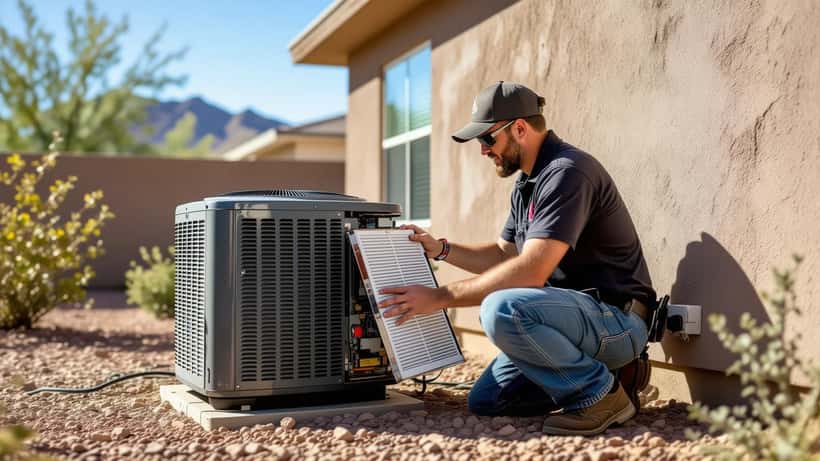
3. Inspect and clean the outdoor condenser. The unit outside your house pulls air across its coils to dump heat. After a haboob those fins pack with grit. Gently rinsing the condenser with a garden hose — power off — restores efficiency. If the fins are bent or matted, leave it to a professional to avoid damaging the coil.
4. Book a post-monsoon coil cleaning. Even with good filters, some dust reaches the evaporator over a season of storms. A professional coil cleaning in early fall clears the buildup before it becomes a frozen coil or a dead compressor. It is the single service that most extends an Arizona AC's life.
The refrigerant deadline makes 2026 the wrong year to gamble
There is a second reason not to let dust quietly kill an aging unit this year. Under the 2026 refrigerant rules phasing out older R-22 and restricting R-410A, homeowners with pre-2015 systems already face higher repair and replacement costs. A dust-damaged compressor on one of these units can push a repair bill into replacement territory fast. If your AC is a decade old, protecting it through monsoon season is not just about comfort — it is about not being forced into an emergency replacement at peak-season prices. Our guide to the 2026 HVAC refrigerant changes for older air conditioners explains what pre-2015 owners need to weigh.
When to call a professional
If, in the days after a dust storm, you notice weaker airflow than usual, a rise in your electric bill, ice on the refrigerant lines, or a musty odor from the vents, do not keep running the system and hope it clears. Those are the early signs of a dust-loaded coil or a straining blower, and continuing to run the unit is how a cleanable problem becomes a compressor failure. A licensed HVAC contractor can diagnose airflow and coil condition in a single visit and tell you whether you need a filter upgrade, a cleaning, or a repair.
For official warnings and preparedness guidance before the next storm, the Arizona Emergency Information Network maintains a public dust-storm resource at ein.az.gov. And if you are also worried about what all that airborne PM2.5 does to the people inside the house, our companion report on dust storm respiratory health and safety covers when blowing dust becomes a medical concern.
Monsoon season runs through September. The homeowners who come through it with a healthy AC are the ones who treat the July 12 haboob as a warning, not a one-off — and who get an expert eye on the system before the next wall of dust arrives.
