 Lucas Price
Does the 2026 refrigerant transition affect your home's air conditioner — and what should you do before summer? For the estimated 10 million U.S. households still running pre-2015 systems, the answer involves two separate regulatory changes with very different practical implications depending on when your AC was installed.
Why Was R-22 Banned, and What Happened to Older AC Systems?
R-22 — marketed for decades as Freon — was the dominant refrigerant in residential air conditioners until environmental regulators acted on its chemistry. The substance depletes stratospheric ozone at roughly 0.05 times the rate of CFC-11, making it a controlled substance under the 1987 Montreal Protocol.
The U.S. Environmental Protection Agency (EPA) began restricting R-22 production and import in 2010, reducing allowable quantities by 75% over the following decade. On January 1, 2020, all production and importation of virgin R-22 was permanently prohibited in the United States [EPA, 2020 R-22 Phaseout Final Rule]. Only reclaimed and recycled R-22 — recovered from decommissioned systems — remains legally available. That supply is finite and shrinks each year as old units are retired.
For homeowners: any system manufactured before 2010 almost certainly contains R-22. Units installed between 2010 and 2014 may use R-410A, but verification is essential.
What Exactly Is the R-410A "Ban" in 2026?
Coverage of the R-410A transition often overstates what "ban" means in practice. Under the American Innovation and Manufacturing (AIM) Act, signed into law in December 2020, the EPA finalized rules creating a phased reduction — not an immediate ban — on hydrofluorocarbons (HFCs) like R-410A.
The pivotal date was January 1, 2025: from that point forward, new residential and light commercial air conditioning equipment manufactured in or imported into the U.S. cannot use refrigerants with a Global Warming Potential (GWP) above 750. R-410A carries a GWP of approximately 2,088 — nearly three times that ceiling EPA AIM Act Final Rule, 2023.
What this means going into summer 2026: no new R-410A air conditioners are being installed in the U.S. But the regulation applies only to new equipment manufacturing and import. Existing R-410A systems can still be serviced with R-410A refrigerant; there is no timeline for banning its use in already-installed equipment.
How Do I Know What Refrigerant My AC System Uses?
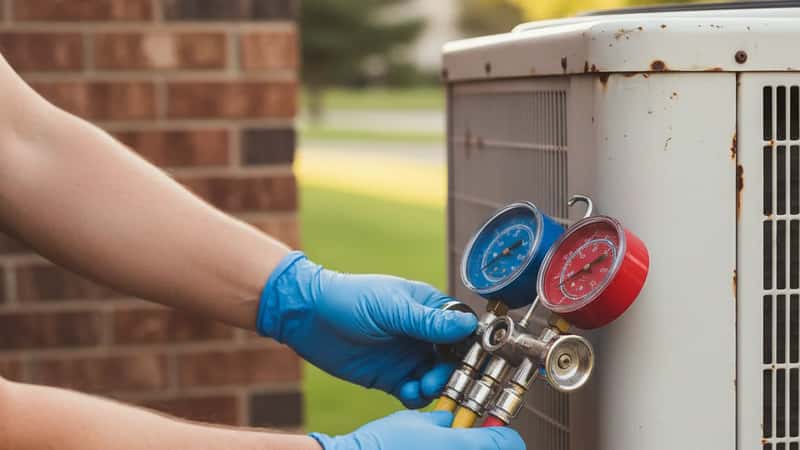
The fastest method is the nameplate on your outdoor condenser unit — typically a silver or white label affixed to the cabinet near the electrical panel. Look for a line reading "Refrigerant Type" or simply the refrigerant designation.
Three reliable indicators:
- Manufactured before 2010: almost certainly R-22 (Freon)
- Manufactured 2010–2014: likely R-410A, but confirm via the nameplate
- Manufactured 2015 or later: R-410A, and likely still within its service life
If the label is weathered or missing, a licensed HVAC technician can identify the refrigerant with a pressure reading. R-22 operates at approximately 70 psi on the low side at 75°F ambient; R-410A runs at roughly 118–120 psi under the same conditions. These pressure differences are immediately apparent to any certified technician. Never attempt to add refrigerant yourself — handling refrigerants requires EPA Section 608 certification and proper recovery equipment.
What Will It Cost to Service a Pre-2015 AC This Summer?
Refrigerant costs in 2026 vary dramatically depending on which substance your system uses. The table below reflects current market benchmarks:
| Refrigerant | Approx. Cost/lb (2026) | Typical Top-Off Cost | Equipment Status |
|---|---|---|---|
| R-22 | $150–$250/lb | $750–$1,500+ | Phase-out complete (reclaimed only) |
| R-410A | $12–$28/lb | $150–$450 | New equipment banned; existing fully serviceable |
| R-454B / R-32 | $8–$20/lb | $100–$350 | Next-gen replacements in new 2025–2026 equipment |
Cost benchmarks: ACCA (Air Conditioning Contractors of America), 2024–2025
A refrigerant top-off without fixing the underlying leak is a temporary fix, not a solution. Refrigerant does not "wear out" — if a system is low, it has a leak. Repeatedly recharging a leaking R-22 unit at $200/lb is expensive, and each pound that escapes contributes to ozone depletion. A qualified technician should perform a leak test and provide a repair estimate before adding refrigerant.
Should I Repair or Replace My Pre-2015 Air Conditioner in 2026?

The repair-or-replace decision follows a straightforward three-step framework:
Step 1: Apply the "5,000 Rule." Multiply the system's age (in years) by the estimated repair cost in dollars. If the result exceeds $5,000, replacement typically delivers better long-term value. A 13-year-old R-22 system needing a $600 top-off: 13 × 600 = $7,800 → a strong indicator to replace.
Step 2: Check current incentives. The Inflation Reduction Act (IRA) provides a federal tax credit of 30% (up to $600) for qualifying central air conditioners and up to $2,000 for qualifying air-source heat pumps installed in 2026 [IRS Form 5695, Energy Efficient Home Improvement Credit]. Many utilities layer additional rebates of $100–$500 on top of federal credits for replacing sub-SEER-14 equipment.
Step 3: Understand what you're buying. New systems installed in 2026 use R-454B (marketed as Opteon XL41, GWP 466) or R-32 (GWP 675) — both below the 750 GWP threshold. These A2L-classified refrigerants require technicians with updated EPA Section 608 certification, but that is your contractor's concern, not yours.
Key takeaway: An R-22 system older than 12 years that needs refrigerant in 2026 is almost always a replacement candidate. The combination of escalating refrigerant costs, system age, and the efficiency gap between a vintage SEER 8–10 unit and a modern SEER2 15–20 system rarely makes repair the rational economic choice over a 5-year horizon.
Frequently Asked Questions
Can I still run my R-22 air conditioner in 2026? Yes. The 2020 R-22 ban prohibits the production and import of new virgin R-22, not the operation of existing systems. You can continue using your unit, but repair costs are significant — reclaimed R-22 currently trades at $150–$250 per pound, compared to under $10 when it was in full production.
Will R-410A refrigerant become scarce like R-22? Not immediately. The 2025 EPA rule bans new R-410A equipment, not servicing of existing systems. Expect prices to rise gradually as the AIM Act phasedown tightens production quotas — but R-410A will remain available for service calls well into the late 2020s.
Can my R-22 system be converted to use R-410A or a newer refrigerant? No. R-22 and R-410A operate at fundamentally different pressures — R-410A runs approximately 60% higher on the high side. Compressors, expansion valves, and copper lines are designed for a specific refrigerant. A retrofit voids warranties, reduces efficiency, and commonly causes compressor failure within months.
What refrigerant will my next air conditioner use? Most residential systems sold in the U.S. in 2026 use R-454B (Opteon XL41) or R-32. Both meet the EPA's sub-750 GWP requirement and offer comparable or slightly better efficiency than R-410A in most residential applications.