 Emily Wang
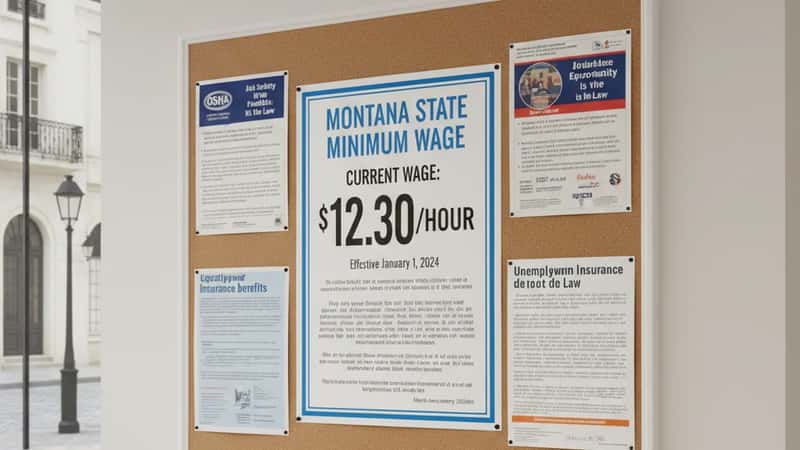
What is Montana's minimum wage in 2026? The Montana Department of Labor and Industry (DLI) sets the state minimum wage at $10.55 per hour, effective January 1, 2026. This rate applies to most private-sector employees and is significantly higher than the federal floor of $7.25 per hour. For workers and employers across Billings, Missoula, and the rest of the state, $10.55 is the baseline — and one of the most employer-significant rules in Montana is that no tip credit reduces this floor.
This Q&A covers the most common questions about Montana's 2026 minimum wage: who it covers, how it was calculated, what exceptions apply, and what to do if your employer is paying less.
How Does Montana Calculate Its Minimum Wage Each Year?
Montana's minimum wage is indexed to the Consumer Price Index (CPI) under Mont. Code Ann. § 39-3-409. Each year, the DLI calculates the inflation-adjusted rate based on the CPI for All Urban Consumers in the Western Region for the August-to-August period preceding the adjustment. The new rate takes effect on January 1 of the following year.
This automatic CPI-indexing mechanism means Montana's minimum wage has increased nearly every year since indexing was introduced in 2007. The rate is not subject to annual legislative approval — the calculation is administrative. Workers benefit from wages that keep pace with regional inflation; employers can plan for predictable, annually-published increases.
Does the Minimum Wage Apply to All Montana Employees?
No — one significant exemption applies to very small businesses. Employers whose annual gross volume of sales or business is less than $110,000 and who are not covered by the federal Fair Labor Standards Act (FLSA) may pay the federal minimum wage of $7.25 per hour rather than Montana's higher rate.
In practice, this exemption is narrow. Most Montana businesses — including small restaurants, retailers, and service providers — exceed the $110,000 threshold or have employees engaged in interstate commerce, making them FLSA-covered and subject to the $10.55 Montana minimum. Agricultural and domestic workers may also face different treatment under federal exemptions.
If you are unsure whether your employer falls under this exemption, the Montana DLI's Wage and Hour Unit can advise on coverage based on the employer's specific business volume and activities.
What About Tipped Employees?
Montana does not permit a lower minimum wage for tipped workers. Federal law allows employers to pay as little as $2.13 per hour to tipped employees, counting tips received toward the minimum wage obligation. Montana law rejects this tip credit entirely.
All employees in Montana — including servers, bartenders, delivery drivers, and hotel housekeeping — must receive the full $10.55 per hour in cash wages regardless of tips earned. Tips are the employee's own money; they cannot offset the employer's minimum wage obligation.
This rule is one of Montana's most significant departures from federal law and consistently catches out-of-state hospitality businesses opening Montana locations. An employer who pays tipped workers $7.25 per hour in Montana and relies on tips to reach the minimum wage is in violation of state law, regardless of the tips actually received.
What Is the Minimum Wage for Young Workers and Trainees?
Montana does not have a separate sub-minimum wage for workers under 18, unlike the federal Youth Minimum Wage of $4.25 per hour for the first 90 days of employment. Montana's $10.55 floor applies regardless of the worker's age.
A training wage or "learner's rate" below the minimum wage is not authorized by state statute in Montana. If an employer claims an employee is being paid a "training wage," the employee is still entitled to $10.55 per hour from day one.
How Does Montana's Minimum Wage Compare to Nearby States?
Montana's $10.55 per hour ranks it in the middle tier of Mountain West states. See the state minimum wage comparison for 2026 for a full 50-state breakdown. Among neighboring states: Wyoming and Idaho both follow the $7.25 federal rate; Colorado's minimum wage ($14.81 for 2026) significantly exceeds Montana's. Workers considering interstate employment and employers managing multi-state payroll need to apply the correct rate for each employee's work location, not a single nationwide figure.
Montana's broader labor law framework — including the WDEA's good-cause termination protection and the prohibition on tip credits — provides additional worker protections beyond the minimum wage floor.

What If My Employer Pays Less Than the Montana Minimum Wage?
An employer who pays less than $10.55 per hour (assuming the exemption doesn't apply) is in violation of Montana's Minimum Wage Law. Workers can pursue recovery through two paths:
Montana DLI wage claim: File at erd.dli.mt.gov. No attorney required, no filing fee. The DLI investigates and may order back wages plus a penalty of up to 110% of the amount owed. The statute of limitations is two years (three for willful violations) from the date wages were due.
Federal DOL or private FLSA lawsuit: If FLSA coverage applies, the same minimum wage violation may be pursued federally, with the option of liquidated damages equal to the underpaid amount — effectively doubling recovery — plus attorney's fees.
À retenir: Montana's $10.55 minimum wage is CPI-indexed, tip-credit-free, and applies equally to adult and minor workers. The most common compliance failure is hospitality employers relying on a federal tip credit that does not exist in Montana law.
When Will the 2027 Montana Minimum Wage Be Announced?
The Montana DLI typically announces the following year's minimum wage in October or November, based on CPI data collected through August. Employers should monitor the DLI website in Q4 of 2026 for the 2027 rate announcement. The new rate always takes effect January 1 of the following year. Building the anticipated increase into budget projections for Q1 2027 before the official announcement is standard practice for Montana HR and finance teams.
This article is provided for educational purposes only and does not constitute legal advice. For specific situations, contact the Montana Department of Labor and Industry or consult a qualified Montana employment attorney.