
West Virginia workers and employers navigate a labor law framework that blends federal standards with state-specific rules that often differ from neighboring states like Virginia, Ohio, and Pennsylvania. The Mountain State's Division of Labor enforces wage payment, overtime, and child labor protections under West Virginia Code Chapter 21, while certain protections — particularly around sick leave and meal breaks — remain exclusively federal territory. Understanding which rules are state-driven versus purely federal is the first skill every West Virginia HR manager and employee needs.
This dossier covers the six employment law topics that generate the most questions for West Virginia workers and employers in 2026: overtime calculation, final paycheck timing, non-compete enforceability, meal and rest breaks, sick leave, and minimum wage. Each sub-article goes deep on one topic. This overview maps the full landscape so you know where to focus first.
The State-Federal Dynamic in West Virginia Employment Law
West Virginia does not operate a state OSHA plan — federal OSHA directly governs private-sector workplace safety throughout the state. This makes WV one of 26 states where the U.S. Department of Labor's Occupational Safety and Health Administration handles all inspections and enforcement, rather than a state agency.
On wages and hours, the picture is more layered. West Virginia has its own minimum wage statute (W. Va. Code §21-5C-1 et seq.) and its own Wage Payment and Collection Act (W. Va. Code §21-5-1 et seq.), which govern pay timing, final paychecks, and deduction rules independently of federal law. Where state protections exceed federal minimums, the state standard applies. Where state law is silent — as it is on sick leave for private employees — the federal framework (FMLA, where applicable) is the only safety net.
À retenir: West Virginia does not mandate paid sick leave for private-sector employees, does not require meal or rest breaks for adult workers under state law, and does not impose notice requirements before mass layoffs beyond federal WARN Act thresholds. Workers relying on these protections must look to federal law or their employment contract.

Overtime and Wage Payment: The Core of West Virginia Labor Law
Overtime is the single most litigated employment law issue in West Virginia. Under the West Virginia Minimum Wage and Maximum Hours Standards (W. Va. Code §21-5C-3), most employees who work more than 40 hours in a single workweek are entitled to overtime pay at 1.5× their regular rate. This mirrors the federal Fair Labor Standards Act (FLSA) standard — but WV's state law applies to employers with six or more employees, while federal FLSA applies to most businesses regardless of size.
West Virginia's overtime rules use the workweek (a fixed, recurring 168-hour period) as the baseline — not the pay period. An employee who works 48 hours in week one and 32 hours in week two is owed 8 hours of overtime for week one, even though the two-week average is 40 hours. Averaging across pay periods is prohibited.
For HR managers in industries like healthcare, hospitality, and manufacturing — all significant employers in West Virginia — accurate overtime tracking is non-negotiable. Misclassification of employees as exempt is the most common compliance failure the WV Division of Labor identifies during audits.

West Virginia Overtime Laws: The Complete 2026 Guide for Workers and Employers
15 minFinal Paycheck Rules: Timing Matters More Than You Think
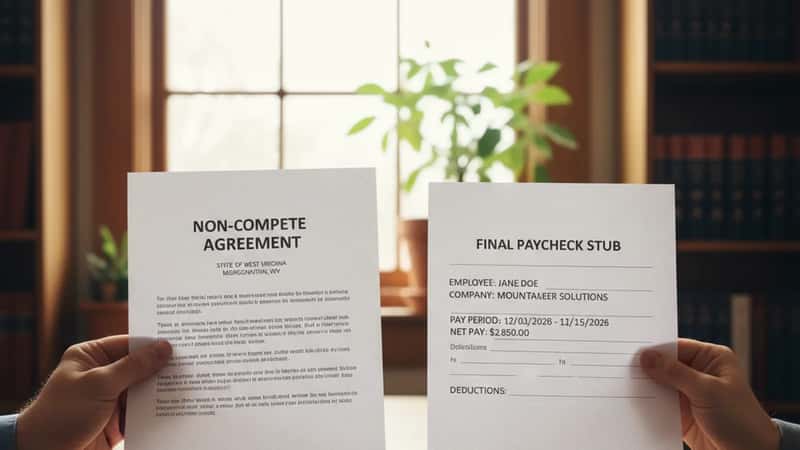
West Virginia's Wage Payment and Collection Act sets strict deadlines for final paycheck delivery that many employers misapply. Under W. Va. Code §21-5-4, if an employer discharges an employee, the final wages are due within 72 hours of the separation. If the employee resigns, final wages are due on the next regular payday.
These are not suggestions — they are enforceable timelines with teeth. An employer who fails to pay final wages on time faces penalties of up to three times the unpaid wages, plus attorney fees and court costs, under W. Va. Code §21-5-4(e). The WV Division of Labor can also impose administrative penalties on employers with repeat violations.
A common point of confusion: vacation pay and PTO. West Virginia law treats accrued, unused vacation pay as wages owed at separation — but only if the employer's written policy says so. If your employee handbook is silent on PTO payout at termination, the employer has no legal obligation to pay it. This makes your written policy the deciding document, not the law itself.
For employees in neighboring Virginia, rules on final paycheck timing differ — Virginia requires payment on the next regular payday regardless of whether the employee was fired or quit, with no 72-hour rule for terminations. Workers who split time across state lines need to know which state's rules apply to their situation.
Non-Compete Agreements: Enforceability in West Virginia Courts
West Virginia courts scrutinize non-compete agreements closely. Unlike states that ban them outright (California, Minnesota, Oklahoma) or enforce them broadly, West Virginia applies a reasonableness test under common law. A non-compete must be: (1) ancillary to an otherwise enforceable agreement, (2) supported by adequate consideration, (3) reasonable in duration, (4) reasonable in geographic scope, and (5) reasonably necessary to protect a legitimate business interest.
West Virginia courts have "blue-pencil" authority — they can modify an overly broad non-compete rather than void it entirely. This means a clause saying "no competition for 10 years, worldwide" is not automatically unenforceable; a court may reduce it to "2 years, within 50 miles of the employer's operations." Employees who sign overbroad agreements cannot assume those agreements are void without litigation.
Legal note from the West Virginia State Bar (2025): "Courts in WV have consistently refused to enforce non-competes that restrict employees from working in an industry entirely, rather than protecting specific trade secrets or customer relationships. The narrower the restriction, the more likely it survives judicial review."
The 2026 FTC rule attempting to ban most non-competes nationwide was struck down by federal courts. West Virginia state law, not federal regulation, controls enforceability for WV-based employees. This distinction matters for HR teams drafting employment agreements in 2026.

West Virginia Non-Compete Agreements: WV vs. Florida vs. California Compared
6 minMeal Breaks, Sick Leave, and Minimum Wage: What West Virginia Mandates
Meal and Rest Breaks: A Notable Gap
West Virginia state law does not require employers to provide meal or rest breaks to adult employees. The only statutory requirement under W. Va. Code §21-3-10a applies to minors under age 16, who must receive a 30-minute break after 5 consecutive hours of work. Adult workers in West Virginia rely on federal Department of Labor guidance (rest breaks of 20 minutes or fewer must be paid; bona fide meal periods of 30+ minutes where the employee is completely relieved of duties need not be paid) rather than state mandates.
In practice, most West Virginia employers provide breaks as a matter of workforce management and industry norms — particularly in healthcare, manufacturing, and food service. But employees have no state-law right to demand them. Workers in Ohio, by contrast, face a similarly limited break law, while Pennsylvania only mandates breaks for minors as well.
Sick Leave: Federal FMLA as the Baseline
West Virginia has no state-mandated paid sick leave law for private employees. The federal Family and Medical Leave Act (FMLA) provides up to 12 weeks of unpaid, job-protected leave per year to eligible employees at covered employers (50+ employees) — but only for qualifying medical and family reasons, not routine illness. State employees and public school employees may have additional protections under state employment contracts or collective bargaining agreements.
Minimum Wage: $8.75 Per Hour in 2026
West Virginia's state minimum wage stands at $8.75 per hour as of 2026 — above the federal minimum wage of $7.25 per hour. Employers covered by West Virginia's Minimum Wage and Maximum Hours Standards Act (W. Va. Code §21-5C-1) must pay the state rate. Tipped employees may be paid a minimum of $2.62 per hour, provided tips bring total hourly earnings to at least $8.75. If they do not, the employer must make up the difference.
How West Virginia Employees File a Wage Complaint
When an employer fails to pay wages, overtime, or a final paycheck on time, West Virginia employees have two primary enforcement channels:
West Virginia Division of Labor — File a wage claim at labor.wv.gov. The Division investigates claims and can order back wages plus liquidated damages. There is no filing fee. Claims must generally be filed within 2 years of the violation (or 3 years for willful violations under federal FLSA).
Private civil lawsuit — Under W. Va. Code §21-5-4(e), employees may sue directly for unpaid wages and seek up to three times the unpaid amount as liquidated damages, plus attorney fees. This makes wage claims in WV particularly powerful when an employer has made systematic errors.
À retenir: Document everything. Keep copies of pay stubs, time records, and any employer communications about wages. West Virginia courts routinely side with employees when paper trails support wage claims, but verbal disputes are much harder to win.
The Division of Labor handled 1,847 wage complaints in fiscal year 2024, recovering over $3.2 million in unpaid wages for West Virginia workers [WV Division of Labor Annual Report, 2024]. Construction, healthcare, and food service generated the highest complaint volumes.
When to Consult an Employment Lawyer in West Virginia
Not every workplace issue requires legal counsel, but certain situations in West Virginia call for professional advice before taking action:
- Misclassification disputes — If you believe you are misclassified as an independent contractor to avoid overtime, a WV employment lawyer can assess your situation under the FLSA economic realities test and state common-law tests simultaneously.
- Non-compete enforcement or challenge — Whether you are an employer defending a non-compete or an employee challenging one, West Virginia's reasonableness standard makes the outcome fact-specific. An attorney can assess enforceability before you violate the agreement — or before you try to enforce it.
- Retaliation claims — West Virginia's Whistle-Blower Law (W. Va. Code §6C-1-1 et seq.) and federal whistleblower statutes protect employees who report labor law violations. If you face adverse action after complaining about wages or safety, get legal advice quickly — retaliation claims have short filing windows.
- Mass layoff notices — Employers with 100+ employees considering plant closings or large layoffs must comply with the federal WARN Act (60 days' notice). WV has no state WARN Act, but federal compliance is mandatory.
Avertissement: The information in this dossier is provided for general informational purposes only and does not constitute legal advice. West Virginia employment law is complex and fact-specific. Consult a licensed West Virginia employment attorney for guidance on your particular situation.
