 Sofía Fernández
$7.25 or $20.76. Both are legally required minimum wages in the United States in 2026 — the first in Wyoming, the second in Seattle. A full-time worker earning $7.25/hour grosses roughly $15,080 per year before taxes. A full-time worker at Seattle's $20.76 minimum grosses approximately $43,180. The gap between them is not an anomaly. It is the direct result of a federal minimum wage that has not changed since 2009 and a state-and-city patchwork that has moved dramatically in the intervening 17 years.
This comparison maps where every tier of US minimum wage law stands in 2026: the unchanged federal floor, the states that have built far above it, and the states that remain at or near the bottom — and what the difference means in practice for workers and employers.
The Federal Floor That Time Forgot
The federal minimum wage has been set at $7.25 per hour since July 24, 2009 [Fair Labor Standards Act, as amended — see DOL Wage and Hour Division]. In nominal terms, it has not changed in 17 years. Adjusted for inflation, $7.25 in 2026 dollars was worth roughly $10.50 in 2009 — meaning the real purchasing power of the federal minimum wage has eroded by approximately 31% since it was last raised [Bureau of Labor Statistics Consumer Price Index (CPI) calculator].
Congress sets the federal minimum wage through legislation. Despite multiple attempts to raise it — including the Raise the Wage Act proposals in 2021 and 2023 — no increase has passed the full Congress since 2007. The $7.25 floor now applies as a legal minimum only in states that have not enacted a higher state minimum, which as of 2026 means approximately 20 states.
States That Have Left the Federal Minimum Far Behind

As of January 1, 2026, more than 30 states plus the District of Columbia have minimum wages above the federal $7.25/hour. Many of the highest rates are now more than double the federal minimum.
The highest state minimum wages in 2026:
Sources: Washington State L&I; California DIR; NYS DOL; Connecticut DOL; NJ DOL; Massachusetts EOLWD; DOL FLSA. Rates as of January 2026.
Why these states lead: California and Washington state have automatic cost-of-living adjustment mechanisms that increase the minimum wage annually tied to the Consumer Price Index (CPI). This indexing means their minimums rise automatically with inflation without requiring new legislation each year — a structural feature that explains the widening gap from the federal floor.
Oregon and Colorado also use CPI-linked annual adjustments. Oregon's 2026 statewide rate is $15.45/hour [Oregon Bureau of Labor and Industries], with the Portland metro area at $16.45/hour. Colorado's 2026 statewide rate is $14.81/hour [Colorado CDLE].
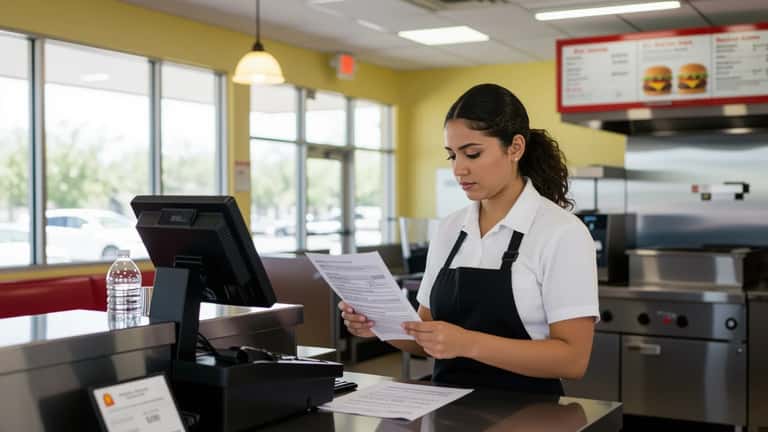
Consider this: Rosa works full-time at a minimum wage job in Seattle, Washington in 2026. At $20.76/hour (Seattle's local rate), she earns approximately $43,180 before taxes annually. Her counterpart in Jackson, Wyoming — doing comparable work at the federal minimum of $7.25/hour — earns $15,080. Same country, same federal legal minimum wage floor ($7.25), outcomes separated by $28,100 per year. Rosa's higher wage reflects Seattle's local ordinance layered on top of Washington's state rate.
States Still at or Near the Federal Floor — and Why It Matters
Twenty states have not enacted a minimum wage above $7.25/hour. Most are clustered in the South and lower Midwest. Several — including Alabama, Georgia, Louisiana, Mississippi, South Carolina, and Tennessee — have no state minimum wage law at all, defaulting entirely to the federal floor [DOL Wage and Hour Division, 2026].
Five other states — including Georgia and Wyoming — have state minimum wages below $7.25/hour, but since they cannot lawfully fall below the federal minimum, $7.25 applies in practice.
Why this matters for workers in these states:
In states without a state minimum above $7.25, there is no automatic inflation adjustment. Every year the federal minimum stays unchanged, the purchasing power of minimum wage workers in these states erodes. In 2009, $7.25/hour could purchase what $10.50/hour can today [Bureau of Labor Statistics (BLS) CPI]. A minimum wage worker in Mississippi today is being paid a wage whose real value has declined by roughly a third since it was last set by Congress.
Workers in low-minimum-wage states who are covered by collective bargaining agreements may earn significantly above the state floor — one of the primary reasons union membership in some sectors creates a measurable wage premium.
À retenir: The minimum wage a worker actually earns is determined by the highest applicable rate among three layers: federal minimum, state minimum, and any local (city/county) ordinance. The floor, wherever it is set, applies to every non-exempt employee — regardless of employer size, industry, or profitability.
The City and County Layer: When Local Rules Exceed State Law
Several cities have enacted minimum wages that exceed their state's rate — sometimes substantially. The most notable examples in 2026:
| City | 2026 Minimum Wage | State Minimum |
|---|---|---|
| Seattle, WA (large employers) | $20.76/hr | $16.66/hr |
| Denver, CO | $18.81/hr | $14.81/hr |
| New York City | $16.50/hr | $16.50/hr (aligned) |
| Flagstaff, AZ | $17.85/hr | $14.35/hr |
| Berkeley, CA | $18.67/hr | $16.50/hr |
| Chicago, IL | $16.20/hr | $14.00/hr |
Sources: Seattle OLS; Denver HRMO; NYS DOL; Flagstaff city code; Berkeley OWCA; Chicago BACP. Rates as of January 2026.
Multi-state and multi-location employers must track the applicable rate for each specific work location — the highest applicable rate always prevails. Paying Seattle workers the Washington state rate ($16.66/hour) instead of the Seattle local rate ($20.76/hour) is a wage violation, regardless of the employer's intentions.
Tipped Workers, Youth Subminimum Wages, and FLSA Exemptions

The federal minimum wage applies with specific carve-outs that many workers and employers misunderstand:
Tipped workers. Under federal law, employers may pay tipped workers a "tipped minimum wage" of just $2.13/hour — as long as tips bring the worker to $7.25/hour total. Seven states, including California, Minnesota, and Alaska, prohibit tip credits entirely: tipped workers in those states earn the full state minimum wage in addition to tips [DOL Wage and Hour Division].
Youth subminimum wage. Federal law permits employers to pay workers under 20 years old a "youth minimum wage" of $4.25/hour for the first 90 calendar days of employment. Many states prohibit this. In California, for instance, no youth subminimum wage is permitted.
Exemptions under the FLSA. Some categories of workers are partially or fully exempt from federal minimum wage requirements, including certain agricultural workers, outside salespeople, and some small newspaper delivery workers. State laws vary on whether these exemptions apply at the state level. Workers in exempt categories should check their state's Department of Labor guidance specifically.
Frequently Asked Questions About State Minimum Wage Laws
If I work in a state with no minimum wage law, what am I entitled to?
The federal minimum wage of $7.25/hour applies in all states. If your state has no state minimum wage or a state minimum below $7.25/hour, you are legally entitled to $7.25/hour under the FLSA. Check the US DOL's Wage and Hour Division for official guidance on your state.
Can my employer pay me less than the state minimum wage?
No, with very limited exceptions (youth subminimum wage programs, certain training wages in specific states, and some agricultural exemptions). Otherwise, paying below the applicable minimum wage — federal, state, or local, whichever is highest — is a wage theft violation. Workers who are paid below the applicable minimum can file complaints with their state Department of Labor or the federal Wage and Hour Division, which can recover back wages plus damages.
My city has a higher minimum wage than my state. Which applies to my job?
The higher of the two rates applies. If your city minimum is $18.00/hour and your state minimum is $15.00/hour, your employer must pay you at least $18.00/hour. If you work across multiple locations in different jurisdictions, the applicable rate is determined by where the work is actually performed.
Does the minimum wage apply to all types of workers?
No. The FLSA minimum wage applies to most employees in the US, but there are exemptions for certain categories of workers including some agricultural workers, some domestic workers, workers in certain small businesses below the FLSA's coverage threshold, and tipped workers (subject to the tip credit rules). State minimum wage laws may cover workers that the FLSA exempts. Always check your state's specific law.
Disclaimer: The information in this article reflects US federal and state minimum wage law as of 2026 and is provided for informational purposes only. It does not constitute legal advice. Minimum wage rates change frequently; always verify current rates through your state's Department of Labor or the US DOL Wage and Hour Division website before making employment decisions.