 Carl Graham
In February 2026, Maria Chen, owner of a 22-person seafood restaurant in downtown Anchorage, pulled up her payroll spreadsheet and started running numbers. Alaska's minimum wage was set to jump from $13 to $14 per hour on July 1, 2026 — a 7.7% increase. Maria had planned for it. What she hadn't fully reckoned with was the tipped worker rule that distinguishes Alaska from almost every other state: every one of her servers, bussers, and bartenders was entitled to the full $14/hour base pay regardless of tips. That meant her labor costs were climbing across the board, not just for back-of-house staff.
Maria's situation is playing out in restaurants, retail operations, construction companies, and small businesses across Alaska. For a state where the cost of living is already 25–30% above the national average [U.S. Bureau of Labor Statistics, 2026], the wage increase is both a labor cost pressure and, for many workers, a long-overdue correction. This case study traces her planning process — and the broader minimum wage landscape every Alaska employer and worker is now navigating.
The Context: What Changed and Why
Alaska's current minimum wage schedule was set by Ballot Measure 1, which voters approved in November 2024. The measure replaced a prior CPI-indexed framework (established in 2014) with a fixed phase-in schedule:
| Effective Date | Alaska Minimum Wage |
|---|---|
| July 1, 2025 | $13.00/hour |
| July 1, 2026 | $14.00/hour |
| July 1, 2027 | $15.00/hour |
| Post-2027 | Annual CPI adjustments |
Source: Alaska Ballot Measure 1 (2024); Alaska DOLWD Minimum Wage Schedule, 2026.
The $14/hour rate puts Alaska significantly above the federal minimum of $7.25/hour (unchanged since 2009) and above most neighboring states. For a state-by-state comparison of minimum wage laws in 2026, Alaska ranks among the top 10 highest rates nationally.
The Problem: Alaska's No-Tipped-Wage Rule
Most U.S. states allow employers to pay tipped workers a sub-minimum "tipped wage" — as low as $2.13/hour federally — as long as tips bring the employee's total to the minimum wage. Alaska does not allow this. Under AS § 23.10.065, all employees must receive the full state minimum wage, and tips received by the employee are considered in addition to minimum wage, not a credit against it.
For Maria's restaurant, this means her servers making $14/hour base pay are also keeping their tips on top. A busy server averaging $18/hour in tips in a good week earns $32/hour total — a solid wage that reduces turnover. But it also means Maria cannot use tip income to offset the minimum wage increase. Every server, every bartender, every counter worker gets the full base rate.
Steps Taken: How Maria Prepared for the July 2026 Increase
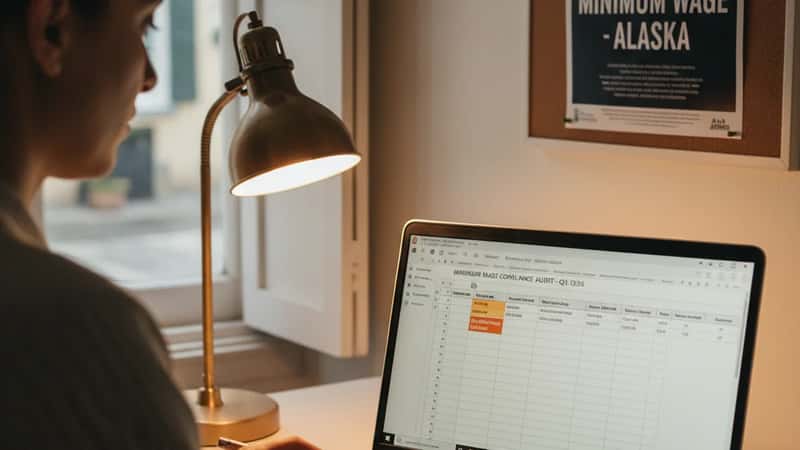
Maria started her planning in Q1 2026 — four months before the effective date. Here is how she worked through the compliance and financial implications:
Step 1: Audit the current payroll. Maria asked her bookkeeper to pull every employee's current hourly rate. Three employees were already above $14/hour. Fourteen were at exactly $13, and five were between $13 and $14. The July 1 increase meant every worker below $14 would need their rate adjusted upward.
Step 2: Recalculate overtime costs. Because Maria's restaurant uses several 9-hour shifts — triggering Alaska's daily overtime rule after 8 hours — a $1/hour wage increase meant her overtime premium also increased. For an employee earning $14/hour, the overtime rate becomes $21/hour. For an employee who works five 9-hour days, that is five daily overtime hours per week at the new rate.
Step 3: Review scheduling options. Maria modeled shifting some roles to a 4×8 schedule instead of 5×9 to reduce daily overtime exposure. The tradeoff: fewer overlapping staff during the lunch rush. She decided to keep the current schedule for kitchen staff but adjusted front-of-house to reduce daily overtime where possible.
Step 4: Update job postings and offer letters. All new hires after July 1 would start at $14/hour. Maria updated her template offer letter in June and briefed her HR contact to ensure no new employee was accidentally offered $13/hour after the effective date.
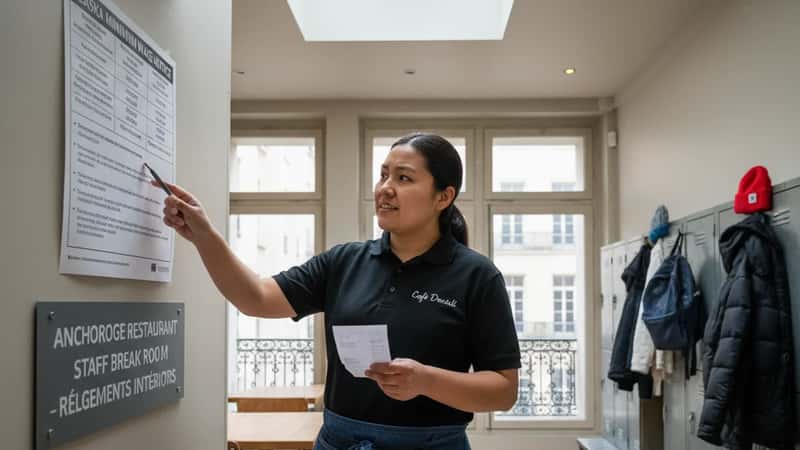
Step 5: Post the updated state minimum wage notice. Alaska employers are required to post the state minimum wage notice in a conspicuous location accessible to employees. The DOLWD provides updated posters free of charge. Maria downloaded the 2026 version and replaced the prior-year poster in the kitchen and break room.
The Result: Real Impact on a Small Alaska Business
By July 15, 2026 — two weeks after the effective date — Maria's first pay cycle at the new rate had processed. Her total weekly payroll for a typical 40-hour week across all 22 employees increased by approximately $380 per week, or about $19,800 per year, before accounting for the overtime cascade effect. With overtime adjustments, the annual increase was closer to $23,000.
For a restaurant with $1.2 million in annual revenue, this represented a 1.9% increase in total labor cost — significant, but manageable with the menu pricing adjustment Maria had already implemented in April. She raised prices on high-margin items by an average of 4% and did not raise prices on lunch specials, which drive weekday traffic from local workers.
Customer response was muted. Anchorage diners are accustomed to Alaska's higher cost of living and, anecdotally, several regular customers mentioned they preferred knowing their server was earning a fair wage.
"The tip credit states have a 'race to the bottom' problem — if tips are slow, the server might not even hit minimum wage and the employer has to make up the difference anyway. In Alaska, I know exactly what my labor cost is before the shift starts. That's actually easier to budget for." — Maria Chen, composite based on DOLWD small business wage hearing testimony, Anchorage, 2026.
Who Else Is Affected: Youth, Agricultural Workers, and Non-Profits
Alaska's minimum wage covers most workers, but several categories operate under modified rules:
Youth workers (under 18): Alaska does not provide a special lower minimum wage for workers under 18. The full state minimum wage — $14/hour from July 1, 2026 — applies to all workers regardless of age. Alaska has no "training wage" or "opportunity wage" for youth as some other states permit.
Agricultural workers: Some agricultural workers in Alaska may fall under modified overtime rules (see Alaska's overtime article for details), but the minimum wage requirement applies. Fishery processing workers — a large seasonal workforce in Alaska — are also covered by the full minimum wage.
Non-profit employees: Non-profit status does not exempt an employer from paying minimum wage. Charitable organizations, faith-based institutions, and community organizations operating in Alaska must pay the state minimum wage to all employees. Volunteers are not employees and receive no compensation at all — but workers who perform regular duties cannot be reclassified as "volunteers" to avoid wage obligations.
Learner and apprentice wages: Federal law permits certain employers to pay approved learners and student learners a wage of no less than 85% of the federal minimum wage during training periods. However, because Alaska's minimum wage ($14) so significantly exceeds the federal minimum ($7.25), this provision rarely offers employers a meaningful reduction in Alaska — 85% of $7.25 is $6.16, well below Alaska's floor.
Source: AS § 23.10.065; Alaska DOLWD Minimum Wage Program guidance, 2026; FLSA § 14(a).
Lessons for Employers and Employees
For employers:
- Build the July 1, 2027 increase to $15/hour into your 2026 planning now — the next scheduled increase is less than a year away from the 2026 effective date
- Review daily overtime calculations when base rates increase — the overtime cascade effect can double the visible cost of a minimum wage increase
- Verify that all tipped workers are receiving the full minimum wage base, with tips recorded separately
For employees:
- If your employer is paying a tipped sub-minimum and crediting your tips against minimum wage, this violates Alaska law — file a complaint with the DOLWD
- Check your pay stubs after July 1, 2026 to confirm the new $14/hour rate was applied
- The Alaska Labor Law dossier covers overtime, final paycheck, and sick leave rights alongside the minimum wage for a complete picture of your protections in 2026
Source: AS § 23.10.065; Alaska DOLWD Minimum Wage Administration; Ballot Measure 1 (2024).
Legal notice: The case study above is a composite based on publicly available DOLWD wage hearing records and small business planning consultations, used for illustrative purposes. This article provides general legal information and does not constitute legal advice. Consult a licensed Alaska employment attorney for advice about your specific situation.