 Evelyn Carter
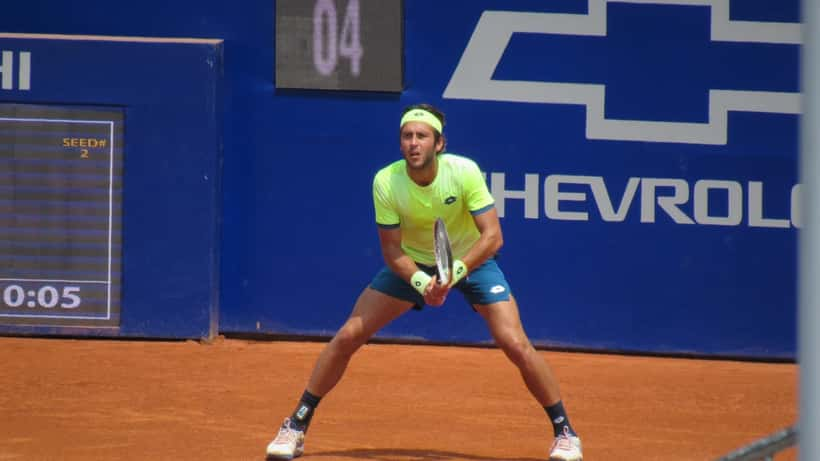
Tomas Martín Etcheverry moved through the opening round of the Vienna ATP 500 this week, confirming that Argentina's premier clay-court specialist has turned his autumn hard-court form into something real — and doing it just seven months after a left leg injury forced him off tour following his breakthrough Rio Open title in February 2026. For the millions of American recreational tennis players now transitioning into fall indoor season, Etcheverry's Vienna campaign offers an unexpectedly useful window into why this particular moment in the tennis calendar creates more injuries than almost any other.
Vienna and the Brutal Logic of the Autumn Swing
The Erste Bank Open in Vienna is one of six ATP 500 events on the tour calendar and sits squarely in the middle of the hardest stretch of the indoor hard-court season — a run that extends from late September through early November across Shanghai, Tokyo, Antwerp, Vienna, Basel, and Paris. For players like Etcheverry, whose formative years and best results have come on clay courts in South America, this stretch demands a full biomechanical reset.
Clay courts are forgiving by design. The surface absorbs roughly 15–20% of the impact force generated with each stride and allows players to slide into position, distributing deceleration loads across the hip flexors, glutes, and lateral stabilizers. Indoor hard courts — the Greenset and Plexicushion surfaces used at Vienna and similar venues — return nearly all of that force upward through the kinetic chain. Players cannot slide. Every direction change is an abrupt stop-and-go event. The result, according to sports medicine researchers who study professional tennis, is a measurably higher load on the patellar tendon, medial knee structures, and plantar fascia over the course of a single week of competition compared to clay.
Etcheverry knows this first-hand. His left leg injury in March 2026 — which emerged in the weeks after the Rio Open and required a six-week absence — was not yet publicly attributed to a specific diagnosis, but the timing placed it during a period when he was shifting from South American clay events toward hard-court tournaments in Europe. Vienna 2026 is, in many respects, a proof-of-concept for how much physical preparation his team put in to handle the demands that sidelined him earlier this year.
What Elite Surface Transitions Can Teach Weekend Players
The gap between how professional athletes manage surface transitions and how recreational players handle them is significant — and costly.
Sports medicine specialists who treat recreational tennis players at orthopedic clinics across the United States report a consistent pattern: the highest volume of tennis-related injuries arrives not in midsummer, when people are playing most, but in October and November, when players shift from outdoor courts to indoor facilities. The surface often changes. The footwear is sometimes the same. The training load frequently increases, because fall indoor leagues and club programs start precisely when outdoor season ends.
The injuries that follow tend to cluster around three areas. Patellar tendinitis — inflammation of the tendon connecting the kneecap to the shinbone — responds acutely to the harder return surface that indoor hard courts produce. Plantar fasciitis, the sharp heel pain most recreational players recognize, worsens when players used to softer summer surfaces suddenly train at higher intensity on firm indoor boards without adjusting their warm-up or load. Lateral ankle sprains, more common on indoor courts than on clay, occur because the same court properties that make hard courts fast also reduce the margin for error in lateral footwork.
None of these injuries are inevitable. What makes them common is that recreational players don't have the physiotherapy infrastructure around them that Etcheverry does when he steps onto the Vienna center court.
When "Normal Soreness" Becomes a $4,000 Mistake
Consider the situation facing a 38-year-old project manager in suburban Minneapolis — call her Dana — who plays three times per week in the USTA adult recreational leagues. From May through September, Dana plays on the outdoor hard courts at her city's public tennis complex. In October 2026, her fall indoor league begins at a sports center with faster, firmer courts than her summer venue.
By day ten of the fall season, Dana notices a dull ache in the inner side of her right knee after matches. It rates a 3 out of 10 in discomfort. She treats it as expected adjustment and keeps her full schedule. At three weeks, the ache persists for 36 hours after play and occasionally produces a small catching sensation when she descends stairs. She switches to ibuprofen before matches and scales back from three sessions to two.
At week five, lunging for a wide forehand, her knee buckles on the direction change. MRI reveals a Grade 2 medial collateral ligament sprain and a partial medial meniscus tear.
The critical threshold Dana crossed without noticing: the American Academy of Orthopaedic Surgeons (AAOS) recommends seeking medical evaluation for joint pain that persists beyond five to seven days of consistent activity, or that begins to interfere with non-sport activities like stair descent, rising from a seated position, or walking for more than 20 minutes without discomfort. Pain that starts modifying how you move — favoring one side, shortening your swing, unconsciously protecting a joint — has already become a biomechanical problem, not merely a soreness issue.
If Dana had consulted a sports medicine physician or physical therapist at week two, when her pain was mild and consistent but had not yet produced structural damage, her likely treatment path would have been a targeted two-to-three-week protocol of eccentric quad strengthening, foam rolling of the iliotibial band, and a temporary 20% reduction in playing time. Total cost: under $350 out-of-pocket for two or three physical therapy sessions, and no lost court time.
Her actual outcome: 12 weeks off the court, three imaging sessions (X-ray and MRI), ten physical therapy sessions, and out-of-pocket costs exceeding $3,800 after insurance. The injury itself healed. The delay in treatment is what drove the severity and recovery timeline.
This pattern repeats thousands of times every fall across the United States. The arithmetic of early expert consultation versus waiting for the body to force the appointment is consistently the same: early intervention is faster, cheaper, and produces better long-term joint outcomes.
Four Warning Signs That Cannot Wait
For recreational tennis players who, unlike Etcheverry, do not have an ATP-certified physiotherapist watching their movement patterns, orthopedic sports medicine specialists agree on four signals that require professional evaluation within 48–72 hours — not after the next match:
Joint swelling visible to the eye. Any effusion (fluid accumulation) in a knee, ankle, or wrist that is noticeable during or after play indicates tissue-level inflammation that warrants imaging. Do not play through visible swelling.
Pain that interrupts sleep. Soreness that dissipates over an evening is normal. Joint inflammation severe enough to wake you at 2 a.m. signals active tissue damage, not muscle fatigue.
Locking, catching, or giving way. A joint that hesitates mid-movement, catches on direction change, or buckles unexpectedly is exhibiting signs of structural compromise — loose cartilage, meniscal involvement, or ligament laxity — that worsen with each subsequent session.
Pain that changes your mechanics. If you have started favoring one leg, modifying a ground stroke to protect a joint, or avoiding specific movements, the injury has already altered your movement patterns, placing other structures at compensatory risk.
For guidance on recognizing and managing common tennis-related orthopedic injuries, the American Academy of Orthopaedic Surgeons maintains a detailed resource at orthoinfo.aaos.org.
An emergency room or urgent care clinic is not the right first contact for most tennis-related joint issues. The appropriate consultation is with an orthopedic sports medicine physician or a physical therapist with experience in racquet sport injuries. Most sports medicine practices offer initial assessments within one week; telehealth options can shorten that timeline for a first evaluation.
What Etcheverry's Vienna Campaign Can Teach Before Your Next Session
Professional players making Etcheverry's surface transition in Vienna this week are working through a structured protocol developed over months of preparation: gradual increases in hard-court volume, targeted tendon loading exercises, modified footwork drills that retrain the lateral movement patterns clay courts allow and hard courts punish.
Recreational players can apply a simpler version without an ATP support team. In the first two weeks of fall indoor play, reduce session duration by 15–20% from your summer baseline even if you feel fine. Prioritize a 10-minute dynamic warm-up that includes lateral band walks, calf raises, and hip rotations before stepping on court. Add a post-session five-minute stretching routine focused on calves and hip flexors — the muscles that bear the most additional load on firm indoor surfaces. And take the four warning signs above seriously from day one.
The difference between Etcheverry returning healthy from a significant injury to win matches in Vienna, and a recreational player ending their fall season on crutches, is not talent or physical conditioning. It is the quality and timing of professional support around the body when it is under adaptation stress.
That same quality of expert assessment is available to every US recreational player, on demand. For questions about joint pain, surface-related injuries, or when a persistent ache has crossed into medical territory, a sports medicine consultation — in person or via telehealth — is the same tool that keeps ATP players like Etcheverry competing through October. See also: how Brandon Nakashima's 2026 comeback season highlighted the role of sports medicine for competitive athletes and the clay court fatigue patterns Musetti's team managed ahead of Monte Carlo.
This article provides general health information for educational purposes. It does not constitute medical advice. Readers experiencing joint pain or injury should consult a licensed healthcare professional.
