 Sarah Miller
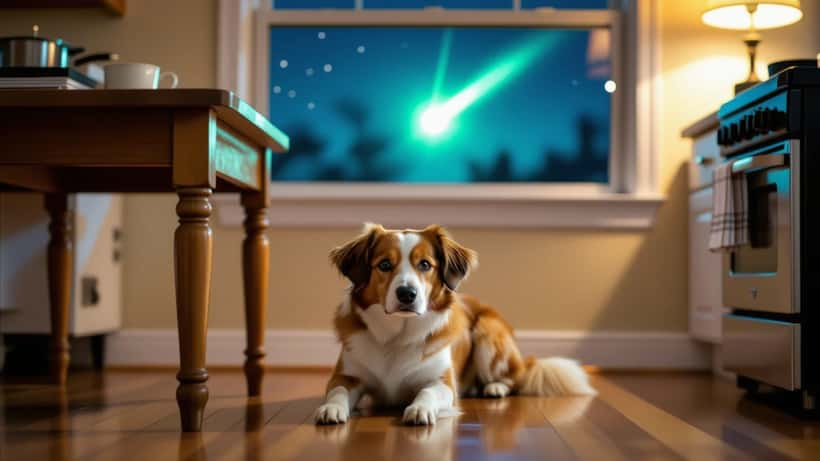
When a brilliant fireball streaked across New Jersey skies this month and a recovered meteorite was later confirmed to contain organic molecules, the headlines focused on the science of life's building blocks. But in thousands of homes across the state, the first sign that something unusual was happening came not from a telescope — it came from the family dog. Owners from Hillsborough to Metuchen reported pets barking, pacing, hiding under beds or refusing to eat in the minutes surrounding the flash and the low rumble that followed.
That reaction is not a coincidence, and it is not your imagination. Animals routinely sense sudden atmospheric events before their owners do, and a meteor bright enough to light up the sky — sometimes accompanied by a sonic boom as the rock decelerates — is exactly the kind of stimulus that triggers acute stress in a pet's nervous system.
What actually happened in the sky
According to NASA, meteors become visible fireballs when a small piece of asteroid or cometary debris enters the atmosphere at tens of thousands of miles per hour, heating the air around it until it glows. Larger fragments can survive the plunge and reach the ground as meteorites, and a fraction of those — like the New Jersey specimen now being studied — preserve organic molecules such as amino acids that formed in space long before Earth existed.
For scientists, the chemistry is the story. For a household pet, the relevant details are simpler and far more immediate: an intense, unexpected flash of light, followed seconds later by a pressure wave or booming sound that has no obvious source. Dogs and cats cannot rationalize the event the way we can once we read the news the next morning. To them, it registers as a sudden threat.
Why animals react before we do
Pets experience the world through senses that are tuned differently from ours. A dog's hearing extends well beyond the human range, and both dogs and cats detect low-frequency vibrations and changes in air pressure that we barely notice. A meteor's sonic boom, or even the subtle infrasound that can accompany atmospheric disturbances, can reach an animal before a person consciously registers anything at all.
This is the same mechanism that makes so many pets terrified of thunderstorms and fireworks. Veterinarians have long documented that the combination of an abrupt loud noise and a bright flash produces a classic fight-or-flight response: elevated heart rate, dilated pupils, trembling, and a powerful urge to flee or hide. A one-off meteor event is briefer than a fireworks display, but for a sensitive animal the spike of panic can be just as sharp — and the confusion afterward can linger for hours.
The signs of acute stress to watch for
Most pets settle on their own once the trigger passes, but it helps to know what a stress response looks like so you can tell the difference between a startled animal and one that needs support. Common signs include:
- Trembling, panting or drooling with no physical exertion to explain it
- Hiding, clinging to owners, or trying to escape through doors and windows
- Pacing, whining, or repetitive barking
- Flattened ears, tucked tail, or a crouched posture
- Refusing food or water, or having a toileting accident indoors
Cats often internalize fear more quietly than dogs, retreating to a high or enclosed space and staying there. That silence can be misread as calm when the animal is in fact highly stressed.
What to do — and when to call a veterinarian
In the moment, the goal is to make your pet feel safe rather than to force reassurance. Bring animals indoors, close curtains to reduce further flashes, and let a frightened pet retreat to whatever spot it chooses. Speaking in a normal, calm voice and continuing ordinary routines signals that there is no ongoing danger. Never punish a scared animal, and avoid flooding it with attention it does not want, which can accidentally reinforce the fear.
For most pets, that is enough. But certain situations warrant a professional opinion. If your dog or cat is still panting, hiding or refusing food many hours later, if an older animal or one with a heart condition shows extreme distress, or if a panicked pet injured itself trying to escape, a veterinarian should assess it. Chronic noise phobia is a recognized and treatable condition — vets can recommend behavioral desensitization, calming aids, or in severe cases short-term medication so the next storm or startling event does not send your pet into the same spiral. A qualified veterinarian can also rule out any physical injury a frightened animal may have hidden.
The same guidance that helps pets through predictable stressors applies here. Owners who have worked through the panic of a fireworks night or protected animals during wildfire smoke events already have the tools; a meteor is simply a rarer, shorter version of the same challenge.
The bigger picture
New Jersey's meteorite will be remembered for what it tells us about the origins of life. But it is also a useful reminder that our pets are constantly reading a version of the environment we cannot fully perceive. A fireball is a once-in-a-lifetime event for a household, and the odds of another are vanishingly small. Knowing why your animal reacted the way it did — and having a plan for the next thunderstorm or fireworks display — turns a moment of alarm into an opportunity to keep your companion calmer and safer. If your pet's fear of sudden noise and light is severe or recurring, an expert veterinary consultation is the fastest route to a lasting solution.
