 Christopher Adams
A fresh surge of Canadian wildfire smoke pushed hazardous air across the Upper Midwest, Northeast and Mid-Atlantic during the week of July 14, 2026, leaving more than 124 million Americans under orange, hazy skies. Air Quality Index readings topped 500 in Toledo, Milwaukee and Detroit on Thursday — far past the 300 mark that officially signals "hazardous" — while Chicago, Pittsburgh and Washington briefly ranked among the worst-polluted cities on Earth. For homeowners, the real battle is not outdoors. It is keeping that fine smoke from seeping through window frames, door gaps and HVAC intakes into the rooms where families sleep.
Why your house is not the safe room you think it is
Wildfire smoke is dominated by PM2.5 — particles so small they slip through ordinary weatherstripping and standard furnace filters. When outdoor AQI climbs into the 200s and 300s, indoor levels in a leaky home can track surprisingly close behind within hours. More than 100 million people were under air quality alerts during the July 2026 episode, and cities responded fast: New York opened emergency operations and handed out free KN95 masks, while Philadelphia suspended trash pickup and closed public pools.
Staying indoors helps only if the building envelope actually holds. A home built for winter heat retention is not automatically sealed against summer smoke, and the weak points — a bathroom exhaust fan, an old sliding door, an HVAC system pulling in outside air — are exactly the spots most owners overlook.
The HVAC upgrade experts reach for first
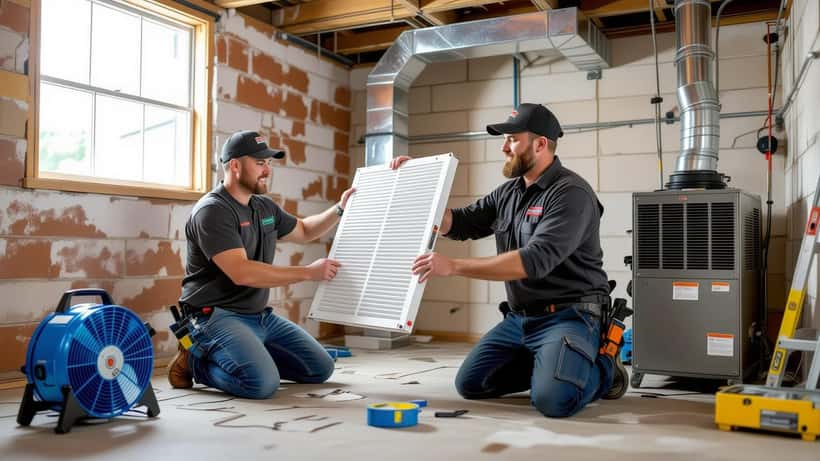
The single highest-impact move is inside your furnace or air handler. The U.S. Environmental Protection Agency recommends upgrading to a filter rated MERV 13 or higher during smoke events, because that rating captures a large share of the fine smoke particles a basic MERV 8 filter lets pass. Most residential systems can accept a MERV 13 filter without strain, provided you swap it more often than the manufacturer's normal schedule — smoke clogs filters quickly.
Two settings matter just as much as the filter itself. Set the thermostat fan to "On" rather than "Auto" so air keeps cycling through the filter even when the system is not actively cooling. And if your system has a fresh-air intake, switch it to recirculate mode or close the outdoor intake damper so you are not actively inviting smoke inside. A licensed HVAC technician can confirm your unit tolerates the higher-resistance filter and locate that intake damper — details that vary by system and are easy to get wrong. If you are weighing a standalone unit instead, our guide to choosing the right air purifier for wildfire smoke walks through sizing and CADR ratings.
Sealing the envelope, gap by gap
Filters clean the air already inside; sealing stops new smoke from arriving. Start by closing every window, exterior door, fireplace damper and pet flap. Push a rolled towel or a draft snake against the bottom of exterior doors. To find hidden leaks, run the back of your hand slowly around window frames and door edges — if you feel moving air, add painters' tape or fresh weatherstripping until the draft disappears. Painters' tape peels off cleanly once the smoke clears, which makes it the go-to for temporary sealing.
Bathroom and kitchen exhaust fans, along with clothes-dryer vents, are two-way streets that can pull smoke in when not running. During the worst hours, keep them off unless you genuinely need them. These are the same air-sealing fundamentals a contractor applied when Phoenix's haboob dust storms threatened homes — our breakdown of HVAC air-sealing against airborne dust covers the technique in depth.
Build a clean room — the EPA's DIY safeguard
When AQI spikes above 300, the EPA advises setting up a single "clean room" the household can retreat to. Choose a bedroom or living room with few windows, close the door and seal any obvious cracks. Run a portable HEPA purifier on high if you own one. If you do not, the agency endorses a low-cost alternative: tape four MERV 13 furnace filters into a box around a standard box fan, arrows pointing inward, to create a DIY air cleaner that EPA testing shows lowers indoor PM2.5 quickly. Full assembly instructions and safety notes are published on the EPA's clean-room guidance page.
Size the room to your household, avoid running the fan unattended overnight, and keep the door shut. A modest bedroom with the door closed and a working DIY filter can hold PM2.5 far below whatever the rest of the house is breathing.
Health note and when to call a professional
This guidance is general and does not replace medical advice. People with asthma, COPD, heart disease, or a household member who is pregnant, elderly or very young should follow their doctor's plan and treat any breathing difficulty as urgent. If symptoms appear, contact a physician.
For the house itself, a professional visit pays off when the fixes go beyond tape and a new filter. An HVAC contractor can tell you whether your ductwork is leaking unfiltered attic or crawlspace air into living areas, whether your system can safely run a MERV 13 filter long-term, and whether a whole-home filtration upgrade or a fresh-air unit with proper filtration makes sense before the next smoke season. A home-improvement specialist can pinpoint envelope leaks a homeowner cannot see — around recessed lighting, attic hatches and rim joists — and seal them permanently rather than seasonally.
What to do before the next plume arrives
Meteorologists expect Canadian fire activity to keep sending smoke south intermittently through the summer, so the smart play is to prepare during the clear days between episodes. Buy MERV 13 filters in advance — they sell out fast once an alert hits. Locate your HVAC intake damper now, keep a box fan and painters' tape on hand, and decide which room becomes your clean room before you need it. A few dollars of filters and tape, plus one consultation with an HVAC or home-improvement expert, turns a leaky house into a genuine refuge the next time the sky turns orange.
