 Evan Cole
Pennsylvania spent Friday, July 17, 2026, under a statewide Code Purple air quality alert as thick wildfire smoke from Canada and Minnesota settled over the Commonwealth. The Pennsylvania Department of Environmental Protection warned that the air was unhealthy for everyone, not just sensitive groups. By today, Saturday, July 18, most of the state has improved to Code Yellow as rain arrives and winds push the plume toward New England — but a Code Orange alert still covers Bucks, Chester, Delaware, Montgomery and Philadelphia counties, where cleaner air is arriving more slowly.
If you spent Friday searching "when will the smoke clear in PA," you already learned the hard lesson of 2023, 2024 and now 2026: hazy summer skies are no longer a freak event. They are a recurring feature of the season. And the single most effective piece of consumer electronics you can own for these days is a properly sized portable air purifier. The problem is that most people buy the wrong one — or buy a good one and run it incorrectly.
What actually matters: CADR, not marketing claims
The number that determines whether a purifier can keep up with wildfire smoke is the Clean Air Delivery Rate, or CADR, printed on the box and certified by the Association of Home Appliance Manufacturers. CADR tells you how many cubic feet of filtered air the machine delivers per minute, measured separately for smoke, dust and pollen.
The Environmental Protection Agency's guidance is refreshingly concrete: for smoke, choose a unit whose tobacco-smoke CADR is at least two-thirds of the room's floor area in square feet. A 300-square-foot living room therefore needs a smoke CADR of roughly 200 or higher. Undersize the machine and it will run all day without ever clearing the room; the sticker may still say "purifies up to 1,500 square feet," a claim that usually assumes an hour of runtime and a single air change, which is far too slow for an active smoke event.
Ignore the flashy add-ons. Ionizers, UV lamps and "plasma" modes do little against the fine particles in wildfire smoke and some ozone-generating models can worsen indoor air. The workhorse is the filter itself.
HEPA and MERV 13: the two ratings to look for
Wildfire smoke is dominated by PM2.5 — particles smaller than 2.5 micrometers that lodge deep in the lungs. To capture them you want a true HEPA filter, which by definition removes 99.97% of particles at the hardest-to-catch size. Watch the wording: "HEPA-type" or "99% HEPA-like" filters are not the real thing.
For readers with central heating and cooling, there is a second, cheaper lever. The EPA and CDC both recommend upgrading your HVAC filter to a MERV 13 rating during smoky stretches. A MERV 13 filter captures a large share of PM2.5 while your system's fan circulates air through the whole house — effectively turning the furnace into a building-wide purifier. Check that your blower can handle the tighter filter before you switch, and set the fan to "on" rather than "auto" so it keeps filtering even when the system is not heating or cooling.
There is also a budget option that laboratory studies have repeatedly validated: the DIY box-fan air cleaner. Taped to one or more MERV 13 furnace filters, a common 20-inch box fan can meaningfully cut indoor PM2.5 for around $60 in parts. EPA research found these homemade units safe and effective in controlled testing — a genuinely useful fallback when store shelves empty out mid-alert, as they did across the Philadelphia region this week.
Sizing, placement and runtime
Buying the right box is only half the job. Place the purifier in the room where you spend the most time — usually the bedroom overnight — and keep doors and windows closed while it runs. Run it on a higher setting when an alert is active; the quiet "sleep" mode often drops the fan speed so low that the effective CADR collapses.
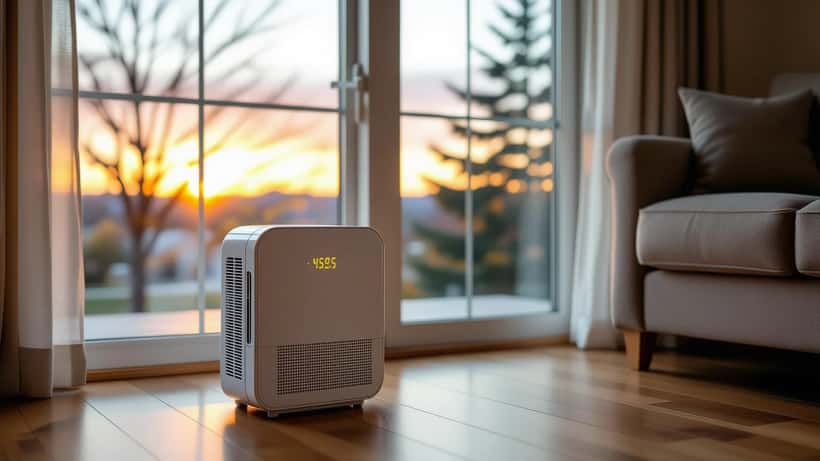
A machine with a particle sensor and a real-time PM2.5 display is worth the premium during smoke season. It lets you see the number fall after you close up the house, confirm the unit is actually working, and dial the fan down once levels are safe. Replace or clean the pre-filter on schedule; a clogged filter starves airflow and quietly erodes the CADR you paid for. During a multi-day event like this one, expect filters to load faster than the manufacturer's normal-use estimate.
Why an electronics expert can save you money
Air purifier specifications are written to sell units, not to inform you. An independent consumer-electronics adviser can match a machine's certified smoke CADR to your actual room sizes, tell you whether your HVAC system can safely take a MERV 13 filter, and steer you away from ozone-emitting gadgets dressed up as "advanced purification." For a household weighing several hundred dollars of purchases before the next Code Orange day, that is a short consultation that pays for itself. It also helps you avoid the opposite mistake — overbuying a commercial-grade unit for a small apartment.
This week's smoke is forecast to lift as the weekend rain clears the air. But the pattern is now annual, and the equipment you buy calmly today will outperform whatever you can grab in a panic during the next alert. If the haze has you worried about symptoms rather than hardware, our guide to reading the air quality index and knowing when to see a doctor covers the health side.
For the authoritative technical checklist on choosing and sizing a unit, the EPA's Guide to Air Cleaners in the Home is the reference to bookmark before smoke season returns.
This article is general consumer guidance and is not a substitute for professional medical advice. If wildfire smoke is causing breathing difficulty, chest pain or other symptoms, contact a healthcare provider.
