 Carl Graham
Texas holds the No. 1 spot in the AP Top 25 for the third consecutive week after the October 5, 2026 release — and with the poll came another surge of sports wagering, as Americans bet an estimated $1.4 billion on college football each weekend of the 2026 season, according to the American Gaming Association. But as millions of fans open their sportsbook apps and eye this weekend's matchups, a quietly shifting legal landscape means that what was a perfectly legal bet last season could now expose you to regulatory action, account forfeiture, or, if you are a student-athlete, NCAA sanctions.
The Rankings Driving Record Betting Activity
The AP Poll Week 6 ballot confirmed Texas at No. 1 with 61 of 62 first-place votes, followed by Georgia (No. 2), Notre Dame (No. 3), Miami (FL) (No. 4), and Ohio State (No. 5). Alabama jumped from No. 7 to No. 6 after routing a ranked opponent by 21 points. Three previously ranked teams fell entirely out of the poll after upset losses — the kind of volatility that drives betting markets to their highest single-week handle of the season, according to Bleacher Report's Week 5-to-6 analysis.
That volatility has financial consequences. The American Gaming Association estimates that a single major Top-25 matchup — such as the Texas-Georgia game on October 18 — can generate more than $300 million in wagers nationally. With sports betting now legal in 39 states plus Washington, D.C. as of May 2026, per Fox Sports, more Americans than ever have near-instant access to licensed books through their phones.
The Legal Patchwork That Trips Up Bettors
Here is where it gets complicated. Thirty states allow online and mobile wagering, but underneath that headline figure sits a maze of sport-specific and wager-type restrictions that have expanded significantly in 2026. The legalization map looks deceptively clean from the outside.
Four states — Louisiana, Maryland, Ohio, and Vermont — now ban individual college athlete proposition bets. In plain terms: in those states, you cannot legally place a wager on a quarterback's passing yard total, a running back's rushing attempts, or a receiver's catch count, even if sports betting is fully legal where you are. Kentucky passed legislation in early 2026 raising the minimum betting age from 18 to 21 and restricting prop bets on all in-state student athletes, including players on Kentucky, Louisville, and Western Kentucky rosters.
Two other states — Illinois and New Jersey — prohibit wagers on in-state college teams entirely. A Chicago resident cannot open their FanDuel account and bet on Northwestern's spread against a ranked opponent, regardless of how many other games are available. The rules also differ for futures markets, parimutuel versus fixed-odds formats, and what each state's gaming commission classifies as a "proposition."
The NCAA's official sports wagering policy explicitly prohibits student-athletes, coaches, and athletics staff from betting on any college sport — and the organization formally urged federal regulators in early 2026 to suspend college sports prediction market contracts. Enforcement is tightening.
"The number of clients who contact me after placing what they believed was a legal wager — and discovering their state had changed the rules mid-season — has roughly doubled since 2024," says a sports and gaming attorney who advises clients across multiple jurisdictions. "They are not bad actors. They downloaded a licensed app, saw a bet type was listed, and placed it — not realizing the platform had not yet updated its geo-blocking for that state."
When a Legal App Produces an Illegal Bet
The exposure is not theoretical. Several state gaming commissions have begun issuing fines to operators for offering restricted bet types — and in a small number of cases, initiating proceedings against individual bettors who placed those wagers. The NCAA has also expanded its monitoring of player-prop markets, using statistical anomaly detection to flag unusual betting volume on specific athlete performance lines ahead of games.
Gambling advertising has compounded the confusion. Operator ad spending on sports betting climbed from approximately $1 billion in 2021 to nearly $2 billion in 2023, and industry observers say 2026 pacing is on track to exceed that. The volume of advertising — much of it prominently featuring bonus offers and "risk-free" bet language — normalizes betting without consistently communicating jurisdiction-specific rules. Of 24 Power 5 public universities in mobile-betting states, only four explicitly warned student-athletes in policy documents about the legal consequences of wagering, according to an analysis by Foley & Lardner cited in the Mondaq legal database.
See also how legal exposure shows up in Georgia vs. Arkansas 2026: What Every SEC Bettor Needs to Know and Projected CFB Rankings 2026: The Hidden Bonuses That Change Everything for related coverage.
Scenario: A Texas Fan Placing a Bet in Ohio
Consider a specific situation that plays out across the country each AP Poll Saturday.
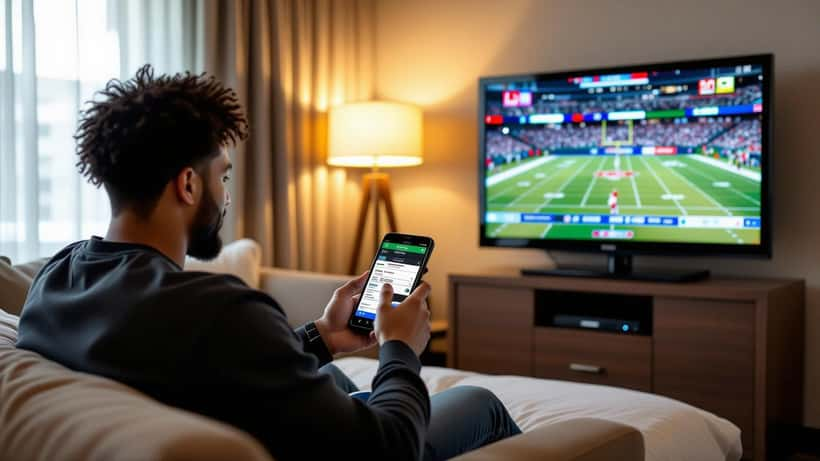
Jason is a 28-year-old Texas fan who lives in Austin, where all major bet types on college football games are legal under Texas's 2025 sports wagering statute. He travels to Columbus, Ohio to attend a friend's watch party for the October 18 Texas-Georgia game. On Saturday morning, he opens his Texas-registered sportsbook account from a Columbus hotel and attempts to place a $50 prop bet on the Texas quarterback's passing yard total.
Ohio banned individual college athlete proposition bets in August 2024. His licensed app was supposed to detect his Ohio geolocation and block that bet type — but a software lag meant the wager was accepted and a confirmation appeared on his screen.
Jason is now in a compliance grey zone. Ohio's Casino Control Commission has the authority to void the bet, order the confiscation of any winnings, and flag his account for regulatory review. If the operator is fined for the geo-compliance failure, Jason's account details become part of the official record. A gaming attorney's initial review of this situation typically costs $250 to $500 as a flat-fee consultation — and can clarify whether he has individual exposure or whether the liability sits entirely with the platform.
The numbers change substantially if Jason were a student-athlete. If he were on Ohio State's roster and placed the same $50 bet from his campus dorm, the consequences shift to a completely different category: NCAA sanctions (including potential loss of scholarship eligibility), school-level disciplinary proceedings, and, depending on the amount wagered across a season, possible violations of Ohio's consumer protection statutes. Legal representation in a preliminary NCAA investigation typically runs $1,500 to $3,500 for the initial proceedings — a cost that vastly exceeds any plausible profit from a $50 prop bet.
The if-then rule is specific: if you are placing wagers in a state that is not your home jurisdiction, then you must verify that state's current prop-bet restrictions and in-state-team prohibitions before betting — regardless of what your account dashboard shows as available.
What to Do Before the Next AP Poll Saturday
Three concrete steps can reduce legal exposure for any bettor who follows the AP Poll closely:
Before each betting session in a new location, check the state gaming commission's official website — not a third-party guide — for the current approved wager types. Ohio's Casino Control Commission and Maryland's State Lottery and Gaming Control Agency update their approved-products lists regularly.
If you are a student-athlete in any sport, consult a licensed sports or gaming attorney before placing any sports wager, regardless of whether it involves your own sport or team. The NCAA's enforcement posture has expanded significantly in 2026 and extends to all intercollegiate athletics participants.
If you have already placed a wager that may not have complied with your jurisdiction's rules, a brief consultation can clarify your exposure before it becomes a formal matter. Platforms are increasingly required to provide suspicious-activity reports to state regulators, and proactively addressing a compliance question is almost always less costly than responding to a commission inquiry after the fact.
The AP Poll will continue to shape Saturday priorities through December's College Football Playoff selection rounds — and the legal rules surrounding those games will continue to evolve at least as quickly as the rankings themselves.
This article is for informational purposes only and does not constitute legal advice. For guidance specific to your situation, consult a licensed attorney in your jurisdiction.
