 Charles Jackson
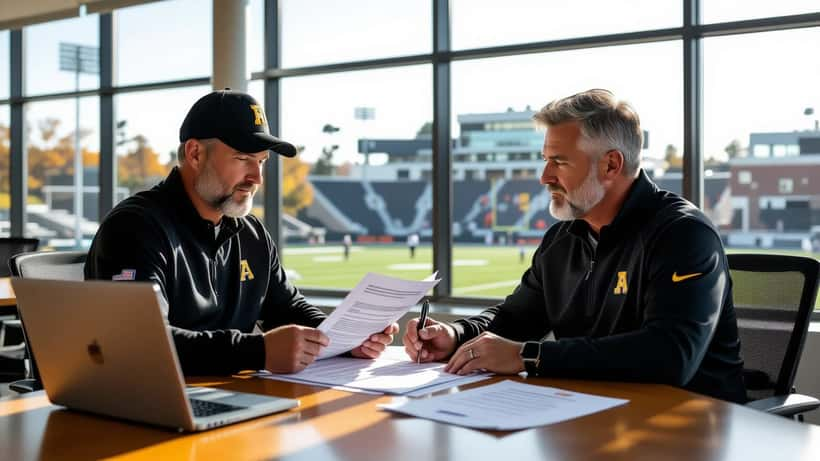
Every Saturday in October, millions of college football fans refresh their phones to check the latest AP Top 25. But while fans obsess over who's ranked where, the people watching those numbers most carefully aren't bettors or analysts — they're the attorneys who drafted multi-million-dollar coaching contracts with performance bonuses tied directly to where a team lands in the polls.
With Week 6 of the 2026 college football season underway and Ohio State, Oregon, and Texas projected at the top of the early rankings, the financial stakes hidden inside coaching contracts are enormous. The first official College Football Playoff Top 25 drops November 3, 2026 — and for dozens of head coaches across the country, that date could trigger automatic extensions, six-figure bonuses, or market-value reviews worth millions.
Rankings Season Has Arrived — and So Has Bonus Season
The projected CFB rankings circulating in October aren't just ESPN debate fodder. They are, in effect, a preview of the financial reckoning that comes when the CFP selection committee releases its first official poll in November.
According to contract disclosures reviewed by sports law reporters and Spotrac, bonus structures in 2026 head coaching deals have grown dramatically more complex since 2020. Where older contracts might include a flat $50,000 bowl appearance bonus, today's deals layer dozens of milestone triggers: a final top-25 ranking, a New Year's Six bowl bid, a CFP quarterfinal, semifinal, or title appearance — each unlocking a separate payment.
UConn's 2025 contract with head coach Jason Candle, for example, pays $150,000 just for finishing the season with a final CFP top-25 ranking, plus an additional $50,000 to $75,000 for bowl appearances and wins. His deal also includes up to $1 million in CFP-achievement bonuses stacked on top of those milestones — but only if the football program maintains an APR (Academic Progress Rate) score above 950.
That APR clause is where attorneys earn their fees.
What the AP Poll Actually Triggers
Projected rankings in October and the official CFP poll in November are legally distinct — most contracts tie bonuses to the final CFP ranking at season's end, not the mid-season polls. But attorneys who specialize in collegiate sports contracts note that mid-season rankings still carry legal weight in two ways.
First, they affect a coach's negotiating leverage. A coach at a mid-major school sitting at 14th in the Week 8 AP poll is already fielding calls from Power Four programs, which triggers "Good Faith Market Review" clauses embedded in an increasing number of contracts. Indiana's deal with Curt Cignetti includes such a clause, triggered specifically by a CFP semifinal appearance. These reviews can result in a coach receiving a raise or extension even before the season ends.
Second, projected rankings affect buyout calculations. If an athletic department is weighing a coaching change, the mid-season AP standing influences what the program would owe — and what a departing coach could claim they forfeited by being fired mid-run toward a bonus milestone.
"A lot of these disputes come down to what the parties meant by 'final ranking' versus 'projected ranking' and whether a mid-season firing deprives a coach of a bonus they were clearly on track to earn," one sports attorney explained in a 2025 Marquette Sports Law Review piece examining the Kiffin and Cignetti contract structures.
The Legal Complexity Behind Performance Bonuses
Not all college football contracts treat bonuses the same way, and that inconsistency is exactly what ends up in arbitration or litigation.
Auburn's $44 million deal with Alex Golesh, signed in December 2025, includes $250,000 bonuses for reaching the CFP quarterfinals and semifinals, with $500,000 for a championship appearance and $1 million for a title. Crucially, these bonuses are cumulative — meaning a title run pays all four thresholds, totaling $2 million.
Penn State's deal with Matt Campbell goes further: a CFP appearance triggers an automatic one-year contract extension plus a minimum $500,000 raise, while a national title triggers a two-year extension with at least a $1 million salary increase. That structure means the bonus isn't just a payment — it restructures the entire employment relationship.
According to analysis published in the Marquette Sports Law Review, public universities must disclose the full terms of coaching agreements under state open-records laws, including all incentive structures. Private schools have no such requirement — which creates enforcement complications when a private school disputes whether a bonus was earned.
The legal battlegrounds are predictable: Was a bowl game "won" before a cancellation? Did an APR shortfall properly void a ranking bonus? Did a coaching buyout extinguish earned-but-unpaid incentives?
When Rankings Put Real Money on the Table: A Real Scenario
Consider a concrete case that attorneys in the collegiate sports space encounter regularly.
Coach David T., a 48-year-old head coach at a Group of Five program, entered the 2026 season under a contract paying $2.4 million per year with the following bonus structure: $75,000 for a final CFP top-25 ranking, $200,000 for a New Year's Six bowl appearance, and a $400,000 bonus for a CFP bid. His buyout if fired without cause was set at $4.8 million (two years remaining on a four-year deal).
By Week 6, his team is sitting at #19 in the AP Poll and firmly in the New Year's Six conversation. The athletic director, facing budget pressure and a vocal faction of unhappy boosters, begins exploring whether to make a change after the season.
Here's the if/then calculation that makes this legally fraught:
- If fired before November 3 (pre-CFP poll): the school owes the $4.8M buyout, but no bonus has technically been triggered. The coach's attorneys argue he was on track to earn $275,000 in bonuses that he is now deprived of — elevating the claim to $5.075M.
- If fired after a final top-25 ranking is earned: the $75,000 bonus is vested and must be paid, but the $200,000 New Year's Six bonus depends on whether the bowl selection committee had already extended an invitation before the termination date.
- If the team loses its final two games and falls out of the top 25: the school owes nothing in bonuses — but the buyout remains $4.8M.
The difference between outcomes A and C in this scenario is $275,000 to the coach and potentially a multi-year legal battle. Attorneys who reviewed the internal contract structure of several 2025–26 coaching deals told Sports Illustrated that many agreements still lack clear language defining what "on track to earn" means when a midseason termination occurs.
A sports law attorney typically charges $400–$900 per hour for contract review and dispute consultation. For a coach or an athletic department navigating a scenario like the one above, the cost of a 15-hour retainer ($6,000–$13,500) is a fraction of the potential $275,000 dispute value.
What Coaches — and Athletic Departments — Get Wrong
The most common mistake in college football contract disputes isn't bad faith — it's ambiguous drafting. Terms like "final ranking," "bowl eligibility," and "CFP-qualifying performance" are used inconsistently across schools.
Minnesota's revised 2026 contract with P.J. Fleck added a new $700,000 annual performance bonus, ranking him 10th in Big Ten compensation at $7.9 million per year. The specificity in that deal — which sources report includes explicit language about AP Poll timing, CFP committee poll timing, and the difference between a "bid received" and a "game played" — reflects how schools have learned from past disputes.
For student-athletes, the legal ecosystem around rankings is less direct but still real. NIL collectives often tie sponsorship agreements to a team's projected ranking, with escalation clauses that pay more when a program breaks into the top 10 or earns a playoff bid. A player drafted into an NIL deal based on a school's top-20 standing has a legitimate legal question if the program drops out of contention mid-season and a sponsor invokes a performance clause.
The projected CFB rankings conversation happening every October on social media is, underneath the surface, a financial and legal countdown clock for dozens of coaches, athletic directors, and legal teams. The numbers on a poll aren't just pride — they're contractual triggers with real dollar values attached.
If you're a coach, athletic administrator, or student-athlete with questions about a contract's bonus structure or a dispute over earned incentives, consulting a sports law attorney before the season ends — not after — is the move that changes outcomes. An attorney with collegiate sports contract experience can identify drafting gaps, advise on the timing of a dispute, and help you understand exactly what a ranking is — or isn't — worth in your specific agreement.
Disclaimer: This article is for informational purposes only and does not constitute legal advice. Consult a licensed attorney for guidance specific to your situation.
