 Emily Wang
The U.S. Department of Transportation has pushed back a rule that changes how airlines label the causes of delays and cancellations. The effective date moves from October 19, 2026 to February 1, 2027, after Airlines for America asked for more time to update reporting systems.
What is the question travelers are actually asking?
Most readers want to know one thing: "Does this change what I get when my flight falls apart?" The short answer is that the rule changes how disruptions are classified, and classification can quietly decide who pays for your hotel room and your dinner.
The rule implements Section 511(b) of the FAA Reauthorization Act of 2024. It removes ten event types from the "Air Carrier" cause code, which covers problems within an airline's control, and places them in a new "Section 511(b)" category. According to the Federal Register, the final rule amends reporting requirements under 14 CFR Part 234.
Reported examples of the moved events include aircraft cleaning after a passenger's death, aircraft damage from extreme weather, foreign object debris and sabotage. Commentary published on October 16, 2026 by Your Mileage May Vary also cites aircraft maintenance problems, including issues found during preflight checks and flights that return to the airport.
Why did the date move to February 1, 2027?
Airlines for America, the trade group for major U.S. carriers, reportedly asked the department for an extension on September 21. Airlines and the Bureau of Transportation Statistics (BTS) both need time to update how they collect and report data.
Because carriers report to BTS after the fact, the new categories are expected to apply to disruptions that occur on or after January 1, 2027. The formal effective date is February 1, 2027. If your trip falls before that, the old categories still govern how the disruption is recorded.
How does a cause code connect to your meal and hotel?
Many major U.S. airlines have made written commitments to provide meals, hotel rooms or ground transportation when a delay or cancellation is within their control. Those commitments are tracked on the DOT's Airline Cancellation and Delay Dashboard.
The key phrase is "within their control." If an event moves out of the "Air Carrier" bucket, the airline has a stronger argument that the disruption was not controllable. DOT's own economic analysis, as summarized by trade coverage, anticipated that passengers would receive fewer amenities as a result. Airlines can still choose to provide them.
Refund rights are a separate matter. Reporting indicates they are unchanged: if your flight is canceled or significantly changed and you decline the alternative, you remain entitled to a refund under existing DOT rules.
A concrete case: one cancelled flight, two possible outcomes
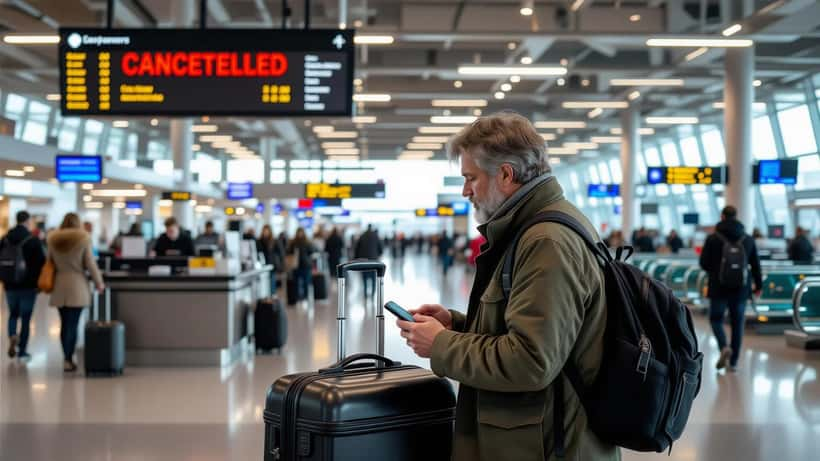
Consider a traveler booked on a 6:40 p.m. departure from Chicago to Denver on February 12, 2027, on a carrier that promises hotel and meal support for controllable cancellations. A mechanical fault found during the preflight check cancels the flight, and the next seat is not available until 11:15 a.m. the following day, about 16 hours later.
If the airline codes the cancellation as controllable, the traveler can ask for the promised hotel, which might cost $180 a night, plus meal vouchers of perhaps $25 to $40. If the airline instead argues the event falls into the Section 511(b) category, it may decline to cover that roughly $220 in costs.
In both versions, the traveler can still request a full refund of the ticket instead of rebooking. The practical difference is the out-of-pocket cost of an overnight stay.
The lesson is to document everything. Save the gate announcement, the airline's written cancellation notice and the reason it gives. If the stated reason later conflicts with the code the airline reports to BTS, that gap is useful evidence in a complaint.
When does a lawyer actually help?
Most disputes of this kind are small, and a well-written complaint to the airline resolves many of them. A consumer or aviation attorney becomes relevant when the amounts are larger or the facts are contested.
Examples include a cancellation that strands a family overseas, a missed prepaid cruise or event, or an airline that denies a refund you are clearly owed. A lawyer can read your contract of carriage, compare the airline's stated reason with its published commitments and advise whether small claims court or a regulatory complaint makes sense.
This is also where the cause code matters. A reason such as "weather" or "sabotage" is easy to assert and hard for a traveler to test without knowing what the rules actually cover.
What should you do before and after February 1, 2027?
Here is a practical checklist:
- Read your airline's commitment. Check the DOT dashboard for the carrier you fly and note which disruptions trigger meals or hotels.
- Buy trip protection with care. Travel insurance often covers delay costs that an airline may not. Check whether the policy's definition of covered delay fits mechanical or weather-related events.
- Ask for the reason in writing. Request the cause of cancellation by email or in the app, and keep a copy.
- Keep receipts. Hotel, meals and ground transportation receipts support any reimbursement request, whether to the airline, an insurer or a card issuer.
- Check your credit card. Several premium cards include trip delay coverage that does not depend on the airline's classification.
- File a complaint if needed. The DOT accepts consumer complaints about refunds and service failures.
Why does the data matter beyond your own trip?
The cause codes feed the public statistics that regulators, journalists and consumers use to compare carriers. When ten event types leave the "Air Carrier" bucket, an airline's reported share of controllable delays can fall without any change in how often its flights actually run late.
That makes year-over-year comparisons harder. A carrier that looks 3 percentage points better in March 2027 than in March 2026 may simply have reclassified events. Treat any improvement claim with caution until analysts adjust for the new definitions.
For travelers, the sensible habit is to judge an airline by its cancellation rate and its written commitments, not by one cause-code percentage. Those two figures are harder to reshuffle and easier to hold the airline to.
What the rule does not do
It does not eliminate refund rights, and it does not stop airlines from voluntarily offering meals or hotels. It does not change the weather or the mechanics. It changes the label on the event, and the label can shift who is expected to bear the cost.
It also does not apply yet. Until February 1, 2027, the existing categories remain in force, which is useful to know if you are booking holiday travel in the next few months.
This article is general information, not legal advice. Your rights depend on your ticket, your airline's contract of carriage and the facts of your trip. For a specific dispute, consult a qualified attorney.
If a cancellation leaves you out of pocket and the airline's explanation does not add up, a consumer or aviation lawyer on Expert Zoom can review your documents and tell you what to claim, and where. See also our guides on what delayed passengers can claim in 2026 and your rights after a Southwest disruption.
