 Charles Jackson
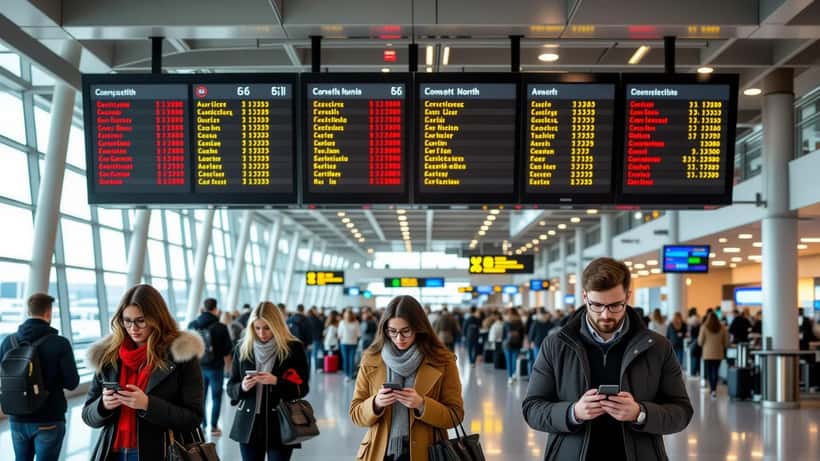
Flight status dashboards are lighting up more yellow and red than usual this summer, and travelers are once again discovering that knowing a flight is delayed is only half the battle. In 2026, a fresh wave of severe weather, air-traffic control staffing gaps, and airline schedule compression has pushed U.S. on-time performance to its lowest point since before the pandemic. For passengers staring at a creeping departure board, the real question is no longer "When will my plane leave?" but "What am I owed when it finally does — or does not?"
The Federal Aviation Administration and major carriers have traded blame for months. The FAA points to controller training pipelines and retirements, while airlines argue that antiquated scheduling systems leave them exposed to cascading delays. Whatever the root cause, the practical effect is the same: millions of Americans are receiving flight status updates that read like slow-motion disappointment. A one-hour slip becomes a three-hour ground hold. A three-hour ground hold becomes an overnight cancellation. And in the gap between the first alert and the last bag on the carousel, passengers are left guessing about refunds, rebooking, and cash compensation.
This is exactly where expert guidance becomes valuable. A travel-law consultant or aviation consumer-rights specialist can decode the difference between a weather event that excuses the airline and a controllable delay that triggers real money. The rules are not as simple as the viral social-media threads suggest. The U.S. does not have a single, EU-style passenger-rights statute that guarantees cash payouts for every delay. Instead, travelers must navigate a patchwork of Department of Transportation regulations, airline contracts of carriage, and state consumer-protection laws.
The most important federal rule to remember in 2026 is still the DOT’s requirement that airlines refund passengers automatically when a flight is canceled or significantly changed and the passenger no longer wishes to travel. That refund must go back to the original form of payment, not as a travel voucher with an expiration date. If an airline tries to push a credit instead of cash, it is violating federal policy. Yet enforcement relies partly on passenger complaints, which means many travelers never recover what they are owed simply because they do not know the procedure.
Significant delays are trickier. The DOT has recently sharpened its definition of "significant change," and airlines are now required to display cancellation and delay compensation policies clearly on their websites. In practice, those policies vary sharply. Some carriers offer meal vouchers after a few hours on the tarmac, while others promise hotel accommodation when an overnight delay is within their control. The key phrase is "within the airline’s control." A mechanical issue or crew-scheduling problem may trigger accommodation, while a thunderstorm over Chicago usually does not. Expert consultation can help a passenger gather the right documentation — gate announcements, screenshots of flight status apps, crew statements — to prove which category applies.
For international itineraries, the Montreal Convention still sets the outer boundary for compensation on baggage and delay damages, though caps and exclusions make it a specialized area. Passengers on flights departing the European Union, or on EU carriers flying into Europe, retain the stronger protections of EC 261/2004. A growing number of U.S.-based claims agencies and aviation lawyers now specialize in bridging these frameworks for American travelers, particularly on codeshare tickets where it is not obvious which regime governs.
The 2026 climate has also introduced a new variable: heat. Extreme temperatures in the Southwest and Southeast are forcing weight restrictions, ground stops, and revised takeoff procedures. Flight status apps may show "operational delay" without explaining that the delay is tied to temperature thresholds that the airline could have anticipated. Consumer advocates argue that airlines have enough historical data to schedule realistically during heat waves, and that repeated "weather" designations may mask controllable capacity decisions. Sorting that out requires technical knowledge of airline operations and meteorology — another reason expert input can be decisive.
Beyond the legal mechanics, there is a softer but equally important role for expert advice: stress reduction. Studies consistently show that uncertainty amplifies travel anxiety more than the delay itself. A consultant who can say, "Here is your precise entitlement, here is the form to file, and here is the timeline," transforms a chaotic airport experience into a solvable problem. In that sense, expert help is not merely about money; it is about restoring a passenger’s sense of control.
Companies in the expert consultation marketplace are responding by offering on-demand aviation consumer-rights sessions. Instead of wading through airline chatbots or waiting on hold for hours, travelers can connect with a specialist who has handled hundreds of similar cases. These experts can review a boarding pass, assess whether the delay qualifies for compensation, draft the complaint language, and identify the correct regulatory channel. For business travelers and families with tight schedules, the fee is often dwarfed by the recovered compensation and the saved time.
Looking ahead, the second half of 2026 is unlikely to bring immediate relief. The FAA’s controller hiring surge will take months to materialize, and airlines are still adjusting schedules to match realistic crew availability. That means flight status boards will remain volatile. Passengers who treat delays as an information problem — solved by a quick app check — will keep leaving money on the table. Passengers who treat delays as a rights problem, with clear documentation and expert backup, will fare much better.
If your flight status shifts from "on time" to "delayed" to "canceled" today, start with the basics: screenshot everything, ask the gate agent for a written reason, and keep receipts for meals, hotels, and ground transport. Then consider consulting an aviation consumer-rights expert before you accept the airline’s first offer. The difference between a voucher you never use and a cash refund you actually receive can be one informed conversation.
