
 Jessica Johnson
In January 2026, Marcus Rivera opened his third location of a fast-casual restaurant chain — this one in Denver, Colorado, 525 miles from his original Salt Lake City flagship. The opening date was six weeks away when his payroll system alerted him: Colorado's minimum wage for 2026 was $14.81 per hour, more than twice the $7.25 per hour his Utah restaurants paid. His labor cost projections, built on Utah assumptions, were wrong by $3,000 per week.
What followed was an intensive audit of his payroll across both states — one that revealed not only the Colorado gap but a quieter compliance issue at his Utah locations that had been accumulating for 18 months.
The Business: Three Locations, Two Wage Worlds
Marcus's chain — a grain bowl and sandwich concept — operated two Utah locations: one in Salt Lake City's Sugar House neighborhood, one in Orem. Both had operated since 2022 under Utah's minimum wage structure:
- Base wage: $7.25/hr (mirrors federal minimum under Utah Code § 34-40-102)
- Tipped employees: $2.13/hr direct wage, with tip credit to reach $7.25 (same as federal FLSA tip credit)
- Youth wage: $6.16/hr (85% of minimum) for employees aged 14–17 in their first 90 days [Utah Code § 34-40-102(3)]
The Denver location introduced a third structure: Colorado's minimum wage of $14.81/hr, with a tipped minimum of $11.79/hr (tipped workers can be paid $3.02 below the standard minimum). Colorado also limits the youth training wage more narrowly than Utah. His single payroll system needed to handle three distinct wage floors simultaneously.
The Utah Compliance Issue: Tip Credit Verification
While preparing the Colorado labor cost model, Marcus's HR consultant discovered that the Utah locations had been improperly applying the tip credit for two employees — both front-of-house servers at the Orem location.
Under the FLSA's tip credit rule [29 C.F.R. § 531.50], an employer may pay a tipped employee $2.13/hr in direct wages if:
- The employee regularly earns at least $30/month in tips
- The employer notifies employees in writing of the tip credit arrangement
- The employee's total hourly earnings (direct wage + tips) equal at least the federal minimum wage of $7.25/hr for every hour worked
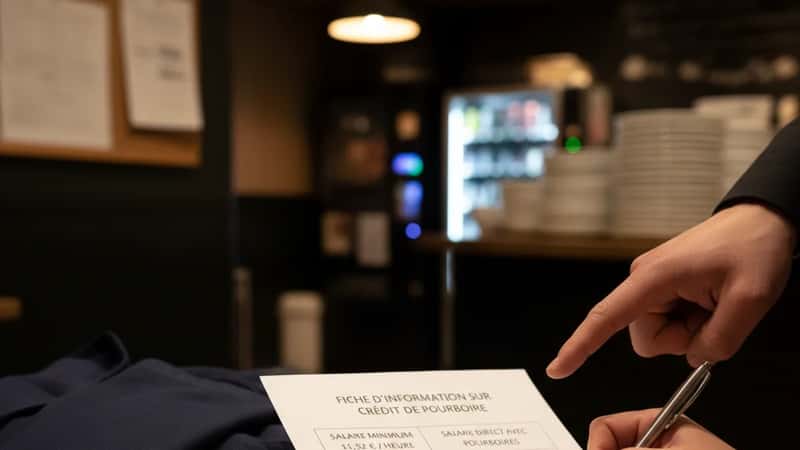
At the Orem location, Marcus's manager had failed to provide written tip credit notification to two servers hired in summer 2024. The server handbooks mentioned tip credit arrangements verbally during onboarding but did not include the formal written disclosure. Without proper notification, the FLSA tip credit is invalid — meaning those employees should have received the full $7.25/hr in direct wages, not $2.13/hr.
The wage gap: 2 employees × ($7.25 - $2.13) × approximately 30 hours/week × 72 weeks ≈ $22,118 in unpaid direct wages. With potential liquidated damages equal to the unpaid amount under FLSA § 216(b), the exposure reached approximately $44,236 — before any penalty.
À retenir: The tip credit is not automatic. Written disclosure to each tipped employee is a prerequisite under federal law, and the absence of documentation invalidates the entire credit arrangement retroactively.
Steps Marcus Took to Remediate and Prevent Recurrence
Step 1: Immediate Back-Pay Calculation
Working with the HR consultant and a Salt Lake City employment attorney, Marcus calculated the total tip credit gap for the two affected employees. He voluntarily paid the amount directly to each employee — $11,059 per person — before any formal complaint was filed. Under FLSA § 216(c), voluntary DOL-supervised back pay settlements can waive the liquidated damages component; a private attorney-mediated settlement does not guarantee the same protection, but the gesture of good-faith remediation significantly reduced litigation risk.
Step 2: Written Tip Credit Disclosure System
Marcus's attorney drafted a two-page Tip Credit Notice document that was added to every new hire packet at all three locations. The notice disclosed:
- The applicable tipped minimum wage ($2.13/hr in Utah, $11.79/hr in Colorado)
- The amount of tip credit claimed
- That the employee retains all tips, except when participating in a lawful tip pool
- The work weeks for which tip credit applies
All existing tipped employees at the Utah locations re-signed the form.
Step 3: Youth Wage Compliance Audit
The Salt Lake City location employed three high school students. Marcus audited their employment dates and confirmed all three had been hired within the current year and were still within the 90-day youth wage period [Utah Code § 34-40-102(3)]. One student was approaching her 91st day: her hourly rate was scheduled to increase from $6.16 to $7.25 on the correct date. The payroll system had not been set to trigger the automatic increase — a potential underpayment that was caught before it occurred.
Step 4: Multi-State Payroll System Configuration
The Denver location required a separate wage configuration:
- Base minimum: $14.81/hr
- Tipped minimum: $11.79/hr (Colorado's tip credit is capped at $3.02, lower than FLSA's maximum)
- No youth training wage available in Colorado at a reduced rate after the first 90 days (Colorado requires at least 95% of state minimum after the training period)
Marcus also learned that Colorado cities can enact local minimum wages above the state floor — Denver does not currently have a higher local rate, but this is a risk factor for any future Colorado expansion.
Utah's Minimum Wage Context: Why the Gap Matters
Utah's $7.25/hr minimum wage has not changed since Congress last raised the federal rate in 2009 — the longest pause without a federal increase in the history of the Fair Labor Standards Act. In real dollar terms, the purchasing power of $7.25 in 2026 is equivalent to roughly $5.25 in 2009 dollars [Bureau of Labor Statistics CPI data, 2025], meaning minimum wage workers in Utah have seen a significant real wage decline over 16 years.
Utah's preemption statute [Utah Code § 34-40-106] prevents Salt Lake City, Provo, Ogden, or any other Utah municipality from setting a higher local minimum wage — a restriction that distinguishes Utah from states like Colorado, where Denver and Boulder have retained limited flexibility. For Marcus's purposes, this simplification is a compliance advantage: one state wage, uniformly applied.
For broader context on how Utah's minimum wage fits the national landscape, the State Minimum Wage Laws comparison guide for 2026 shows Utah among the states still at the federal floor, while neighboring Colorado, Nevada, and Arizona have all indexed their rates to inflation.
The Utah Labor Law dossier covers how the minimum wage interacts with overtime, final paycheck timelines, and non-compete regulations in a unified employment compliance framework.
Lessons for Utah Restaurant and Service Employers
Marcus's experience distilled into four compliance practices now embedded across his three locations:
Tip credit disclosure is not optional — it is a condition of the credit's validity. Implement a signed written notice for every tipped employee before the first day of tipped work.
Youth wage transitions require payroll calendar entries — the 90-day window is a hard cutoff, not an approximate one. Set a calendar alert at 85 days to schedule the rate change before it lapses.
Multi-state expansion requires state-specific payroll configurations from Day 1 — assuming the home state's wage structure will work in the new state is the most common and most expensive payroll error in restaurant chains.
Self-audit before expansion — the Denver opening forced Marcus to find a Utah compliance issue before the DOL did. A proactive internal audit costs far less than a back-wage investigation.
À retenir: Utah's $7.25 minimum wage is low by national standards, but the rules governing how it applies to tipped workers, youth employees, and businesses expanding across state lines create compliance complexity that catches many employers off guard.
Avertissement: This case study is a composite illustration based on typical wage compliance scenarios in Utah. It does not constitute legal advice. Consult a licensed Utah employment attorney for guidance on your specific situation.
What Utah Workers Should Know in 2026
For employees earning at or near minimum wage in Utah, several rights exist regardless of the low baseline:
Overtime still applies: A minimum wage employee who works 50 hours in a week earns $7.25 × 40 + $7.25 × 1.5 × 10 = $398.75 for that week — the overtime premium cannot be waived.
The tip credit is one-directional: An employer cannot retain employee tips. Even with a valid tip credit arrangement, all tips earned belong to the employee. Pool arrangements are lawful only if all participants — including back-of-house staff — are included in a valid tip pool under the 2018 FLSA amendments, and the employer pays the full $7.25/hr direct wage (without claiming tip credit).
The youth wage applies only to new hires: A 16-year-old hired six months ago is not eligible for the $6.16 youth rate, even if still under 18. The 90-day window runs from the date of hire, not the employee's birthday.
Potential federal changes in 2025–2027: The Raise the Wage Act (introduced in Congress multiple times, most recently in 2023) would gradually raise the federal minimum to $17/hr by 2028. If enacted, the change would apply to Utah automatically — no state legislative action required. Employers who want to model future labor cost scenarios should track federal wage legislation as a proxy for Utah's floor.