
 Odette Caplan
When Maria opened Blue Earth Café in Rapid City in January 2015, she set her server wages at exactly the state minimum cash wage for tipped employees: $4.25 per hour. South Dakota had just passed Initiated Measure 18, raising the minimum wage from $7.25 to $8.50 — and indexing it to the Consumer Price Index forever after. Maria had read the ballot measure summary but did not fully absorb what "indexed to CPI" would mean across a decade of ownership.
By January 2026, the state minimum wage had reached $12.35 per hour. The tipped minimum wage — fixed at 50% of the standard rate by SDCL § 60-11-3.3 — was $6.18 per hour. Maria's 2015 server wage of $4.25 per hour was no longer compliant by a wide margin. Along the way, she had experienced three separate wage compliance issues: a tip credit miscalculation in 2019, a training wage error in 2022, and a payday timing problem when she opened a second location in 2024.
Her story is a case study in what South Dakota's deceptively simple minimum wage structure actually demands from employers over time.
Year One: The Annual Adjustment Mechanism and Its Operational Demands
The 2014 ballot measure that indexed South Dakota's minimum wage to the Consumer Price Index for Urban Wage Earners and Clerical Workers (CPI-W) was passed by 55% of South Dakota voters. Its core mechanism: each year, the South Dakota Department of Labor and Regulation (SDDOL) calculates the CPI-W change from the preceding August-to-August period and announces the new minimum wage by October or November. The new rate takes effect January 1.
For Blue Earth Café, this meant Maria had a November-December window each year to audit her wage rates and adjust pay before the new rate kicked in. In her first years, the adjustments were small — $0.05 to $0.20 per year. But after 2021, CPI acceleration pushed the changes to $0.40-$0.85 per year, and the stakes of missing a January 1 deadline grew proportionally.
The South Dakota minimum wage trajectory (selected years):
- 2015: $8.50 (after ballot measure)
- 2019: $9.10
- 2022: $9.95
- 2023: $10.80 (+$0.85 — largest single jump driven by pandemic-era inflation)
- 2024: $11.20
- 2025: $11.50
- 2026: $12.35 [SDDOL, announced October 2025]
The corresponding tipped employee minimum cash wages (50% of standard):
- 2026: $6.18 per hour (down from $4.25 in 2015 — an increase of $1.93 in tipped minimum over 11 years)
The lesson Maria did not anticipate: Indexing means an employer can never set a wage and forget it. Every January requires an active review.
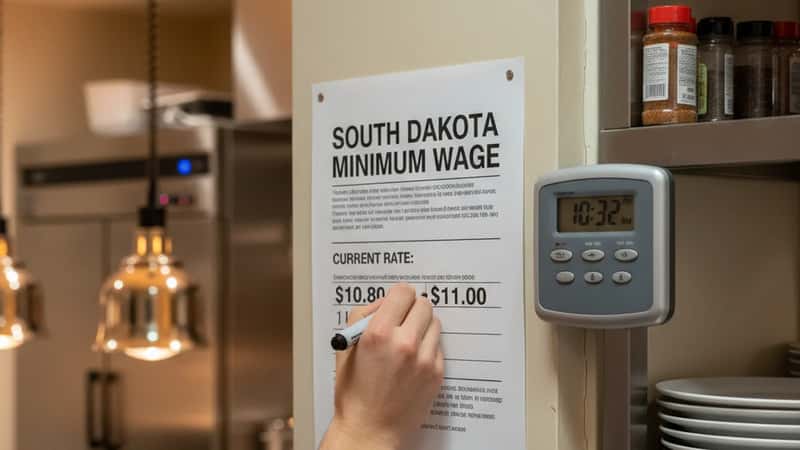
The Tip Credit Problem: Where Blue Earth Café Lost the Thread
In 2019, Maria hired a bookkeeper who had previously managed payroll for a restaurant group in Missouri. Missouri's tipped minimum wage at the time was $4.725 per hour — fixed by state statute. When the bookkeeper set up Blue Earth Café's payroll system, he configured the tipped base rate at the Missouri figure rather than the current South Dakota tipped minimum ($4.55 in 2019).
For 26 pay periods, Blue Earth Café's servers received base pay slightly below the South Dakota tipped minimum cash wage. The servers' total earnings — base plus tips — exceeded the full minimum wage in most cases, so no server had a practical complaint. The violation was technical but real: the employer's direct cash wage obligation under SDCL § 60-11-3.3 is independent of tips. The base cash wage floor must be met regardless of what tips supplement it.
When Maria's accountant discovered the error during a 2020 audit, she calculated approximately $1,100 in aggregate underpaid base wages across the affected pay periods. She corrected the payroll records, issued the difference with interest, and filed a voluntary self-disclosure with the SDDOL. The agency accepted the correction without further enforcement action. A voluntary disclosure before any worker complaint was filed was the right approach. South Dakota labor regulators consistently apply this principle: employers who self-correct promptly fare far better than those who delay until a formal complaint triggers investigation and enforcement proceedings.
Key takeaway: South Dakota's tipped cash wage is not a suggestion. It is a per-hour floor that applies regardless of tip levels. An employer who operates in multiple states must configure each location's payroll independently — never import another state's tipped wage into a South Dakota system.
Who the Minimum Wage Doesn't Cover: Exemptions South Dakota Employers Use
South Dakota's minimum wage law covers most employees working within the state — but several categories of workers may be paid below the standard minimum:
Youth training wage: Under the federal FLSA, employers may pay workers under 20 years of age a youth training wage of $4.25 per hour for the first 90 calendar days of employment. This federal provision applies in South Dakota, which has no conflicting state rule. After 90 days, or when the employee turns 20, the full minimum wage applies. Blue Earth Café's 2022 error: a 17-year-old hostess was paid the youth wage for 95 days rather than 90 — five days of underpayment. Correcting it cost Maria about $28.50 plus an internal payroll audit.
Outside salespersons: Employees who regularly travel to meet customers and whose primary duty is selling are not covered by the minimum wage law under the FLSA — and South Dakota has no conflicting state provision.
Certain agricultural workers: As covered in the overtime section of this dossier, agricultural workers on small farms may be exempt from FLSA minimum wage requirements under 29 U.S.C. § 213(a)(6). This exemption is significant in South Dakota's agricultural economy.
Federal employees: Workers employed directly by the federal government (Ellsworth Air Force Base civilian staff, employees of federally run institutions) are covered by federal civil service wage rules, not South Dakota's minimum wage statute.
Domestic service workers: Home care workers, live-in domestic employees, and babysitters may fall under modified minimum wage rules depending on the number of hours worked and whether they are employed by an agency or a private household.
For a comparative view of how neighboring states handle minimum wage exemptions, the North Dakota Labor Law dossier covers a state with similar rural agricultural exemption patterns. The 2026 State Minimum Wage Laws comparison places South Dakota's rate in national context.

Lessons from Blue Earth Café: A 2026 Compliance Checklist
Maria's decade of operation yielded a working checklist that any South Dakota employer can adapt. Running through it before January 1 each year prevents the categories of errors she experienced:
Annual rate update:
- Check SDDOL announcement (typically October-November at dlr.sd.gov) for the new standard minimum wage
- Update all hourly base rates for non-exempt employees to at least $12.35/hr (2026 rate) by January 1
- Update tipped employee base rates to at least $6.18/hr (2026 rate) — regardless of tip levels
- Confirm that the youth training wage ($4.25/hr) is being applied only within the first 90 days and only for employees under 20
Tip credit compliance:
- Verify that all tipped employees' actual base cash wages meet the state tipped minimum — tips supplement but do not replace this floor
- Confirm tip pool arrangements do not include managers or supervisors (prohibited under federal law)
- Document the tip credit notice required by FLSA: employers must inform tipped employees that they are taking the tip credit before doing so
Recordkeeping:
- Maintain accurate daily and weekly time records for all non-exempt employees
- Keep payroll records for at least 3 years (FLSA requirement)
- Record the wage rate, hours worked, and total earnings for each pay period in accessible format
Multi-location employers (Maria's 2024 lesson):
- Configure each location's payroll independently — do not copy settings from other states or prior years without verification
- Designate a compliance calendar reminder for October each year to monitor the SDDOL announcement
Maria estimates that each compliance error she made — the tipped wage miscalculation in 2019, the youth wage overshoot in 2022, and a payroll system import error in 2024 — cost between $800 and $3,000 in back pay, accounting corrections, and professional review time. The annual calendar reminder she now sets in October costs nothing. For a single-location employer, vigilance at the start of each year is the entire compliance cost.
Legal disclaimer: This article provides general information about South Dakota minimum wage requirements and does not constitute legal advice. Wage laws are subject to annual adjustment and regulatory change. Consult a licensed South Dakota employment attorney or contact the SDDOL Wage and Hour Division for guidance on your specific situation.