
 Daniel Sterling
On December 28, 2025, Rachel Souza received an email from her accountant. The subject line read: "Reminder: Maine minimum wage increases to $14.65 on January 1." Rachel had owned a small diner in Biddeford, Maine since 2019. She employed eight people — four tipped servers, two cooks, and two counter staff. The accountant's message gave her four days to update her payroll system, recalculate tip credits for her servers, and post the new legally required wage notice. Rachel had been through this before: Maine's minimum wage changes every January 1, automatically, tied to the Consumer Price Index for Urban Wage Earners and Clerical Workers (CPI-W) for the Northeast region [26 M.R.S. § 664(1)]. The increase was not a surprise. But for small employers like Rachel, the annual update is still a compliance event that carries real legal risk if missed.
How Maine's Minimum Wage Changes Every January 1
Maine's minimum wage has been inflation-indexed since the legislature amended 26 M.R.S. § 664 in 2017. Each year, the Maine Department of Labor calculates the adjustment using the August CPI-W for the Northeast and announces the new rate before October. The rate for 2026 is $14.65/hour [Maine DOL, January 2026].
Historical trajectory:
| Year | Maine minimum wage | Tipped base wage |
|---|---|---|
| 2023 | $13.80/hour | $6.90/hour |
| 2024 | $14.15/hour | $7.08/hour |
| 2025 | $14.65/hour | $7.33/hour |
| 2026 | $14.65/hour | $7.08/hour |
Note: Annual adjustments vary with CPI-W fluctuations. The 2026 rate reflects a lower CPI-W adjustment than prior years. Source: Maine DOL.
Rachel's diner is in Biddeford — not Portland. This matters: Portland has enacted a local ordinance setting a higher minimum wage than the state rate. Biddeford employers follow the state rate. Portland employers must pay whichever is higher — the state rate or the local rate.
The Tipped Employee Calculation: Where Rachel's Risk Lives
Rachel's servers are tipped employees. Maine allows a "tip credit" — employers may pay tipped workers $7.08/hour (half the standard rate) and apply their earned tips toward the full $14.65/hour minimum [26 M.R.S. § 664(1-A)]. But the obligation is weekly, not daily. In any workweek where a server's total compensation (base wage + tips) falls below $14.65/hour for the hours worked, Rachel must make up the difference in cash.
The math on a bad week:
Server A works 30 hours in a slow February week. Base wages: 30 × $7.08 = $212.40. Tips received: $180. Total: $392.40.
Required minimum: 30 hours × $14.65 = $439.50.
Shortfall: $439.50 - $392.40 = $47.10 — which Rachel must add to that paycheck.
If Rachel fails to identify and close this shortfall on the next regular payday, she owes the $47.10 in unpaid wages — plus a potential $47.10 in double damages, plus the filing fee risk of a Maine Bureau of Labor Standards complaint. A payroll system that automatically calculates weekly minimum reconciliation prevents this; a manual spreadsheet that tracks only hours and base pay will miss it.
For context on how Maine compares to other states on this calculation, see State Minimum Wage Laws in 2026.
Rachel's Four-Day Compliance Checklist
When Rachel got the December 28 email, she had four steps to complete before her staff returned on January 2:
Step 1 — Update payroll rates for all non-exempt employees. Any employee being paid between $13.80 and $14.64/hour needed an immediate increase to $14.65. Rachel had two counter staff at $14.00/hour — both required updates.
Step 2 — Verify tipped wage calculation formula. Rachel's payroll provider had the tipped base rate hardcoded. She verified it was updated to $7.08 and that her weekly reconciliation formula was still running.
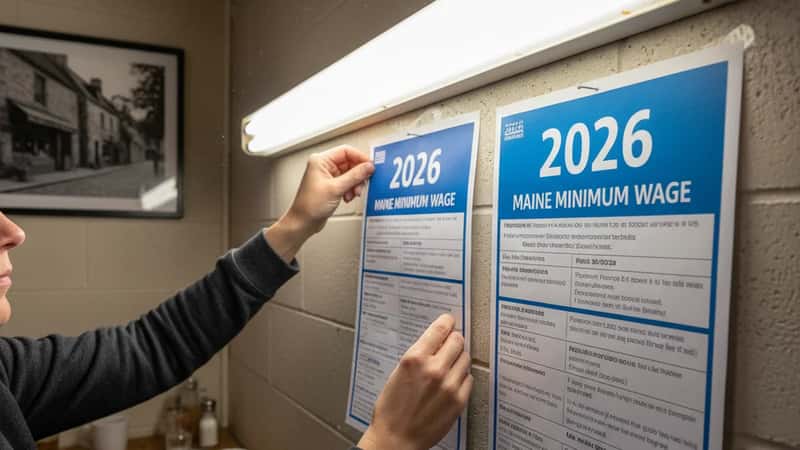
Step 3 — Download and post the new wage notice. The Maine DOL updates the required posted wage notice each January. The notice must be conspicuously posted at the worksite [Maine DOL, 2026 posting requirements]. Failure to post can result in a fine. Rachel printed the updated notice and replaced the 2025 version on the employee break room bulletin board.
Step 4 — Review youth worker pay. Maine allows a reduced training wage for workers aged 16-17 for their first 180 days of employment — currently $13.80/hour (90% of the standard minimum) [26 M.R.S. § 664(2)]. Rachel's 17-year-old dishwasher was 190 days into employment — past the training period — and needed to be bumped to $14.65.
Total compliance time: about 45 minutes. Total cost of non-compliance: potentially thousands of dollars in back wages, double damages, and civil penalties per affected employee.
What Happens When Employers Miss the January 1 Deadline
Three months after the January 1 update, the Maine Bureau of Labor Standards received a wage complaint against a Waterville, Maine retail store. The manager had updated most payroll rates but missed updating two part-time employees who had been hired at $14.00/hour the previous fall. By March, each employee had been underpaid by roughly $2.60/hour over 200+ cumulative hours.
The outcome: The BLS investigation found a combined underpayment of $600. Under Maine's double-damages rule [26 M.R.S. § 626-A], the employer faced $1,200 in back wages. An additional civil penalty of $500 per violation was assessed. The employer's total exposure from a $2.60/hour oversight: over $1,700, plus the time spent in the BLS investigation.
The employer's defense — that the payroll software update had been "in process" — carried no weight. Maine's minimum wage obligation is automatic on January 1. There is no grace period.
The lesson from this case: The annual minimum wage update is not a date for HR to "get to soon." It is a statutory deadline. Employees covered by the new rate on January 1 must receive the new rate in the first paycheck that includes any hours from January 1 forward.
Portland and South Portland: Local Minimum Wages Above the State Rate
Portland, Maine enacted its own local minimum wage ordinance, setting a rate of $15.00/hour effective January 1, 2026 [Portland City Council ordinance, 2025]. South Portland has a similar local ordinance. Employers physically located in Portland and South Portland must pay the higher local rate — not just the state minimum — for all hours worked within those city limits.
This creates a compliance complexity for businesses operating on the border. A Portland restaurant with employees who occasionally work a shift at a Biddeford catering event owes the local Portland rate for Portland-based work and the state minimum for work performed outside Portland. Multi-site employers must track the location of work performed, not just the employee's home store.
Outside Portland and South Portland, no other Maine municipality had a separate local minimum wage rate as of January 2026. The statewide rate of $14.65/hour applies everywhere else.
Exemptions and Special Situations
Not all Maine workers are covered by the $14.65 minimum. Key exemptions include:
Agricultural workers: Employees on farms with fewer than 500 employee-days of agricultural labor per quarter may be subject to different minimum wage standards. Large agricultural employers are generally covered by the state minimum.
Youth training wage: Workers aged 16-17 may be paid 90% of the minimum wage ($13.80/hour in 2026) for the first 180 calendar days of employment with a specific employer. After 180 days, the full minimum applies automatically.
Outside salespersons: Employees whose primary duty is making sales away from the employer's principal place of business, compensated primarily through commissions, may be subject to different standards.
Federal government employees: Workers employed directly by the federal government are covered by federal wage law, not Maine state minimums.
Employees: How to Check Whether You're Being Paid Correctly
Maine workers who want to verify their minimum wage compliance can:
- Calculate their effective hourly rate. Take total compensation (wages + tips if applicable) and divide by total hours worked in the workweek. The result must be at least $14.65.
- Check their pay stub. The hourly rate and total hours should appear on every stub. If the rate has not changed from 2025 to 2026, flag it.
- Contact the Maine BLS. File a complaint online at maine.gov/labor/bls or by phone. The BLS investigates without charge and can recover up to three years of underpayments.
For a complete view of Maine employment law protections, including overtime, paid leave, and final paycheck rules, see the Maine Labor Law dossier.
The information in this article is provided for general informational purposes only and does not constitute legal advice. Consult the Maine Department of Labor or a licensed Maine employment attorney for guidance specific to your situation.