
 Isabella Torres
The Unification That Ended a Decade of Nevada Minimum Wage Complexity
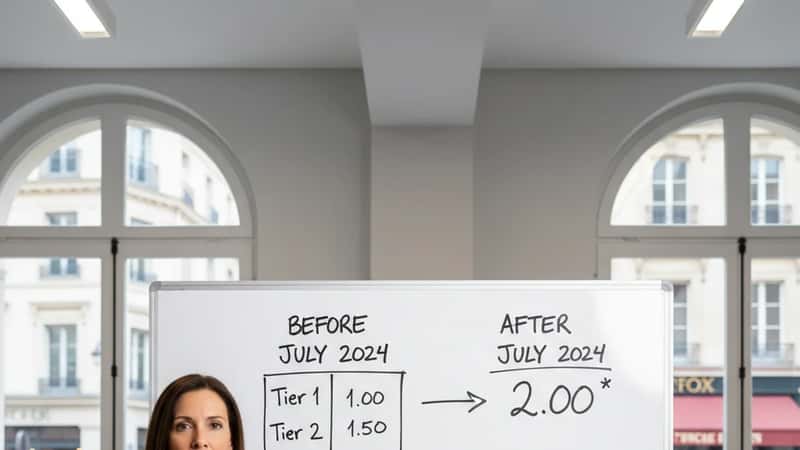
Maria Espinoza managed payroll for a mid-size Las Vegas hotel with 340 employees for twelve years. For most of that time, she maintained two separate minimum wage matrices in her payroll system: one rate for employees whose employer-sponsored health plan met Nevada's qualifying criteria, and a lower rate for everyone else. The math was perpetually complicated by benefit eligibility changes, employee opt-outs, and the annual July 1 rate updates under each tier.
On July 1, 2024, Nevada's two-tier minimum wage system ended — by design. Assembly Bill 456 (2019) had set the tiers on converging paths, and when they merged at $12.00/hour, Maria's payroll complexity dropped sharply. "It was almost anticlimactic," she says. "All those years of tracking two rates, and then one day it's just one number."
Her story captures the practical stakes of Nevada's most fundamental labor law: the minimum wage. This case study traces how Nevada arrived at its unified $12.00/hour rate, what it means for workers and employers in 2026, and what's next.
How Nevada Built Its Two-Tier System — and Why It Ended
Nevada's two-tier minimum wage was established by constitutional amendment in 2006. The framework set a higher rate for employees without qualifying employer health benefits and a lower rate for employees receiving a qualifying plan — creating an incentive structure designed to encourage employers to offer healthcare coverage in exchange for a lower wage floor.
The system created persistent compliance challenges. Employers had to verify benefit plan qualification annually, re-screen employees after open enrollment periods, and apply different wage rates to workers doing identical jobs based solely on their benefit enrollment status. Labor advocates argued the gap between tiers was too small to meaningfully incentivize healthcare coverage and created administrative complexity that mainly disadvantaged small employers.
Assembly Bill 456 (2019) set a glide path that would eliminate the tier differential by raising both rates until they converged. The convergence point: $12.00/hour, reached on July 1, 2024. As of 2026, Nevada maintains a single, unified minimum wage with no tier structure.
Nevada Minimum Wage 2026: What the Numbers Mean
Current rate: $12.00 per hour for all employees, all industries, all employer sizes. Nevada law does not exempt small businesses, new employers, or training periods.
No tip credit: Nevada prohibits employers from applying a tip credit against the minimum wage. Tipped employees in Nevada — casino dealers, hotel food-service workers, Reno restaurant servers — must receive $12.00/hour before any tips. This places Nevada tipped workers at a significant advantage over peers in states using the $2.13/hour federal tipped minimum.
No indexing mechanism: Nevada's $12.00 rate is a statutory flat rate established by the legislature. It does not automatically adjust for inflation, CPI increases, or any other index. Future increases require new legislation. By contrast, neighboring Arizona indexes its minimum wage to the CPI under Proposition 206 — a mechanism that produced Arizona's $14.70/hour rate by 2026.
Local preemption: Nevada law bars municipalities from setting a minimum wage above the state floor. Las Vegas, Henderson, Reno, and Carson City all must apply the state rate — there is no patchwork of local minimum wages as exists in California or New York.
Who the $12.00 Rate Affects Most in Nevada's Economy
Nevada's economy is heavily concentrated in leisure and hospitality — the sector employs approximately 30 percent of the state's private workforce, according to the Nevada Department of Employment, Training and Rehabilitation (DETR). The convergence of the minimum wage tiers, and the elimination of the tip-credit gap, had measurable effects on this sector.
Casino floor workers: Dealers, slot technicians, and cage cashiers saw a standardization of their wage floor. Workers at major gaming companies who previously received a benefit-qualifying health plan and thus received the lower tier are now subject to the same $12.00 floor as non-benefit recipients.
Hospitality back-of-house: Kitchen staff, housekeeping, and maintenance workers — many of whom were below the converged rate before 2024 — received automatic raises as the tiers merged. The Culinary Workers Union Local 226, which covers approximately 60,000 food and hotel workers in Las Vegas, negotiated wages well above the state minimum in its most recent contract cycle (2023 CBA), reflecting the $12.00 floor as a baseline, not a ceiling.
Small retail and service businesses: Independent restaurants, retail shops, and personal service businesses in Reno, Henderson, and Sparks adjusted staffing and scheduling in response to the unified rate. A survey by the Nevada Restaurant Association (2024) found that approximately 22 percent of surveyed operators reduced scheduled hours following the convergence, while 11 percent raised menu prices to absorb the labor cost increase.

What Happens When an Employer Pays Below $12.00/Hour
Paying below the Nevada minimum wage violates NRS § 608.250. Employees who are underpaid may file a complaint with the Nevada Labor Commissioner's Office, which can order back pay for up to 2 years of underpayments. For each pay period where the employer paid below the state minimum, the employee is owed the difference — plus applicable waiting-time penalties under NRS § 608.040 if the unpaid amount qualifies as withheld wages.
Private civil action under NRS § 608.140 is also available, with prevailing employees entitled to recover back wages, court costs, and attorney's fees. Minimum wage violations are among the most straightforward wage claims to prove: time records and pay stubs establish the gap directly.
Lessons from the Two-Tier Sunset: What Employers Learned
Maria Espinoza's payroll team drew three lessons from the 2024 convergence that Nevada HR professionals broadly share:
- Audit your payroll system before legislative effective dates, not after. The July 1 date was known for years, but many employers discovered mid-year that their payroll software had not been updated to reflect the single rate — generating retroactive liability for the benefit-tier gap.
- Train managers on the current rate annually. Supervisors who set hourly rates for new hires must know the current minimum. In Nevada, there is no "training wage" or youth wage — the $12.00 rate applies from the first hour of employment.
- Review offer letters that reference a wage tier. Offer letters drafted under the two-tier framework that referenced "lower-tier rate if health benefits are accepted" became legally problematic after the tiers converged. Updating offer letter templates to reference only the unified rate removed the ambiguity.
Legal notice: This article provides general legal information about Nevada minimum wage law and does not constitute legal advice. Specific minimum wage situations, including classification of workers and benefit-plan qualification, may involve complex legal and tax considerations. Consult a licensed Nevada employment attorney or tax professional for guidance on your situation.
The Legislative Outlook: Will Nevada's $12.00 Rate Rise Again?
Unlike the annual automatic adjustments in states with CPI indexing, Nevada's minimum wage future depends entirely on the Nevada Legislature. The legislature meets every two years in regular session (odd-numbered years); special sessions can convene in even-numbered years on the governor's call.
As of 2026, there is no enacted legislation to raise the Nevada minimum wage above $12.00. Labor advocates and union organizations — notably the Culinary Workers Union and SEIU — have signaled they will pursue legislative increases in the 2027 session, potentially seeking a phased increase to $15.00/hour. Employer groups have countered that Nevada's tourism and hospitality economy operates on tight margins during off-peak periods and that rapid minimum wage increases risk driving automation adoption in gaming and hotel operations.
Nevada's wage gap with California — whose $16.00/hour minimum already exceeds Nevada by $4.00/hour — is cited by proponents as evidence that Nevada workers are underpaid relative to regional productivity levels. Critics argue that Nevada's lower cost of living relative to major California markets makes a direct comparison misleading.
What employers should track: The 2027 Nevada Legislative Session (January–June 2027) is the next opportunity for a statutory minimum wage increase. Employers with large Nevada hourly workforces should model the cost impact of a phased increase to $14.00, $15.00, or $16.00/hour over 2–4 years as part of their labor budget planning. Assuming the $12.00 rate remains stable indefinitely is a planning risk, not a planning baseline.
Nevada Minimum Wage vs. Neighboring States: A 2026 Snapshot
Nevada employers operating near state borders face workforce mobility pressures when neighboring states' minimum wages diverge significantly:
| State | 2026 Minimum Wage | Tip Credit | Indexed to CPI? |
|---|---|---|---|
| Nevada | $12.00/hr | No | No |
| California | $16.00/hr | No | Yes |
| Utah | $7.25/hr (federal) | Yes | No |
| Idaho | $7.25/hr (federal) | Yes | No |
| Arizona | $14.70/hr | Yes | Yes |
Nevada's $12.00 rate sits above Utah and Idaho's federal floor but below California and Arizona. Workers in the Reno/Tahoe corridor — within commuting distance of California — face meaningful cross-border wage differentials, particularly in retail and logistics. For the full picture across all 50 states, the State Minimum Wage Laws in 2026 guide provides a comprehensive national comparison.