
 Daniel Sterling
Nevada is one of a minority of states that mandates both meal periods and paid rest breaks — and the rules are specific enough that employers in the state's dominant industries (hospitality, gaming, retail, warehousing) frequently get them wrong. This listicle breaks down 8 things every Nevada worker and employer must know about the state's meal and rest break requirements under Nevada Administrative Code § 608.130 and the Nevada Labor Commissioner's enforcement guidance.
1. Nevada Requires Both Meal Periods AND Rest Breaks — Not Just One
Many states that mandate breaks provide only one type — either a meal period or a paid rest break. Nevada requires both, independently. An employer who provides a 60-minute meal period but no 10-minute rest breaks is still in violation of state law. These are separate legal obligations that cannot substitute for each other.
2. The Meal Period Kicks In at 8 Hours, Not Less
A meal period (at least 30 consecutive, uninterrupted minutes) is required for any shift of 8 hours or more. Employees working a 7-hour shift are not entitled to a meal period under state law — though employer policy may provide one voluntarily.
The meal period must occur no later than the 5th hour of the shift. A worker who clocks in at 7:00 a.m. must have started their meal break by 12:00 p.m. at the latest.
3. Meal Periods May Be Unpaid — But Only If Truly Uninterrupted
Nevada law allows meal periods to be unpaid if the employee is completely relieved of all duties for the full 30 minutes. If the employee is required to remain on-call, stay at a workstation, or be available to respond to customer or operational needs during the break, the meal period is compensable time and must be paid.
Hotel front-desk workers who must monitor the phone during their "lunch break" are on-the-clock — legally — even if the employer calls it an unpaid break.
4. Employees CAN Waive the Meal Period — Under Narrow Conditions
The meal period can be waived by mutual written agreement between employer and employee only for shifts of 6 hours or fewer. An employee working exactly 6 hours can agree to skip the meal period. An employee working 8 hours cannot waive it, regardless of what any agreement says — the waiver is void for shifts at or above the meal-period trigger.
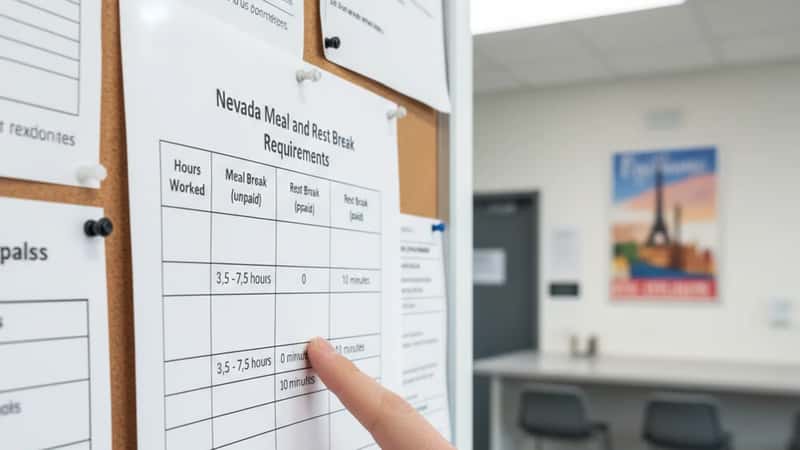
5. Rest Breaks Are 10 Minutes, Paid, Every 4 Hours
For every 4 hours worked (or major fraction thereof — meaning more than 2 hours), employees are entitled to a 10-minute paid rest break. The break schedule works as follows:
| Shift length | Rest breaks owed |
|---|---|
| Less than 3.5 hours | 0 |
| 3.5 to 7.5 hours | 1 break |
| 7.5 to 11.5 hours | 2 breaks |
| Over 11.5 hours | 3 breaks |
Rest breaks must be paid — they are considered hours worked for all compensation purposes, including overtime calculations.

6. Employers Cannot Substitute a Longer Meal Period for Rest Breaks
A common employer error: providing a 60-minute unpaid lunch and claiming this satisfies both the meal period and the rest break obligation. Nevada law treats these as separate requirements. A 60-minute meal period satisfies the meal-period mandate; it does not credit against owed rest breaks. A worker on an 8-hour shift is entitled to a 30-minute meal period and two 10-minute rest breaks — separately.
7. Missed Rest Breaks Must Be Paid as Compensable Time
If an employer requires an employee to work through a scheduled rest break — or the operational demands of a shift prevent a break from being taken — that 10-minute break period is compensable work time. The employer must pay for it and cannot retroactively dock the time from the employee's record.
This is meaningfully different from federal law: the FLSA requires that rest breaks of 20 minutes or less be paid, but does not independently mandate that breaks be provided. Nevada mandates both the provision and the pay.
À retenir: A Nevada employer who regularly skips the 10-minute rest breaks for a team of 20 hourly workers may owe those workers 20 minutes of compensable time per employee per day — compounding into a significant liability over any 2-year period within the statute of limitations. For comparable frameworks in adjacent states, see New Jersey and Maryland break law guides.
8. The Nevada Labor Commissioner Enforces Break Violations as Wage Violations
Meal and rest break violations are treated as wage violations under Nevada law. An employee denied a required paid rest break has been denied 10 minutes of compensable time — a wage claim. The Nevada Labor Commissioner's Office at labor.nv.gov accepts complaints about missed breaks, investigates, and may order back pay plus waiting-time penalties under NRS § 608.040.
The statute of limitations is 2 years for break violations, the same as for unpaid wage claims. Employees who have been denied required breaks systematically should document the pattern (shift records, paystubs, communications directing them to skip breaks) before filing.
Legal notice: This article provides general legal information about Nevada meal and rest break law and does not constitute legal advice. Consult a licensed Nevada employment attorney for guidance specific to your employment situation.
Who Is Not Covered: Key Exemptions to Nevada Break Law
Nevada's break requirements, like other wage-and-hour provisions, do not apply to all workers universally. Important carve-outs include:
Agricultural workers: Employees primarily engaged in farming, crop production, or livestock care on agricultural operations are generally exempt from the meal-and-rest-break mandates under NAC § 608.130's scope provisions, consistent with how agricultural labor is treated across Nevada wage-and-hour law.
Employees covered by collective bargaining agreements: Workers whose employment is governed by a bona fide CBA that expressly addresses meal and rest breaks may be subject to the CBA's negotiated break schedule in lieu of state defaults. The CBA must explicitly cover breaks — silence does not waive the state standard. The Culinary Workers Union Local 226 agreements covering Las Vegas casino workers, for example, contain specific meal period schedules that comply with and sometimes exceed state minimums.
Employees earning above applicable thresholds and classified as exempt: Salaried exempt employees — those meeting the executive, administrative, or professional duties tests under both state and federal law — are not entitled to mandatory breaks under Nevada's wage-and-hour provisions. But misclassification risk is real: an employer who designates a non-qualifying employee as "exempt" faces both overtime exposure and unpaid break liability.
Practical Compliance Checklist for Nevada Employers
HR teams managing Nevada hourly workers should verify the following on a per-shift basis:
- Shift ≥ 8 hours: Has a 30-minute uninterrupted meal period been provided before the 5th hour? Is it unpaid (and the employee is truly relieved of duties) or paid?
- Shift 3.5–7.5 hours: Has 1 paid 10-minute rest break been scheduled and confirmed as taken?
- Shift 7.5–11.5 hours: Have 2 paid 10-minute rest breaks been scheduled?
- Shift > 11.5 hours: Are 3 paid rest breaks scheduled, plus a meal period?
- Any waiver in place? If yes — is the shift 6 hours or fewer? Is the waiver in writing and signed by the employee?
- Time records: Do timekeeping records separately identify breaks taken (or document missed breaks and any resulting pay adjustments)?
A simple break-tracking field added to timekeeping software — requiring shift supervisors to confirm breaks were provided and taken — creates a contemporaneous record that is highly valuable in any Labor Commissioner investigation.