 Emily Wang
On September 3, 2025, Maria Nakamura sat down at the back office of Kailua Grill — the 40-seat restaurant she and her husband have run on Oahu's windward coast for eleven years — and pulled up her payroll software. January 1, 2026 was four months away. That meant Hawaii's minimum wage was about to jump from $14 to $16 per hour under Act 114 (Session Laws of Hawaii 2022). Of her twelve hourly employees, nine were still earning between $14.00 and $15.75. The increase would affect every one of them. Maria's challenge — and the challenge facing thousands of small employers across Hawaii — was not whether to comply, but how to do it accurately, affordably, and in time. This case study walks through the steps she took and the lessons her experience offers for any Hawaii employer managing the 2026 minimum wage increase.
The Problem: Hawaii's Wage Schedule and Who Gets Affected in 2026
Act 114 (SLH 2022) established a phased minimum wage schedule that will take Hawaii to $18 per hour by 2028. The 2026 increase is the largest single step in the schedule — a $2/hr jump from the $14 rate that took effect on January 1, 2024.
| Effective Date | Minimum Wage | Tipped Employee Minimum | Tip Credit |
|---|---|---|---|
| October 1, 2022 | $12.00/hr | $11.25/hr | $0.75/hr |
| January 1, 2024 | $14.00/hr | $13.25/hr | $0.75/hr |
| January 1, 2026 | $16.00/hr | $15.25/hr | $0.75/hr |
| January 1, 2028 | $18.00/hr | $17.25/hr | $0.75/hr |
Source: Act 114, SLH 2022; Hawaii DLIR Wage Standards Division
Hawaii's tip credit — $0.75/hr — is the smallest of any state that allows one. It means tipped employees must be paid at least $15.25/hr in 2026, with actual tips making up the gap to $16/hr. If tips on any shift fall short, the employer must pay the difference that pay period.
For perspective on how Hawaii compares nationally, see the State Minimum Wage Laws 2026 comparison. Hawaii's $16/hr rate places it in the highest tier nationally in 2026, alongside California's $16.50/hr for employers with 26+ employees.
Step 1: Auditing Which Employees Get a Raise
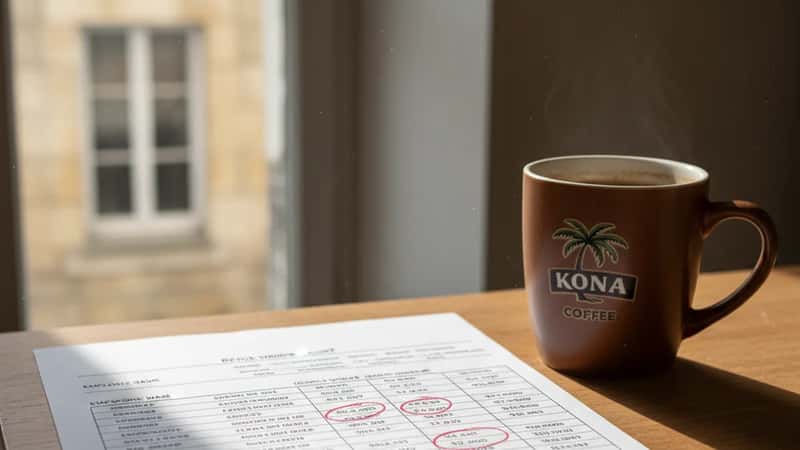
Maria's first step was a wage audit — listing every employee's current hourly rate and identifying who fell below the new $16/hr floor.
Kailua Grill wage audit, September 2025:
| Employee Group | # Workers | Current Rate | Jan 2026 Rate | Weekly Hours | Weekly Cost Increase |
|---|---|---|---|---|---|
| Servers (tipped, using tip credit) | 4 | $13.25/hr | $15.25/hr | 32 avg | +$256/week |
| Full-time cooks | 2 | $17.50/hr | $17.50/hr | 40 | $0 |
| Dishwashers (non-tipped) | 2 | $14.00/hr | $16.00/hr | 35 avg | +$140/week |
| Part-time prep cooks | 3 | $14.50/hr | $16.00/hr | 20 avg | +$90/week |
| Restaurant manager (exempt, salaried) | 1 | $54,000/yr | $54,000/yr | — | $0 |
Total projected weekly labor cost increase: approximately $486/week ($25,272/year)
For a restaurant generating approximately $800,000 in annual revenue, this represents a 3.2% increase in labor costs — significant but manageable with proactive planning. Maria's approach involved a modest menu price increase (average 4% across appetizers and entrées) implemented in October 2025, three months before the wage increase took effect.
What about employees already above $16/hr? Maria's two cooks at $17.50/hr were unaffected by the statutory minimum. However, she reviewed whether their wage premium above minimum wage had narrowed enough to affect morale or create retention risk — a common secondary effect of minimum wage increases that compresses pay bands between entry-level and experienced workers.
Step 2: Updating the Tip Credit Calculation
Four of Kailua Grill's servers were paid at the tipped minimum wage of $13.25/hr (using the $0.75/hr tip credit). With the 2026 increase:
- New tipped minimum wage: $15.25/hr (minimum wage $16 − tip credit $0.75)
- Servers must earn at least $16.00/hr total (base + tips) on every shift
- If a server works a slow Monday lunch and earns only $3.00/hr in tips, the base wage of $15.25/hr + $3.00/hr tips = $18.25/hr — no makeup needed
- If a slow shift yields only $0.50/hr in tips, the employer must bring total compensation to $16.00/hr that pay period: $15.25 + $0.75 makeup = $16.00
Maria updated her point-of-sale system's tip reporting module to flag any shifts where a server's average tips fell below $0.75/hr, triggering an automatic makeup payment. This automated flag prevents the most common tipped-minimum violation: failing to catch and correct below-minimum shifts.
"The restaurant owners who get wage claims filed against them aren't the ones who deliberately underpay. They're the ones whose tip tracking systems haven't been audited since the last minimum wage increase. Set up the flag before January 1, not after." — Hawaii Restaurant Association, 2025 compliance newsletter.
Step 3: Recalculating Overtime Thresholds
The minimum wage increase also changed Kailua Grill's overtime liability. Under HRS § 387-3, overtime is owed at 1.5× the regular rate for hours over 40/week. With a $16/hr minimum wage floor:
- 2024 overtime floor (non-tipped workers): $14.00 × 1.5 = $21.00/hr
- 2026 overtime floor (non-tipped workers): $16.00 × 1.5 = $24.00/hr
- 2026 overtime floor (tipped workers paid at $15.25 base): $15.25 × 1.5 = $22.88/hr minimum (actual rate depends on total compensation including tips)
Maria's dishwashers — who had been working 35 hours per week — occasionally picked up extra shifts during peak periods. Under the $14/hr rate, an extra 5-hour Saturday shift triggered $105 in overtime ($14 × 1.5 × 5). Under $16/hr, the same shift costs $120. The difference ($15) seems minor, but across two dishwashers and an average of 12 overtime-triggering peak weekends per year, it adds $360 to annual payroll — a small but real additional cost that Maria built into her labor budget for 2026.
Step 4: Updating Payroll Systems and Required Compliance Postings
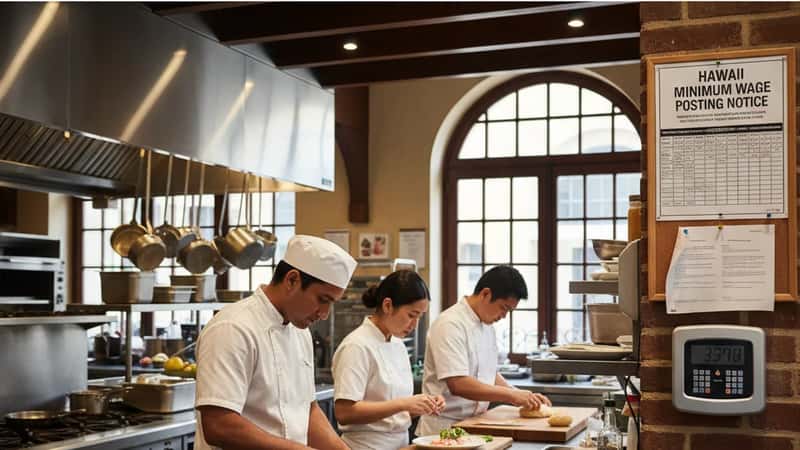
By November 1, 2025 — two months before the effective date — Maria completed four compliance steps:
- Updated payroll software rates for all affected employees, with the January 1, 2026 effective date programmed into the system
- Ordered updated DLIR minimum wage posters — available free at labor.hawaii.gov — and scheduled them for posting on January 1
- Reviewed employment contracts for any clauses referencing a specific wage rate (rare in hourly food service, but present in some manager agreements)
- Communicated the increase to employees in writing, noting the new rates and effective date — a best practice that prevents confusion on the first January paycheck
The Result: What Compliance Looks Like for a Small Hawaii Employer
Kailua Grill successfully implemented the January 2026 minimum wage increase with no DLIR complaints, no employee confusion, and labor costs that were within 0.2% of Maria's projected budget. Her advance planning — audit in September, menu pricing in October, system updates in November, poster updates December 31 — compressed the work into manageable steps across a four-month runway.
Five lessons from Kailua Grill's 2026 compliance:
- Start the audit 4 months before the effective date — identify exactly who is affected and model the cost
- Automate tip makeup checks if you have tipped employees — don't rely on manual review
- Recalculate overtime costs as part of the minimum wage review — every wage floor increase also raises the overtime cost floor
- Update required DLIR postings the day the new rate takes effect — posting non-compliance is a separate violation
- Plan for the 2028 increase now — $18/hr is scheduled for January 1, 2028; build it into multi-year labor budgets today
The $18/hr rate in 2028 will represent a $4/hr increase over the current $14/hr rate in effect when most Hawaii hourly workers were hired. For industries with thin margins — restaurants, retail, small hotels — that increase requires a structural rethink of labor costs that a 4-month planning runway will not be enough to address.
Looking Ahead: What Hawaii Employers Should Plan for in 2028
The $18/hr rate takes effect January 1, 2028. For a business like Kailua Grill, the step from $16 to $18/hr adds another $2/hr to the base rate — an estimated $25,000+ additional annual payroll cost based on the same staff composition. Unlike the 2026 increase, which could be absorbed partly through menu price adjustments in a strong tourism recovery year, the 2028 increase will arrive amid a potentially different economic environment. Maria is already modeling two scenarios: a 5% menu price increase in 2027 and a shift toward larger tips through service model adjustments. HR managers and small business owners across Hawaii who are making capital decisions — whether to expand staff, invest in equipment, or adjust service models — should build the 2028 wage floor into their multi-year financial plans now, not in November 2027.
Disclaimer: This article describes a composite case study for illustrative purposes and does not constitute legal or financial advice. Hawaii minimum wage law is subject to legislative change. Consult the Hawaii DLIR or a qualified Hawaii employment attorney and accountant for compliance guidance specific to your business.