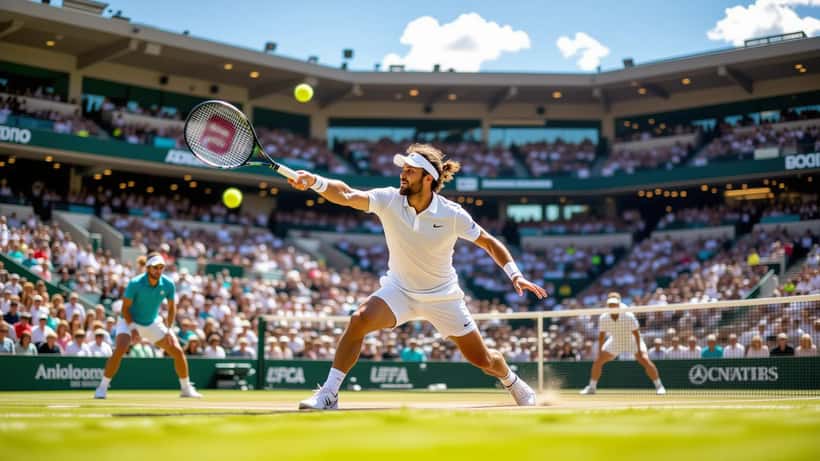
Davidovich Fokina’s 2026 Grass-Court Comeback: What Tennis Pros Can Teach Us About Resilience
The 2026 grass-court season has brought Alejandro Davidovich Fokina back into the spotlight. After a winter disrupted by injury and a spring of stop-start results on clay and hard courts, the Spanish baseliner arrived at the grass swing with something to prove. His confirmation for the Mallorca Championships, one of the key warm-up events before Wimbledon, was enough to push his name back up the UK search trends.
For fans, Davidovich Fokina is entertainment: unpredictable shot-making, speed and a willingness to chase down balls that look impossible. For coaches, physiotherapists and sports psychologists, his 2026 season is a case study in how modern players manage physical setbacks while staying mentally competitive.
The road back in 2026
Davidovich Fokina’s year did not begin smoothly. At the Australian Open in January he was forced to retire during his third-round match against Tommy Paul because of a left hamstring and thigh problem. For a player whose game relies on lateral movement and defensive scrambling, any lower-limb issue is more than inconvenient — it threatens the core of his identity on court.
Rather than rushing back, his team built a phased return. He skipped select events, focused on strengthening work and gradually increased match load. By late spring he had posted credible results on clay, including a run at the Mutua Madrid Open where his all-court creativity was on full display. Now, as the tour switches to grass, he describes the surface as an opportunity rather than a threat.
His willingness to adapt is one reason specialists find him interesting. Grass rewards aggression, shorter rallies and quick reactions. Davidovich Fokina’s improved serve and willingness to finish points at the net show that he has spent his downtime adding weapons, not just repairing damage.
Why resilience matters more than rankings
In professional tennis, the difference between a top-20 player and a top-50 player is often not talent. It is the ability to absorb losses, injuries and scheduling chaos without losing belief. Davidovich Fokina has spent much of his career knocking on the door of a first ATP title. That kind of prolonged near-miss can create psychological fatigue if it is not managed.
Sports psychologists working with individual athletes emphasise two skills:
- Process orientation. Focus on controllable variables — preparation, sleep, recovery, tactical execution — rather than outcomes.
- Injury reframing. Time away from competition can be framed as a chance to rebuild technique and address weaknesses that are hidden during a packed calendar.
Davidovich Fokina’s 2026 grass season appears to be built on both principles. He is not pretending the injury never happened; he is using the comeback as a platform to evolve.
Physical lessons from a tennis comeback
Hamstring and thigh injuries are common in tennis because the sport demands repeated bursts of acceleration and deceleration on hard surfaces. A typical rehabilitation plan includes:
- Acute load management — reducing sprint volume and court time while inflammation settles.
- Eccentric strength work — lengthening the muscle under tension to build resilience.
- Movement re-education — retraining the player to push off without compensating through the hip or knee.
- Graduated return to match play — starting with best-of-three sets at lower-stakes events before re-entering the Grand Slam calendar.
Skipping any of these stages increases the risk of recurrence. Davidovich Fokina’s decision to miss part of the early hard-court season suggests his medical team prioritised long-term durability over short-term ranking points.
The grass-court opportunity
Grass is the shortest season on the ATP Tour, which makes it unforgiving but also full of opportunity. Players who arrive fit and confident can pick up valuable points in just a few weeks. The Mallorca Championships, where Davidovich Fokina is scheduled to compete in 2026, offer a rare chance to gain match rhythm on grass in a relaxed setting before the intensity of Wimbledon.
His game is well suited to the surface when he is healthy. His low centre of gravity, quick hands and ability to change direction make him dangerous on returns, while his improved net skills give him options when rallies shorten.
What this means for amateur players and coaches
The public fascination with Davidovich Fokina’s comeback is not just about celebrity. It highlights questions that millions of recreational players face every year:
- How do you return to sport after a muscle injury without re-injuring yourself?
- When should you push through discomfort and when should you stop?
- How do you stay motivated when results take longer than expected?
Consulting a qualified physiotherapist, sports physician or performance coach is the safest way to answer those questions for your own body. Generic online drills are useful, but an individual assessment makes the difference between recovery and relapse.
Related on Expert Zoom
- Alex de Minaur's 2026 Wimbledon Run: What the Data Shows
- Harriet Dart's Queen's Club Debut: What 2 Hours 48 Minutes Means for Match Fitness
- Iva Jovic at 18: What Her Queen's Club Run Tells Us About Young-Athlete Health
- Amanda Anisimova's Wrist Comeback at Roland Garros
- Alexandra Eala's Wimbledon Charge: The Physical Price of the Grass Season
Looking ahead
If Davidovich Fokina can stay healthy through the grass swing, 2026 could still become the year he finally lifts his first ATP trophy. More importantly, his season is a reminder that comebacks are not linear. They require patience, expert support and a willingness to adapt your game rather than simply replay old habits.
For anyone navigating their own return to sport after injury, the lesson is practical: build the body first, trust the process second, and let the results follow.
