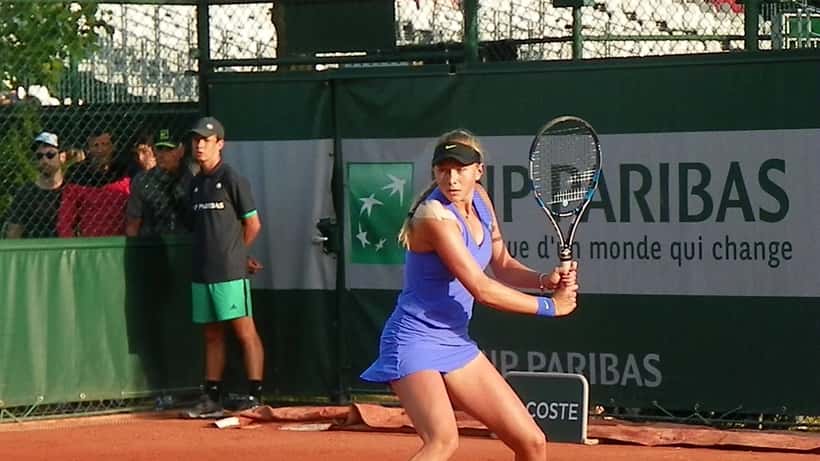
 Grace Davies
Amanda Anisimova won her Roland Garros 2026 first-round match 6-4, 6-1 against French wildcard Tiantsoa Sarah Rakotomanga Rajaonah on 25 May — her first competitive match since withdrawing from the Italian Open with a left-wrist injury in early May. The 24-year-old world No. 6, who had also pulled out of Madrid and last played at the Miami Open in late March, told Olympics.com she was "grateful" to stage the comeback on the Paris clay where her career first broke out in 2017.
For hand and wrist specialists, the more interesting story is which wrist she injured — and why a left-wrist problem in a right-handed two-handed backhand player carries a longer recovery curve than the casual viewer realises.
What actually happened in May 2026
According to the official Roland Garros report and Olympics.com, Anisimova withdrew from the Italian Open citing a left wrist injury. She did not specify the precise diagnosis publicly, which is standard practice on the WTA Tour, but the timing — eight weeks between Miami and Paris — and the visible strapping during her Saturday 23 May practice session at Roland Garros are consistent with a soft-tissue rather than a fracture injury.
Anisimova faces Austria's Julia Grabher in the second round on Wednesday 28 May. She has played down expectations publicly, framing the tournament as a return-to-competition rather than a results push. That framing matches how hand therapists describe a textbook return from ulnar-sided wrist pain — and is itself a clinical signal.
Why the left wrist matters in a right-handed player
Anisimova is right-handed and uses a classical two-handed backhand. In that stroke, the left wrist is the lead hand — the one that ulnar-deviates aggressively through contact and that absorbs the most rotational load on heavy topspin shots on clay.
The cluster of injuries that the left wrist of a two-handed backhand player tends to develop is well documented in sports medicine:
- TFCC injury — the triangular fibrocartilage complex sits on the ulnar (little-finger) side of the wrist and is loaded heavily by ulnar deviation under torque
- ECU tendinopathy — the extensor carpi ulnaris tendon and its sheath, which can subluxate over the ulnar styloid in some grips
- DRUJ instability — distal radioulnar joint laxity, which makes pronation/supination painful
- Ulnar impaction — when a long ulna grinds against the lunate bone on repeated heavy backhands
The NHS wrist pain guidance is calibrated for general population presentations. Elite tennis sits in a niche the general guidance does not really cover — and the rehabilitation timeline is longer than most fans expect.
The four phases of a tennis wrist comeback
For hand therapists watching Anisimova's return on Court Philippe-Chatrier, the recovery has four broadly recognised phases. Players, parents and amateur tennis players running into similar problems benefit from understanding them.
Phase 1: Protection (weeks 0-4). Diagnostic imaging confirms whether the injury is tendinous, ligamentous, articular or bony. The wrist is immobilised in a position that off-loads the affected tissue — typically slight extension and ulnar offset for TFCC injuries. No racquet contact.
Phase 2: Restoration (weeks 4-8). Range-of-motion work, grip strength rebuilding, proprioceptive drills with a foam roll under the wrist. Light shadow swings, no ball contact yet. The therapy floor is where the real work happens — and where many comebacks are extended because the player rushes this phase.
Phase 3: Reintroduction (weeks 8-12). Mini-tennis from the service line, then half-court rallies, then full-court rallies with reduced spin. The biggest risk in this phase is overconfidence — the wrist often feels normal at rest but is still vulnerable under match-pace torque.
Phase 4: Return to competition (weeks 12-16+). Match-pace practice, then lower-tier competition, then return to tour level. Anisimova's eight-week gap between Miami and Paris sits at the short end of this curve, which is one of the reasons her staff have framed Roland Garros as a "return" rather than a target. The same staged playbook is visible across other 2026 comebacks — including the elbow surgery comeback we covered around Caty McNally at the Miami Open.
The three things hand specialists watch in the first three matches back
Beyond the protocol, there are three specific signals therapists track once a player is back in competition:
1. Backhand drive rate. Comeback players typically reduce backhand drive winners and lean on the slice in the first three matches. A spike back to pre-injury drive rates inside two matches is a flag, not a positive sign.
2. Inter-point grip changes. Players unconsciously adjust their grip between points to off-load the affected tissue. Video analysis between sets is one of the most informative tools the team has at this stage.
3. Serve velocity asymmetry on the deuce side. A left-wrist injury in a right-hander affects the ball toss arm and the follow-through balance. Subtle drops in deuce-court serve velocity show up before the player will report any discomfort.
Why amateur players get this wrong
Recreational tennis players returning from a wrist injury tend to compress the four phases into two or three and skip the boring restoration phase. The result is the most common pattern in club tennis: a partial return, six weeks of "feeling fine", then a re-injury that sets the recovery clock back to week one.
The same pattern shows up across women's tennis comebacks more broadly — we covered the broader arm-shoulder picture around McCartney Kessler's Miami Open return earlier this spring. Different joint, same compressed-timeline mistake.
For UK club and county-level players, the practical advice is short:
- Get the diagnosis before you self-rehab. A TFCC tear and an ECU tendinopathy look identical to the patient but have completely different rehabilitation protocols.
- Find a hand therapist, not just a physio. Hand therapy is a specialism within physiotherapy — accredited members of the British Association of Hand Therapists (BAHT) have the relevant training.
- Plan for 12 weeks, not 4. Even a "minor" wrist sprain in a regular tennis player benefits from a 12-week protected return curve rather than the 3-4 weeks most amateurs allow.
What to watch on Wednesday
Anisimova's match against Grabher will be the first real torque test of the left wrist on clay — Grabher's heavy topspin off both wings is exactly the kind of ball that forces a two-handed backhand into hard ulnar deviation. The interesting metric will be the slice rate on her backhand side and the serve velocity in the second set.
Whatever the result, the comeback itself is the more important data point. Anisimova has returned ahead of the typical 12-week curve, and Roland Garros is the highest possible test bed. If the wrist holds through the first three matches, the rest of the season looks open.
ExpertZoom connects UK players, parents and club-level athletes with vetted hand therapists, sports medicine doctors and physiotherapists who specialise in wrist and forearm rehabilitation — the people who actually make a return like Anisimova's happen behind the cameras.
