 Amelia Ward
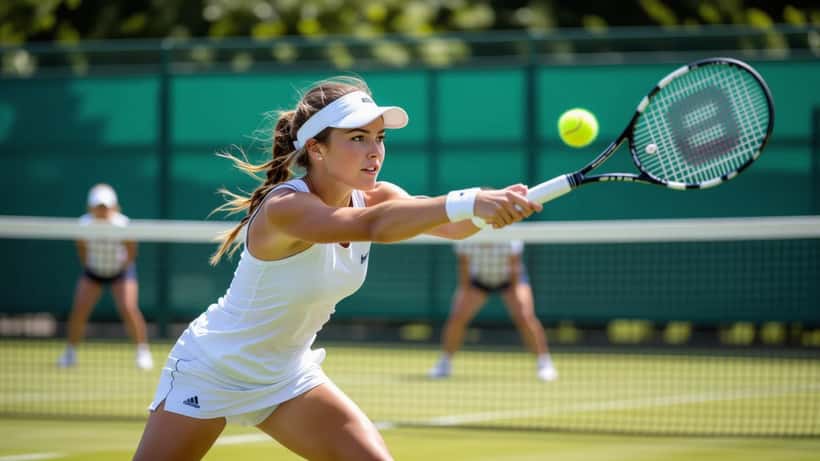
Iva Jovic turned 18 less than a year ago. On 12 June 2026, she walked off the Andy Murray Arena at Queen's Club having dismantled Alexandra Eala 6-2, 6-2 in just 77 minutes — extending her career grass court record to an exceptional 10-1. The American, seeded sixth at the HSBC Championships, will now face Amanda Anisimova in the quarterfinals. The tennis is dazzling. The question a sports medicine professional might ask is far simpler: how is an 18-year-old body actually handling all of this?
Grass Courts Are Not Gentle on Young Joints
Grass may look forgiving, but it is one of the most physically demanding surfaces in professional tennis, particularly for younger players. The ball stays low and fast, forcing competitors to compress their bodies into wide, bent-knee stances throughout a match. The footwork required — sharp lateral cuts, rapid direction changes, and abrupt stops on a surface with less grip than hard courts or clay — places significant stress on ankles, knees, and hips with every rally.
Unlike clay, which absorbs impact and allows players to slide gradually into shots, grass demands precise, instantaneous footwork. A misstep on a slightly damp patch or an unexpected bounce can produce the kind of ankle or knee injury that takes weeks to resolve, even with the best medical support available at tour level.
Jovic won her first WTA Tour title at the WTA 500 in Guadalajara in January 2025, at age 17. She followed that by capturing the Lexus Ilkley Open WTA 125 title — a grass court event — before coming through Wimbledon qualifying to reach the main draw of the most prestigious tournament in the world. That is a substantial programme of competitive matches across completely different surfaces in a compressed calendar, all completed before turning 18.
The Clay-to-Grass Transition and Its Toll
Grass court season follows directly from the clay court season. Roland Garros, played on slow, high-bounce clay, concludes in early June. Wimbledon, on fast, low-bounce grass, begins barely three weeks later. Even seasoned professionals describe the surface transition as one of the most physically and technically demanding adjustments on the annual tour calendar.
For an 18-year-old whose musculoskeletal system is still maturing, the additional demands of this transition deserve attention. Bones, tendons, and ligaments continue developing throughout the teenage years and into the early twenties. Growth plates — areas of cartilage near the ends of long bones — remain vulnerable to stress injury in young athletes engaged in high-level sport, even when there are no obvious symptoms.
According to the NHS guidance on sports injuries, injuries in young people can be more complex to diagnose and treat than adult injuries precisely because of this developing physiology. What presents as a minor tendon strain in an adult athlete can involve cartilage or growth plate damage in a teenager if not properly assessed and managed from the outset.
The Signs That Warrant Professional Assessment
None of this diminishes what Jovic is achieving at Queen's Club in 2026. A 10-1 grass court record at professional tour level, aged 18, is extraordinary. Elite academies employ teams of physiotherapists, strength and conditioning coaches, and sports medicine specialists precisely to manage the demands placed on young talent at this level. The structures are in place at the top of the sport.
But for any young athlete — or the parents of a teenage player watching Jovic's run with admiration — her success raises a useful and practical question: when does sports pain cross the line from normal to something that needs professional attention?
Muscle soreness in the 24 to 48 hours after intense exercise is entirely normal and expected. The following, however, are signs that should prompt medical evaluation rather than rest and self-management:
- Persistent joint pain that does not improve within 48 to 72 hours of rest
- Sharp pain during movement, particularly in the knee, ankle, or hip
- Swelling around a joint after activity
- Pain that disrupts sleep or is present at rest
- Any pain in the area of a growth plate in a young person still in their teens
During high-intensity competition periods like grass court season — where professional players can compete every two or three days — these signals can easily be rationalised away as the cost of playing. A sports medicine specialist or physiotherapist can assess whether rest is sufficient or whether intervention is needed to prevent a short-term problem from becoming a long-term injury.
Playing the Long Game
Jovic's 25-12 win-loss record across all surfaces in 2026 suggests a well-managed schedule. Reaching the quarterfinals of a WTA 500 event on grass without a major fitness setback at 18 is a strong indicator of good physical management. But tennis history offers cautionary examples of gifted young players who encountered significant injury setbacks in their early twenties — setbacks that interrupted careers built on similarly promising foundations.
Sports medicine consultants increasingly emphasise that peak performance and long-term health are not competing objectives. Load management, structured recovery, and early professional intervention when pain signals appear are not signs of caution — they are the foundations of a sustainable career. A physiotherapist or sports medicine practitioner can identify biomechanical patterns that increase injury risk, design training loads appropriate to a developing body, and build a programme that protects an athlete's longevity without limiting competitive performance.
Consult a Sports Health Expert
If you or a young athlete you support experiences recurring pain during or after tennis — particularly in the knees, ankles, or hips — an ExpertZoom health specialist can conduct a professional assessment and provide guidance tailored to your situation. Early intervention consistently produces better outcomes than waiting for a problem to worsen during a competitive season. See also our analysis of what a three-hour Queen's Club match does to a player's body.
This article provides general health information and does not substitute for medical advice. Consult a qualified healthcare professional for assessment and treatment of sports injuries.
