 Dimitri
 TL;DR: Canada's Electric Vehicle Availability Standard (EVAS) mandates that 20% of new light-duty vehicles sold by manufacturers must be zero-emission by 2026, scaling to 100% by 2035. Auto dealers must prepare showrooms, staff, and charging infrastructure now. Mechanics face a skills gap — high-voltage safety certification is no longer optional. Both groups have access to federal funding to offset transition costs.
The countdown is real. As of January 1, 2026, automakers selling new passenger cars and light trucks in Canada must hit mandatory zero-emission vehicle (ZEV) sales targets or face financial penalties. This affects every link in the automotive chain — from the manufacturer filling the lot to the technician diagnosing a battery fault. If you run a dealership or an independent auto shop in Canada, here is what the regulation actually requires and how to get ready before the deadline catches you unprepared.
What Is the EVAS and Who Does It Apply To?
Canada's Electric Vehicle Availability Standard (EVAS) — the regulatory framework behind the ZEV Mandate — was finalized by Transport Canada in December 2023 under the Canadian Environmental Protection Act (CEPA). It applies to manufacturers and importers of new light-duty vehicles sold in Canada, not directly to dealers or repair shops. Under EVAS, each qualifying zero-emission vehicle earns the manufacturer a number of compliance credits: Battery Electric Vehicles (BEVs) and Fuel Cell Electric Vehicles (FCEVs) earn more credits than Plug-in Hybrid Electric Vehicles (PHEVs). Conventional hybrids (non-plug-in HEVs) earn zero credits.
Manufacturers that fall short of annual targets must purchase credits from compliant manufacturers or face escalating financial penalties. The annual ZEV requirements are 20% by 2026, 60% by 2030, and 100% by 2035 [Transport Canada, EVAS Final Rule, 2023]. While the obligation sits with automakers, the downstream pressure lands on dealers who must stock, sell, and service these vehicles — and on mechanics who must maintain them safely.
À retenir: EVAS does not penalize individual dealers or shops. But manufacturers under pressure to meet quotas will push allocations of ZEV models to dealer networks, creating inventory and workforce demands that independent operators must anticipate.
What Auto Dealers Must Know and Do Before 2026
The ZEV Mandate changes the composition of dealer inventory. With 20% of new vehicle sales required to be ZEVs as of 2026, manufacturers will prioritize allocating electric and plug-in hybrid models to Canadian dealers. Dealers who are unprepared — no chargers on the lot, sales staff who cannot answer basic range or charging questions — will lose those allocations to competitors or struggle to move units once they arrive.
Inventory Strategy and Sales Targets
Dealers should work directly with their OEM representatives now to understand projected ZEV allocation volumes for 2026 model years. For multi-brand dealers, prioritizing BEV and PHEV models from manufacturers that are already ZEV-compliant (such as Tesla, Volvo, and GM's EV lineup) is a lower-risk strategy than relying solely on manufacturers still in credit-deficit positions.
Managing the transition also means reducing dependence on high-margin internal combustion engine (ICE) trucks and SUVs as a revenue anchor. According to DesRosiers Automotive Consultants, ZEV registrations in Canada reached approximately 11% of new light vehicle sales in 2024 [DesRosiers, 2025]. That figure falls below the 2026 mandate threshold — a gap manufacturers must close by pushing more ZEV inventory through their dealer networks.
Charging Infrastructure on the Lot
A dealership without Level 2 charging in the showroom and service drive cannot demonstrate, deliver, or service EVs adequately. At minimum:
- Showroom: At least 2 Level 2 EVSE (Electric Vehicle Supply Equipment) units for customer test drives and demos
- Service drive: 1–2 Level 2 units plus capacity for overnight charging of customer vehicles left for service
- Sales lot: Dedicated charging bays for ZEV inventory to arrive fully charged for delivery
The federal Zero Emission Vehicle Infrastructure Program (ZEVIP), administered by Natural Resources Canada, provides funding for public and fleet charging installations. Dealers qualify under the "destination charging" stream [Natural Resources Canada, ZEVIP, 2025]. Eligible projects can receive up to 50% of eligible project costs, capped at $5,000 per Level 2 port.
Training Sales Staff for the ZEV Shift
Customer hesitation around EVs — range anxiety, charging costs, cold-weather performance — is the leading barrier to ZEV adoption, not vehicle availability. Sales staff at dealerships must be able to address these concerns with accurate, data-backed answers.
The Canadian Vehicle Manufacturers' Association (CVMA) and individual OEMs offer product-specific EV training modules through dealer portals. The key topics sales staff must cover fluently: real-world range by season, home charging installation requirements (typically 200-amp service and a 240V outlet), total cost of ownership versus ICE equivalents, and applicable federal and provincial rebates. Ontario, BC, and Quebec each run separate ZEV incentive programs on top of the $5,000 federal iZEV rebate, so staff must stay current on stacking rules by province.
Consider a scenario: a customer at a dealership in Hamilton, Ontario walks in asking about a BEV SUV. They live in a townhouse without a garage. A trained sales consultant should be able to outline workplace charging options, the Ontario Greener Home program's charging rebate, and how public DC fast charging covers highway trips — turning a potential objection into a closed sale. Without that preparation, the customer leaves undecided and the unit stays on the lot.
What Mechanics Must Know About Zero-Emission Vehicles
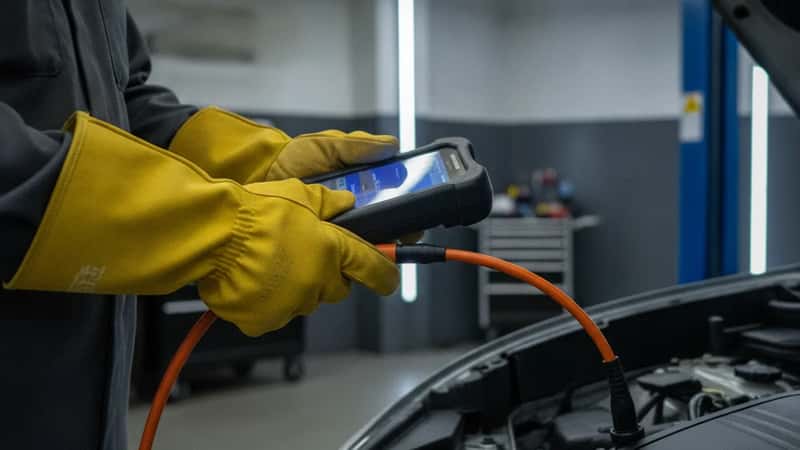
Servicing a zero-emission vehicle is categorically different from working on an ICE vehicle. A BEV's high-voltage battery system operates at 300–800 volts DC — compared to a conventional 12V system — and an accidental contact can be fatal. Before any ZEV enters a service bay, the technician must be trained and certified in high-voltage electrical safety.
This is not optional. Under the Canadian Centre for Occupational Health and Safety (CCOHS) framework and provincial occupational health regulations, employers are required to ensure workers are trained for the specific hazards of the equipment they service. An untrained mechanic working on an EV high-voltage system is a liability exposure that no shop should accept.
For shops that have not yet serviced EVs, the shift in EV battery costs and service patterns directly affects what customers will request and how often — and what diagnostic skills are needed to manage those service visits profitably.
High-Voltage Safety Certification
The gold standard for Canadian technicians is the SAE International HEV/EV Technician (SAE J2082) certification pathway, which covers electrical safety procedures, personal protective equipment (PPE) requirements, and proper high-voltage isolation and de-energization before any service work. Provincial programs also exist: the Ontario College of Trades recognizes EV-specific curriculum units within the Motor Vehicle Service Technician (310S) apprenticeship.
Key safety protocols every certified EV technician must follow before servicing any high-voltage component:
- Verify the vehicle is in PARK and the ignition is fully off
- Remove the 12V auxiliary battery connection to disable the HV system activation circuit
- Remove the manual service disconnect (MSD) plug — location varies by OEM
- Wait the manufacturer-specified discharge period (typically 5–10 minutes for capacitors to discharge)
- Use a Category III or Category IV rated multimeter to verify zero voltage across HV terminals before touching any component
Skipping any step is the source of the majority of EV workshop electrical injuries reported by the International Labour Organization in transition-economy automotive sectors.
Tools, Equipment, and Shop Upgrades for EV Service
A conventional auto shop cannot service EVs without capital investment. The minimum equipment list for a shop taking in ZEV service work includes:
| Equipment | Purpose | Approx. Cost (CAD) |
|---|---|---|
| Class 0 insulated gloves + arc flash PPE | High-voltage personal protection | $800–$1,500 per technician |
| Cat III/IV multimeter (1,000V rated) | HV circuit verification | $400–$800 |
| HV-capable diagnostic scan tool | Battery, BMS, and drivetrain faults | $3,000–$12,000 |
| EV battery lift/hoist adapter | Safe battery pack removal | $2,000–$5,000 |
| Thermal imaging camera | Battery thermal management check | $1,500–$3,500 |
| Level 2 EVSE (for shop charging) | Vehicle charging during service | $1,200–$4,000 installed |
Total first-investment range: approximately $9,000–$27,000 CAD for a single-bay EV-capable setup.
The Honda EV plant cancellation in Ontario underscores that the transition isn't always linear — hybrid vehicles will remain on Canadian roads alongside BEVs for years, meaning shops that also invest in PHEV and HEV diagnostic capability will maximize their customer base during the transition period.
Shops with five or more technicians should designate at least two as certified high-voltage specialists. This creates redundancy and ensures the shop is not unable to accept EV service when one technician is absent.
Training Programs and Certifications Available in Canada
The skilled-technician shortage is the biggest operational risk for shops entering EV service. According to a 2024 survey by the Automotive Industries Association of Canada (AIA Canada), 67% of independent repair facilities reported that lack of trained EV technicians was their top barrier to accepting ZEV service work [AIA Canada, 2024]. Several recognized pathways are available:
Institutional programs:
- SAIT (Southern Alberta Institute of Technology) — Offers a dedicated Electric Vehicle and Alternative Fuel Vehicles certificate program, covering high-voltage safety, battery diagnostics, and drivetrain systems. Duration: 15 weeks.
- Centennial College (Ontario) — EV and Green Transportation Technology program, 1 year, includes hands-on lab with real EV platforms.
- Red River College Polytechnic (Manitoba) — Offers short-form EV technician upskilling modules for working mechanics, completable in 5–10 days.
OEM-specific certification: Most major manufacturers require dealer technicians to complete brand-specific EV certification before performing warranty repairs. GM's Ultium EV certification, Ford's EV Level 1–3 technician program, and Tesla's independent shop authorization pathways all require verified lab hours and online assessment. Independent shops that complete OEM programs can access technical service bulletins (TSBs) and proprietary diagnostic software unavailable otherwise.
Connecting with an electric vehicle repair specialist is also a practical option for independent shops needing case-by-case guidance on specific EV models while building in-house capability.
Government Incentives That Offset Transition Costs

The federal government has created several programs to reduce the financial burden of ZEV transition for automotive businesses:
For dealerships:
- iZEV Program — Customers receive up to $5,000 off a qualifying BEV or FCEV, and up to $2,500 off a qualifying PHEV, at point of sale. Dealers administer the rebate and are reimbursed by Natural Resources Canada. No separate dealer application is needed — registration through the iZEV dealer portal is required.
- ZEVIP (Zero Emission Vehicle Infrastructure Program) — Covers up to 50% of eligible charging infrastructure costs. Applications accepted through NRCan's call cycles; dealers qualify under the employer/destination stream.
For repair shops:
- Canada Job Grant (provincial) — Most provinces fund up to two-thirds of EV technician training costs for existing employees. For a $3,000 course, a BC shop could receive up to $2,000 back. Contact your provincial employment ministry for current intake periods.
- SR&ED (Scientific Research and Experimental Development) Tax Credit — Shops investing in new EV diagnostic processes or tool adaptations may qualify for federal SR&ED credits on eligible R&D expenditures.
À retenir: The combined federal and provincial support available to dealers and shops reduces the net investment required significantly. A dealer investing $50,000 in showroom charging and staff training could recover $20,000–$30,000 through stacked programs, depending on province.
FAQ: Canada's ZEV Mandate for Dealers and Mechanics
What is the ZEV Mandate and who enforces it? Canada's ZEV Mandate operates through the Electric Vehicle Availability Standard (EVAS), finalized under the Canadian Environmental Protection Act (CEPA). Transport Canada administers compliance. Obligations fall on manufacturers and importers, not dealers or repair shops — but dealers and mechanics must adapt their operations to the resulting inventory and service shifts.
Are PHEVs considered zero-emission vehicles under EVAS? Yes, Plug-in Hybrid Electric Vehicles (PHEVs) count as ZEVs and generate compliance credits for manufacturers, though fewer credits per unit than Battery Electric Vehicles (BEVs) or Fuel Cell Electric Vehicles (FCEVs). Conventional non-plug-in hybrids (HEVs) do not qualify.
Do mechanics need a specific license to work on EVs? There is no single national EV repair license in Canada, but high-voltage safety training is legally required under provincial occupational health and safety legislation before a technician works on HV systems. SAE International's EV Technician certification and OEM-specific programs are the recognized industry standards. Many provinces are updating their apprenticeship curricula to include EV modules within the Motor Vehicle Service Technician (310S) pathway.
How does the $5,000 iZEV rebate work for dealers? Dealers registered in the iZEV program apply the rebate directly at point of sale and then submit a reimbursement claim to Natural Resources Canada. The customer never needs to apply separately. Dealers must verify vehicle eligibility (current list on the NRCan iZEV portal) and maintain sales records for audit purposes. Registration is free and mandatory before offering rebates.
When must dealers have ZEV infrastructure in place? There is no statutory deadline for dealership charging infrastructure — ZEVIP funding is available but not compulsory. However, OEM dealer standards increasingly require certified charging capability as a condition of receiving ZEV model allocations. Dealers seeking 2026-model-year EV inventory should confirm infrastructure requirements with their OEM brand standards team by mid-2025.
Disclaimer: The information in this article is provided for informational purposes only and does not constitute legal or regulatory advice. Regulations, rebate amounts, and program eligibility criteria may change. Consult Transport Canada, Natural Resources Canada, and your provincial employment ministry for the most current requirements applicable to your business.