 Laura Clark
On August 31, 2026, two division leaders take the field in Houston with their rosters dented by injury. The Chicago White Sox (72-64, leading the AL Central) are missing Brooks Baldwin, their 23-year-old outfielder who underwent internal brace surgery on his right elbow just four days ago. The Houston Astros (69-68, fighting for the AL West lead) are still without Jeremy Peña, their starting shortstop, who missed his third consecutive game after a 100 mph fastball struck his right hand twelve days prior. Two injuries, two teams, one September pennant race — and a question that matters to anyone who's ever pushed through pain on a field, a court, or a weekend pickup game.
Two Injuries That Tell Very Different Stories
Brooks Baldwin's injury was not sudden. He suffered a right UCL (ulnar collateral ligament) tear during spring training and spent months managing the damage before the White Sox made the call on August 27: internal brace surgery, 60-day IL, see you in 2027. The UCL is the primary stabilizer of the elbow joint during overhead throwing. When it tears, the arm loses the capacity to generate and absorb rotational force. It is the defining injury of modern baseball pitching culture — and increasingly of position players who throw hard.
Jeremy Peña's situation was exactly the opposite in character: acute, sudden, violent. During a game against the Los Angeles Angels on August 19, a 100.1 mph pitch from Kenley Jansen struck Peña's right hand. The Astros got him into an MRI machine within 24 hours. Results showed no structural damage, but "some swelling" — the kind of language that in sports medicine means the bone is intact, but the soft tissue is not done speaking yet. X-rays were negative. Peña described his hand as "pretty sore." The Astros hope to avoid the injured list, but as of the August 31 game, their starting shortstop is still unavailable.
Two mechanisms. Two prognoses. One shared lesson.
What the UCL and the Hamate Have in Common
The reason both injuries matter to recreational athletes — softball players, weekend baseball leagues, tennis players, racquetball regulars — is that the UCL and the bones of the hand are the two most commonly mismanaged structures in upper-extremity sports medicine.
UCL injuries don't usually announce themselves dramatically. They begin as a vague ache on the inner elbow during throwing, often dismissed as muscle fatigue. Over weeks, the ache becomes a pinch. Then the arm loses velocity. Then it loses accuracy. By the time the athlete finally sees someone, what was a Grade I or II sprain has often become a complete tear — the difference between physical therapy and surgery.
Hand contusions like Peña's carry a subtler danger: the hamate fracture. The hamate is a hook-shaped bone in the wrist that sits directly in the path of the bat handle or a struck ball. It fractures under exactly the kind of impact Peña absorbed, and negative X-rays do not rule it out. Per reporting by the Houston Chronicle citing Astros team physicians, Peña's MRI was what provided diagnostic clarity — not the standard X-ray taken immediately post-injury. For most amateur athletes, that MRI step never happens, because the X-ray comes back negative and the "injury" is declared minor.
According to research published by the Yale School of Medicine, early identification of UCL stress — before full rupture — is possible through hands-on physical examination tests including the moving valgus stress test, which applies rotational load to the elbow in a controlled clinical setting. When caught early, conservative management (structured rest, physical therapy, platelet-rich plasma injections) can resolve partial UCL tears without surgery in 40 to 50 percent of cases.
The Expert Angle: What Changes When a Specialist Is Involved
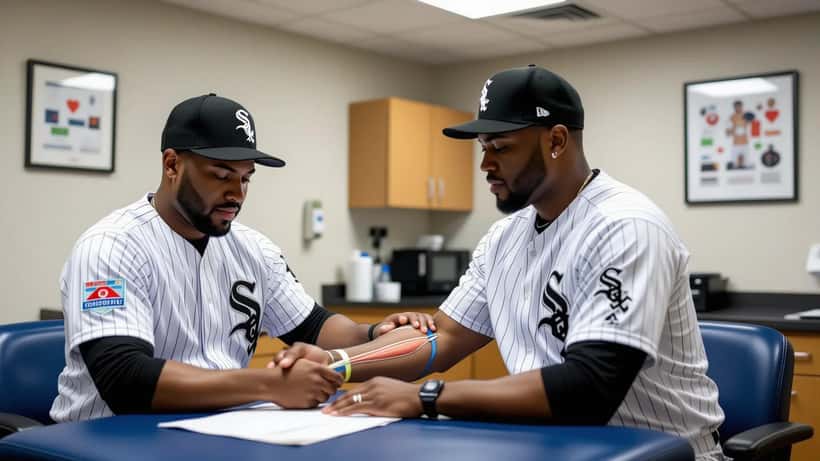
The White Sox's handling of Baldwin's case illustrates what early specialist involvement looks like — even when the outcome is still surgery. The diagnosis of his UCL tear came in spring training, not after months of playing through pain. That early identification allowed the team to manage his workload and timeline, and to plan a surgical option (internal brace, not full Tommy John reconstruction) that may carry a shorter recovery window.
Internal brace surgery, a technique that reinforces the damaged UCL with a synthetic suture rather than replacing it entirely with a tendon graft, has become an increasingly common alternative for athletes with partial or acute tears. Traditional Tommy John surgery — the procedure named after the pitcher who died in August 2026 at 83, having become one of the sport's great comeback stories — requires 12 to 18 months of recovery. The internal brace approach may allow return to sport in 6 to 9 months in appropriate candidates.
But neither option is available to someone who shows up to urgent care six weeks after the injury with a fully ruptured UCL, having assumed the pain would go away on its own.
For someone interested in understanding how these decisions affect a player's career and financial security, this overview of pitcher injury recovery timelines and contract implications offers useful professional context.
The pattern that sports medicine specialists see routinely: an athlete absorbs what feels like a minor arm injury, waits several weeks, and presents with a far more complex structural problem that the original injury would not have required. A specialist consultation — typically in the range of $150 to $300 for an initial visit — is the gateway that prevents that escalation.
When It's You on That Field
Here is a specific scenario that maps directly onto what Baldwin and Peña experienced, translated to the recreational level.
Suppose you play outfield in an adult softball league. In a late-August game, you make a hard throw to the plate from deep right field — a maximum-effort throw you make maybe twice all season. Three days later, you notice a dull ache on the inner side of your throwing elbow. It's mild. You ice it, take ibuprofen, sit out the next weekend, and assume it's fine.
Four weeks later, it's not fine. The ache has become a sharp, localized pain during any throwing motion above 60 percent effort. You can still play — technically — but you can't throw with authority.
This is the window in which the UCL status matters enormously. An MRI at the four-week mark, in this scenario, might show a 40 to 60 percent partial tear — still manageable without surgery in many patients. That same MRI at the twelve-week mark, after weeks of additional loading, frequently shows a complete rupture.
If the inner-elbow pain does not resolve within 5 to 7 days of complete rest, then you need a sports medicine evaluation — not additional ibuprofen and ice. The five-to-seven-day rule applies equally to hand contusions: if swelling and pain have not meaningfully improved within that window, the negative X-ray from urgent care is not the final word.
For comparison: physical therapy for a partial UCL tear, if caught early, typically runs 8 to 16 weeks and costs $800 to $2,000 depending on insurance. Tommy John reconstruction, including surgery, anesthesia, follow-up care, and rehabilitation, often totals $20,000 to $40,000 before insurance, with a recovery period of 12 to 18 months. The decision to see a specialist early costs, at most, a few hundred dollars and a single afternoon.
What to Watch for This September
As the White Sox and Astros head into September — the month that decides playoff berths — both organizations will be managing injury loads across their rosters. The 162-game season is a cumulative stress test. Pitchers who have thrown 160 or more innings arrive at September with arm fatigue that borders on structural load. Position players who play through hand and wrist soreness risk the kind of quiet fracture that shows up only when the season ends and a full imaging workup is done.
For the recreational athlete, September is also the end of the league season — the time when people who have been playing through pain all summer either get it evaluated or hope it goes away over winter. According to the American Sports Medicine Institute, the three-to-four-month rest window recommended for throwing athletes between seasons is also the window for addressing accumulated arm injuries before they become structural. Late summer and early fall are the right time to see a sports medicine specialist, not spring.
The warning signs that indicate a specialist visit — not a wait-and-see approach:
- Inner or outer elbow pain during or after throwing that persists beyond 5 days of rest
- Hand or wrist swelling that hasn't resolved within 48 to 72 hours after trauma
- A "pop" or "snap" sensation during a throw or swing
- Numbness or tingling radiating into the fingers
- Loss of grip strength compared to the unaffected hand
See an emergency physician immediately if you observe visible deformity, inability to move the fingers, or severe immediate swelling following direct impact.
Baldwin's elbow and Peña's hand are reminders that the gap between a manageable injury and a season-ending one is often measured in days, not months — and in whether or not someone with the right training had a look.
This article is for informational purposes only and does not constitute medical advice. If you are experiencing pain or injury symptoms, consult a qualified healthcare professional.
