 Katherine Choi
Former Maine Senate President Troy Jackson, a fifth-generation logger from the state's northern potato-farming country, effectively locked up the Democratic nomination for U.S. Senate over the weekend of July 18–19, 2026, sweeping 456 of the 500 elected delegate slots at county caucuses across Maine. According to the Bangor Daily News, that haul — added to the 101 sitting state committee members who also vote — puts him far beyond the 302 delegates needed to win at next Saturday's state convention, where he is expected to be confirmed as the challenger to Republican Sen. Susan Collins.
The result was lopsided enough to end the race before it reached the convention floor. The Boston Globe reported that Jackson won every delegate in three of Maine's 16 counties and all but one in five others — including Cumberland County, the state's largest, where he took 148 of 149 available slots. By Sunday evening, his top rivals, including Secretary of State Shenna Bellows and former Maine CDC director Nirav Shah, had suspended their campaigns.
Behind the political drama sits a set of numbers that confuse a lot of students — and plenty of adults. Percentages, delegate thresholds, and "winning without a general election" are exactly the kind of civics-meets-math problem that shows up on tests and in dinner-table arguments. Here is how a tutor would break it down.
What actually happened at the caucuses
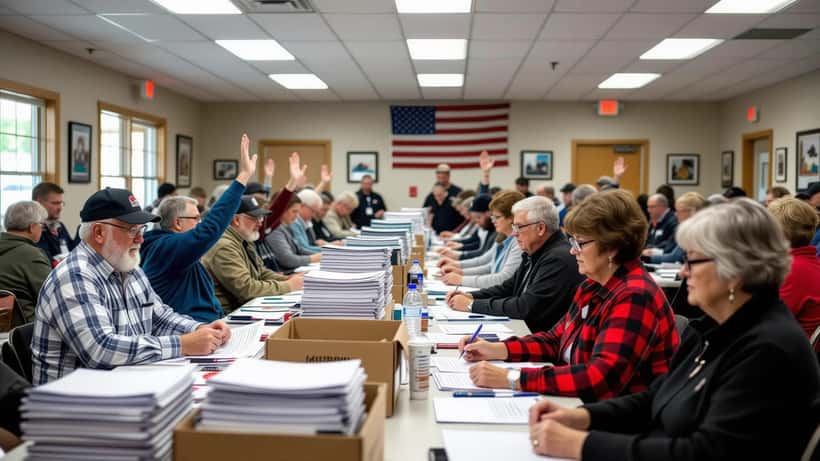
A caucus is not the same as the primary most people picture. Instead of voters filling in a ballot at a polling booth, party members gather in each county to elect delegates — people who will represent that county's preference at a later convention. The candidate who controls a majority of those delegates wins the party's nomination.
Maine held its county caucuses on July 18 and 19. Jackson's supporters didn't just win; they ran up the score, capturing 91.2% of the 500 elected slots. That is why CNN and other outlets called the contest "effectively over" days before the formal vote. When one candidate crosses the delegate threshold on paper, rivals usually withdraw rather than spend money on a lost cause.
The delegate math, step by step
Start with the headline figure: 456 out of 500. To turn that into a percentage, divide the part by the whole and multiply by 100.
456 ÷ 500 = 0.912, and 0.912 × 100 = 91.2%.
Now add the second pool of voters. There are 101 state committee members who also cast votes at the convention, so the total electorate is 500 + 101 = 601 delegates. The number required to win is 302 — just over half of 601 (601 ÷ 2 = 300.5, and you round up to the next whole delegate to guarantee a majority).
Even if Jackson won zero support from the 101 committee members, his 456 elected delegates already clear 302 with 154 votes to spare. That is the difference between "leading" and "mathematically clinched," and it is the single concept students most often miss: a majority is measured against the total pool, not against the number an opponent happens to have.
Why these problems trip students up
Election coverage mixes three math skills at once, and that overlap is what makes it hard.
- Part-to-whole percentages. 456 of 500 and 148 of 149 look similar, but 99.3% (Cumberland County) is meaningfully more dominant than 91.2% statewide. Comparing two fractions with different denominators is a classic stumbling block.
- Thresholds and inequalities. "302 needed" is really the inequality delegates ≥ 302. Students who treat it as an exact target instead of a floor draw the wrong conclusion about who has already won.
- Combining separate groups. Merging the 500 elected delegates with the 101 committee members changes the denominator from 500 to 601. Forgetting to update the denominator is the most common error on questions like this.
Work through each layer in order — convert to percentages, define the threshold as an inequality, then recompute the denominator — and a story that looks like political noise becomes a clean arithmetic problem.
Turning the headlines into a homework win
This is where a private tutor earns their keep. A good Homework Help session doesn't just hand a student the answer to 456 ÷ 500; it uses a real event the student already cares about to teach proportional reasoning, rounding rules, and how to read a data table without being misled. Civics teachers call this "anchoring" — attaching an abstract skill to a concrete, memorable moment.
Parents preparing a middle- or high-schooler for a statistics unit can use this week's Maine result as a ready-made worksheet: calculate each county's win percentage, rank the counties, and prove whether Jackson had clinched before the committee members voted. A tutor can then extend the lesson to the general election, where different math — polling margins of error, turnout models — comes into play.
Jackson built his political brand on labor organizing long before this campaign; readers can revisit that thread in our coverage of the May Day 2026 worker-rights mobilization. But the lesson for students is subject-neutral: the numbers behind a headline are almost always simpler, and more revealing, than the headline itself.
For the official rules on Maine's nomination and general-election calendar, the state publishes them through the Maine Bureau of Corporations, Elections and Commissions. And if your student stares blankly at a percentage table the next time an election dominates the news, that is a signal — not a failing. A one-on-one tutor can turn that exact confusion into the clearest math lesson of the semester.
