 Elizabeth Chen
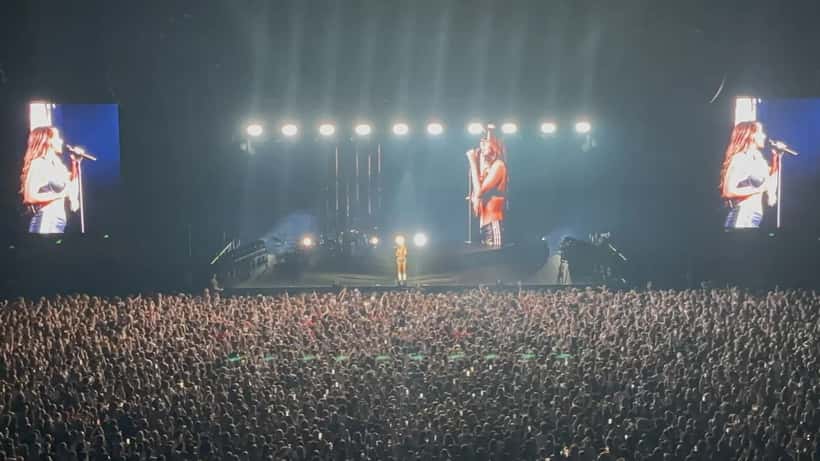
Tate McRae took the Lollapalooza 2026 stage on August 1, drawing tens of thousands of fans to a set that ran close to 90 minutes, cycling through fan favorites including "greedy," "you broke me first," "2 hands," the biting "TIT FOR TAT," and the emotionally charged "Dear god." Within hours, searches for her full setlist spiked across the US — fans sharing video clips, debating song order, and mapping out remaining festival dates. What almost none of them are factoring into their summer concert math is what 90 minutes at stage-front volume actually does to the microscopic hair cells inside the inner ear, and why losing even a small percentage of them is a one-way transaction.
Tate McRae's 2026 Season: A Summer of Packed Venues
Her Lollapalooza appearance is one of several landmark moments in a breakout live year. Earlier this spring, McRae performed at the Billboard Women in Music ceremony at the Hollywood Palladium in Los Angeles on April 29, 2026. Her Miss Possessive Tour, which anchors her 2026 schedule, typically runs 12 to 15 songs per set, often including "Sports Car," "Run for the Hills," "ANYTHING BUT LOVE," "Like I do," "hurt my feelings," and "Purple lace bra" alongside her biggest catalog hits. Shows consistently exceed 90 minutes, frequently with multiple costume changes and production elements designed to fill large venues and festival footprints.
That production scale has a direct audio consequence. Pop concerts of this size routinely drive audience-level sound pressure to between 95 and 110 decibels (dB) on the main floor, peaking closer to 115 dB near speaker stacks. Those numbers sit well above the thresholds established by federal health authorities for safe hearing exposure — a fact that gets little attention during setlist planning but significant attention afterward, when the ringing doesn't stop.
What the Science Actually Says About Concert Volume
The National Institute on Deafness and Other Communication Disorders (NIDCD), part of the National Institutes of Health, sets 85 dB as the threshold at which prolonged or repeated exposure begins to cause noise-induced hearing loss (NIHL). At that level, the safe exposure window is roughly eight hours. The math changes sharply at higher volumes: every 3 dB increase halves the time before damage risk rises.
At 100 dB — a conservative reading for the main floor of a major pop concert — the safe unprotected exposure window falls to approximately 15 minutes. At 110 dB, common near front-of-stage speaker arrays at festivals, you have roughly 90 seconds before inner-ear hair cells begin to take measurable damage. These figures come from OSHA's permissible noise exposure standard (29 CFR 1910.95), originally designed for industrial workplaces but directly applicable to any high-noise environment, including live music.
The mechanism is well understood. The cochlea — the fluid-filled, spiral-shaped structure in the inner ear — is lined with approximately 15,000 to 16,000 hair cells, each tuned to a specific frequency. At high sound-pressure levels, the basilar membrane vibrates so forcefully that these cells bend past their elastic limit. A single moderate exposure causes a temporary threshold shift: the muffled, cotton-in-the-ears sensation that concert-goers typically describe as "concert ears." Most people assume it will be gone by morning. For mild exposures, it often is.
Repeated or high-intensity exposures cause something different: permanent threshold shift. The hair cells die, and unlike bone or skin, they do not regenerate. The frequencies lost first are typically those between 2,000 and 4,000 Hz — the range that carries consonant sounds essential to speech intelligibility and the upper harmonics that give music its crispness and detail. The result is not sudden deafness. It's a gradual flattening: voices that sound slightly muffled, difficulty following conversation in a restaurant, asking people to repeat themselves more often. Most people don't notice until 20 to 30 percent of their hair cells are already gone. By that point, a standard audiogram confirms what the brain has been quietly compensating for all along.
The Concrete Case: Three Concerts, One Weekend, Real Numbers
Consider a 23-year-old fan who attends Tate McRae's Lollapalooza set on Friday evening, a second headline act on Saturday, and a late-night club event afterward. At each event, she stands approximately 25 feet from a speaker stack. A calibrated sound-level meter at that position would read approximately 108 dB.
Here is what OSHA's noise exposure formula produces for that scenario:
- At 108 dB, the maximum unprotected exposure before damage risk rises significantly is approximately 1 hour
- Each 90-minute concert set exceeds that safe window by 50%, meaning she receives 1.5 times the permissible dose per event
- Three such exposures across 48 hours accumulate to roughly 450% of the OSHA safe noise dose — even before accounting for the fact that her hair cells had no meaningful recovery time between events
Now apply musician-grade earplugs rated at 25 dB noise reduction — available at most music stores and pharmacies for $15 to $30. The effective sound level at the eardrum drops from 108 dB to 83 dB. That single change pushes all three events below the 85 dB damage threshold. The entire weekend now falls safely within OSHA guidelines.
If you attend three festival performances this summer at an average of 108 dB without hearing protection, OSHA's own exposure formula indicates you are accumulating 4.5 times the safe dose per event. If you use musician-grade 25 dB earplugs, your exposure drops to 83 dB — a full 2 dB below the damage threshold — across every set.
That distinction matters because the most common objection to concert earplugs is that they ruin the sound. Standard foam plugs do muffle high frequencies disproportionately, making music sound dull. High-fidelity musician's earplugs work differently: they reduce the entire frequency range evenly, preserving the balance of the music while bringing the level down to a safe range. Audiologists who treat musicians and touring production staff consistently report that many patients switch to high-fidelity plugs expecting to dislike them, and quickly won't go to a concert without them.
When to See a Hearing Specialist
The early signs of noise-induced hearing loss are easy to rationalize as temporary inconvenience. A ringing that fades by noon the next day. Speech that sounds slightly flat for a day or two. A feeling that you're hearing everything through a thin layer of gauze. Audiologists and ENT specialists identify the following as clear triggers for a professional evaluation rather than a wait-and-see approach:
- Tinnitus — ringing, buzzing, or hissing — that persists for more than 24 hours after a concert
- Voices or music that continue to sound muffled or "underwater" 48 hours after exposure
- Attending more than four to six concerts or festivals per year without hearing protection consistently
- Existing noise-exposure history (occupational noise, recreational shooting, years of musical performance) combined with regular concert attendance
- Any new asymmetry in hearing — one ear feeling different from the other after an event
A baseline audiogram is especially valuable for people in their 20s and 30s who attend live music regularly. The test takes about 20 minutes, is entirely painless, and maps your current hearing thresholds across all frequencies. If your hearing changes over the coming years, the shift is immediately visible against your baseline. Without a reference measurement, gradual loss goes undetected until it reaches the level where everyday function is visibly affected — at which point the damage has already accumulated.
An audiologist can also perform extended high-frequency audiometry, which tests hearing in the 8,000 to 20,000 Hz range not captured by standard clinical screenings. Damage at these higher frequencies often appears earlier than any deficit visible on a conventional test — making it a useful early-warning tool for anyone whose lifestyle involves regular loud-music exposure.
If you've noticed any ringing, muffling, or shift in how sound reaches you after this summer's concerts, connecting with a health specialist early is the kind of decision that pays forward across decades. ExpertZoom's hearing health experts can help assess your specific situation and recommend the right next step — whether that's a baseline test, protection guidance, or a referral for further evaluation.
What to Do Before Your Next Show
The NIDCD recommends consistent hearing protection in any environment where sound regularly exceeds 85 dB — a threshold crossed before the first chorus at any major festival stage. For the rest of the 2026 concert season, a few practical changes reduce risk substantially:
Invest in high-fidelity earplugs. Musician's plugs preserve the frequency balance of the music while reducing overall level. A $20 to $30 pair worn at every show is a straightforward trade against a permanent change in how you hear music for the rest of your life.
Choose your position deliberately. Moving 10 feet further from a speaker stack can reduce exposure by 3 to 6 dB, which meaningfully extends the time before damage risk rises. Positions off to the side, slightly behind the main speaker array, are often quieter than positions directly in front.
Take regular breaks from the main floor. Stepping back from the crowd for 10 minutes per hour allows partial recovery of the temporary threshold shift that builds during loud sections of a show. It doesn't eliminate cumulative risk, but it reduces the dose.
Avoid high-volume headphone use immediately after a concert. Hair cells stressed by a loud event need time without additional acoustic loading. Commuting home with headphones at full volume after a festival set stacks exposure risks at exactly the wrong moment.
The NIDCD's complete guide to noise-induced hearing loss — including safe exposure tables, protection options, and warning signs — is available at the National Institutes of Health: Noise-Induced Hearing Loss.
Tate McRae's 2026 setlist is genuinely one of the most rewarding live experiences of the summer. With the right preparation, there is no reason to trade your long-term hearing health to be part of it.
This article is for educational and informational purposes only and does not constitute medical advice. If you are experiencing hearing symptoms, tinnitus, or any changes in your hearing after attending a concert or other loud event, consult a qualified audiologist or ENT specialist for personalized evaluation and guidance.
