 Michael Campbell
The Rocket That Waited 18 Months
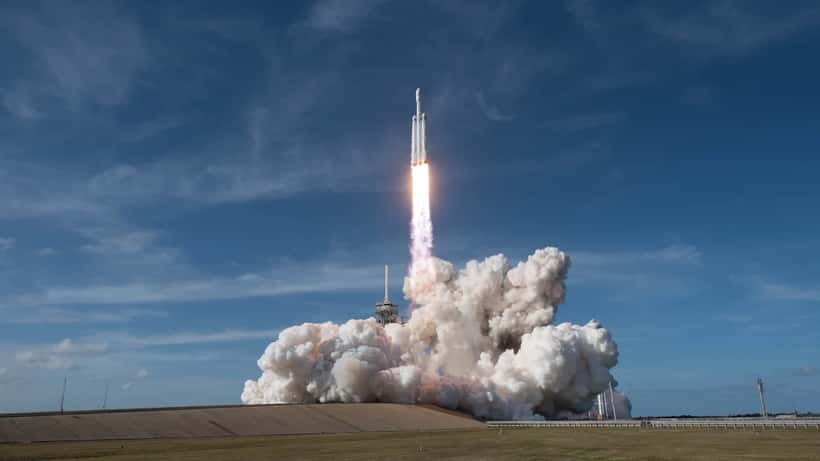
SpaceX's Falcon Heavy rocket was rolled out to Launch Complex 39A at NASA's Kennedy Space Center in Florida on Sunday, April 27, 2026, for what will be the vehicle's first flight in 18 months. The launch, originally scheduled for 10:21 a.m. EDT on Monday, was scrubbed due to unfavorable weather at the pad—the same severe storm system battering the central US this week. SpaceX has now set Wednesday, April 29, at 10:13 a.m. EDT as the next launch window.
The mission will carry the ViaSat-3 F3 communications satellite—a 6.6-metric-ton spacecraft—to geostationary orbit 22,236 miles above Earth, where it will deliver high-capacity broadband across the Asia-Pacific region. The launch marks the completion of ViaSat's three-satellite global constellation, a $3 billion infrastructure project years in development.
What ViaSat's Constellation Signals for the Space Economy
ViaSat-3 F3 is not just another satellite launch. It is the third piece of a commercial broadband architecture designed to serve aviation customers, defense contractors, maritime operators, and direct-to-consumer internet subscribers across three global regions simultaneously.
ViaSat's leadership described the launch as "a pivotal moment in our journey to bring fast, secure, and reliable high-capacity broadband to commercial, defense, and consumer customers." The commercial satellite broadband market—driven by competitors including SpaceX's Starlink, Amazon's Project Kuiper, and OneWeb—is projected to generate hundreds of billions in revenue over the next decade as aviation, defense, and maritime sectors migrate connectivity services to space-based infrastructure.
The Falcon Heavy itself underscores the industrial scale of this moment. Generating 5.1 million pounds of thrust at liftoff, it is the second most powerful operational launch vehicle on the planet after NASA's Space Launch System. Its 18-month absence from the launch schedule—not due to failure but to a gap in commercial demand—reflects how specialized and lumpy the market for superheavy commercial missions remains.
Space Stocks: Opportunity or Volatility Trap?
The excitement around SpaceX, ViaSat, and satellite broadband has fueled significant investor interest in the space economy. Companies including Rocket Lab (RKLB), Iridium (IRDM), and ViaSat (VSAT) have seen sharp price moves tied to launch news, contract wins, and earnings surprises.
But the space sector has several characteristics that make it structurally different from more familiar technology stocks:
Long development timelines. Satellite constellations take years and multiple launches to reach operational capacity. Revenue from new systems often lags initial investment by three to five years or more.
High capital intensity. Building and launching satellites requires enormous upfront spending. ViaSat's three-satellite constellation cost approximately $3 billion. SpaceX's Starlink program has required sustained capital infusion over more than a decade before reaching the subscriber scale needed for profitability.
Concentrated customer bases. Many commercial satellite companies depend heavily on defense and aviation contracts. A shift in government procurement priorities or a single contract loss can materially change a company's revenue outlook.
Technology obsolescence risk. Satellite technology evolves quickly. A constellation optimized for 2026's demand patterns may face competitive pressure from lower-cost, higher-bandwidth successors within five to seven years.
None of these risks make space stocks unsuitable for a portfolio. But they do mean that enthusiasm around a headline launch event—like Wednesday's Falcon Heavy mission—requires filtering through a longer analytical lens before becoming an investment decision.
What Financial Advisors Say About Sector Investing
Thematic or sector-based investing—allocating capital to industries like space, clean energy, or artificial intelligence—has grown significantly as a retail investing strategy. The appeal is straightforward: identify a structural growth trend early and position for the long-term payoff.
The risk that financial advisors consistently flag is timing and concentration. Even investors who correctly identify a sector as transformative can generate poor returns by entering at peak valuation, concentrating too heavily in one or two names, or exiting during volatility before the thesis plays out.
For the space economy specifically, advisors often distinguish between:
Pure-play space companies (Rocket Lab, Iridium, ViaSat, Maxar before its acquisition) — high growth potential, high volatility, sector-specific risks
Diversified aerospace and defense (Boeing, Northrop Grumman, L3Harris) — significant space exposure within a broader business that smooths revenue variability
Broad innovation ETFs that include space holdings as part of a technology or future-economy basket — reduced concentration risk at the cost of diluted upside
The Federal Aviation Administration's Office of Commercial Space Transportation licenses and regulates US commercial launch operations, and its public data on launch frequencies and licensed operators provides useful context for evaluating market scale—one tool advisors use alongside traditional financial metrics.
Questions to Ask Before Adding Space Exposure to Your Portfolio
If Wednesday's Falcon Heavy launch has prompted you to reconsider your portfolio's exposure to the space economy, a conversation with a wealth management professional should address several practical points:
What percentage of my portfolio is already exposed to aerospace and defense? Many large-cap technology and industrial holdings include companies with substantial space revenue. Check for unintentional concentration before adding dedicated positions.
What is my investment horizon? Space economy returns are likely to be realized over a five-to-fifteen-year window. If you need liquidity in three years, high-volatility space stocks introduce meaningful risk.
How does this fit my risk tolerance? Single-company space stocks can move 20 to 40 percent on a single earnings report or launch outcome. That volatility is appropriate for a growth allocation within a diversified portfolio—not for capital you cannot afford to lose.
What are the tax implications? Buying into a sector on a news event often means entering near a valuation peak. Short-term capital gains from rapid trading in volatile sectors can meaningfully erode returns.
Expert Zoom connects investors with verified independent wealth management professionals who can evaluate space sector exposure in the context of your full financial picture—without the conflict of interest that comes from advisors who earn commissions on the products they recommend.
This article is for informational purposes only and does not constitute investment advice. Consult a licensed financial advisor before making any investment decisions. Past performance of sector funds or individual securities does not guarantee future results.
