 William Reed
When an 82-foot fishing vessel slipped beneath the surface at Seattle's Fisherman's Terminal on August 6, 2026, Washington State had less than 24 hours to alert NOAA before a potential 500-gallon diesel discharge threatened the harbor. The vessel was recovered — but the real work started the moment the hull cleared the waterline. For the tens of thousands of recreational boat owners who face a sinking each year in U.S. waters, what happens after the crane lifts your hull out is what separates a manageable insurance claim from a financial catastrophe. Marine mechanics who specialize in post-salvage restoration say most owners drastically underestimate what comes next — and that the window for action is measured in hours, not days.
Shipwrecks Are More Common Than You Think
The U.S. Coast Guard records thousands of reportable boating accidents each year, with vessel sinkings accounting for roughly 13 percent of those incidents. A single storm surge, a failed bilge pump, or a hull breach from a dock collision can send a $50,000 recreational boat to the bottom in minutes. In July 2026, Pacific Underwater Construction spent approximately $600,000 recovering a 77-foot sunken vessel from Honolulu's Ala Wai Small Boat Harbor — a stark reminder that salvage operations are far from routine, even for professionals.
For smaller recreational vessels, the costs are lower but still substantial. Basic towing assistance averages $960 out-of-pocket for non-members of marine assistance programs. But full submersion recovery — divers, crane, pump-out, environmental containment — runs $3,500 to $10,000 or more depending on depth, water type, and vessel length. And that figure covers only getting the boat back on the dock. The mechanical bill is a separate chapter entirely.
According to NOAA's Office of Response and Restoration, which tracks vessel incidents in U.S. navigable waters, a sunken vessel in a marina triggers mandatory federal notification requirements if there is any risk of fuel discharge — even if the boat is recovered quickly. Owners who delay reporting can face additional regulatory exposure on top of repair costs. The full incident response framework is available at NOAA's Office of Response and Restoration.
What a Marine Mechanic Actually Does When Your Boat Surfaces
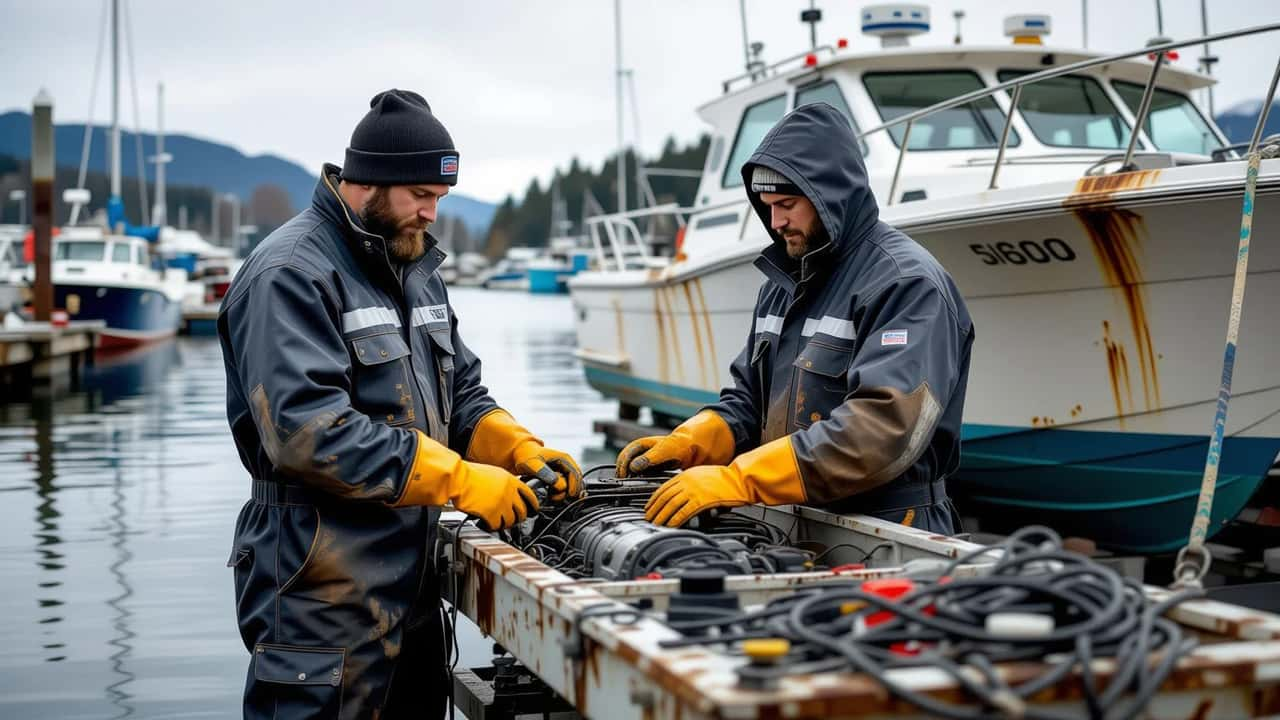
Most boat owners picture salvage as the hard part — the crane, the divers, the drama of watching their vessel lifted from the deep. Marine mechanics know the real challenge starts the moment the hull clears the waterline.
Saltwater is an engine's worst enemy. Within hours of submersion, it corrodes aluminum engine components, fouls fuel systems, and seizes moving internal parts. In engines with electronic fuel injection — standard on virtually all vessels built after 2005 — water infiltrates injector bodies and ECU (engine control unit) housings. In many cases, component replacement, not repair, is the only viable path.
A thorough post-salvage inspection by a certified marine mechanic covers:
- Hydrolockcheck and decompression test — water in a combustion chamber bends connecting rods on ignition. Testing before any start attempt is non-negotiable.
- Electrical system diagnostic — every wire harness, switch panel, bilge pump, and navigation instrument must be tested after saltwater exposure. Full replacement is common.
- Fuel system flush — tanks, lines, carburetors, and injectors retain contaminated fuel that can destroy a freshly rebuilt engine on first start.
- Structural assessment — hull blisters, fiberglass delamination, and keel integrity on sailboats require hands-on evaluation before relaunch.
"Most owners want to turn the key and see if it starts," says one Florida-based marine technician with 18 years of salvage-recovery experience. "That's the worst thing you can do with a submerged engine. You'll destroy it in seconds." The first 2–4 hours after surfacing are when a mechanic's intervention makes the most difference — before corrosion sets in hard, before oxidation locks moving parts, before dried saltwater crystals foul electrical contacts permanently.
The $14,000 Scenario: What Boat Recovery Really Costs in 2026
Consider a 28-foot center-console powerboat with twin 150hp outboard engines — one of the most common recreational configurations from the Gulf Coast to the Chesapeake. The boat sinks overnight in a marina after a cleat fitting fails during a storm surge. By morning, it's sitting in 12 feet of saltwater.
Here's the realistic recovery math:
| Item | Cost |
|---|---|
| Salvage operation (crane, divers, pump-out, fuel containment) | $6,200 |
| Emergency haul-out and first week of storage | $800 |
| Marine mechanic inspection (both engines) | $450 diagnostic |
| Engine teardown and corrosion assessment | $2,400 ($1,200/engine) |
| Parts and rebuild — if engines are salvageable | $3,800–$7,000 |
| Electrical system replacement | $1,500–$3,500 |
| Total (engines repairable) | $15,150–$20,350 |
| Total (engines need replacement — twin 150hp) | $22,000–$28,100 |
The if/then logic is straightforward and consequential: if your policy includes an agreed-value marine insurance rider with salvage and wreck-removal coverage, the insurer typically reimburses 80–100% of documented costs up to the policy limit. If you hold only basic liability coverage with no physical damage or salvage riders, every dollar above the deductible comes out of pocket. Many standard boat policies sold as "full coverage" exclude wreck-removal costs unless a specific endorsement was added at purchase — a gap most owners discover only after a sinking.
The time dimension matters too: if the boat sank in freshwater and was recovered within 24 hours, engines often can be rebuilt rather than replaced, cutting the total bill roughly in half. If the submersion was in saltwater and exceeded 48 hours, the mechanical prognosis shifts dramatically — most systems require replacement. Each hour of delay after surfacing costs real money in accelerating corrosion.
When to Call a Marine Mechanic — Not Just a Salvage Company
Marine salvage companies recover vessels. Marine mechanics determine what's actually recoverable. These are different skill sets, and confusing them is one of the most common expensive mistakes boat owners make.
A salvage crew's job ends when the boat is on the dock. A marine mechanic's job begins there — and their assessment, produced within 48 hours, is what your insurance adjuster and your own repair decision hinge on. Independent mechanical documentation protects your claim; an adjuster's estimate without a mechanic's teardown report often underestimates the full extent of saltwater damage.
For the legal side of on-water incidents — including who bears liability when a sinking boat damages neighboring vessels at a marina — maritime property law creates a distinct set of questions that affect recovery costs. The ongoing debate over wreck ownership rights explored in New Titanic 3D Scans Reignite Debate Over Wreck Ownership Law illustrates how property and liability frameworks on the water differ significantly from land-based rules.
What to Do If Your Boat Sinks
Act in this order:
- Notify the marina and U.S. Coast Guard immediately — federal regulations (33 CFR Part 173) require reporting any sinking that causes injury, death, or significant property damage. If fuel discharge is possible, NOAA notification is mandatory.
- Do not attempt to start the engine — even briefly. Water in a combustion chamber destroys cylinders on the first crank.
- Reach a marine mechanic before the salvage crew leaves — get an independent mechanical assessment on the dock. This documentation is essential for your insurance claim.
- If no mechanic is immediately available, flush with fresh water now — run a garden hose through air intakes and over exposed electrical connections. Do not open fuel lines yourself.
- Review your policy for wreck-removal and salvage riders — call your insurer within 24 hours. Many policies require prompt notification or they can dispute coverage.
- Get a written 48-hour prognosis — your mechanic's written assessment determines whether repair or replacement is the economically rational choice before you commit to thousands in labor.
Marine mechanics who work post-salvage recoveries aren't just fixing engines — they're drawing the line between a vessel that returns to service and a hull sold for scrap. Finding a certified marine technician with specific saltwater-damage and submersion-recovery experience is as important as finding the right crane operator. Expert Zoom connects boat owners across U.S. coastal and inland waterways with vetted marine mechanics who specialize in post-salvage assessment and engine recovery — before you write a single check to a repair yard.
