 William Reed
The Old Farmer's Almanac just released its fall 2026 weather forecast, and drivers from the Northeast to the Upper Midwest should take it seriously. The outlook calls for a cooler-than-average September and October — about 1°F below normal — with drier conditions across much of the country. For the tens of millions of Americans who haven't touched their car since spring, that seasonal shift is arriving faster than most realize, and September is the window mechanics say you shouldn't miss.
What the Almanac's Fall 2026 Forecast Actually Says
The 2026 Old Farmer's Almanac paints a consequential picture for autumn across the United States. The nation's interior — from the Northern Plains through the Heartland and into the Deep South — can expect warmer-than-average temperatures through October. But for the eastern United States and the Pacific Coast, cooler air arrives earlier and lingers longer than in recent years.
The Northeast faces a double weather shift: both cooler and wetter than usual this fall. That combination — dropping temperatures and wet roads — is precisely the scenario that catches unready drivers off guard. The Upper Midwest will see a particularly cool September before temperatures moderate slightly in October. Most of the country is also forecast to run about an inch of rainfall below historical averages, which means dry, leaf-covered roads — a hazard that many drivers underestimate compared to ice or rain.
According to the Almanac, September and October temperatures across the eastern U.S. will register roughly 1°F below normal. That modest number matters more than it sounds: it means frost arrives earlier in the season calendar, overnight temperatures drop into dangerous ranges for aging batteries weeks ahead of schedule, and tire pressure loss accelerates through the month in ways drivers rarely track.
Why Mechanics Say September Is the Window — Not October
Experienced mechanics share a common observation: the drivers who arrive in October are the ones who should have come in September. By the time the first frost hits, service appointment demand spikes, parts sourcing slows, and quality shops run two-to-three-week waiting lists for non-emergency inspections.
The case for September car prep comes down to how cold weather interacts with three systems that most drivers ignore until something fails.
Batteries lose up to 35% of their output at 32°F, according to automotive safety testing data. A battery that starts your car reliably in August can refuse to crank at all in November if it's hovering near the end of its three-to-five-year service life. Cold cranking amps (CCA) — the rating that determines a battery's cold-start ability — degrade gradually and invisibly until the first genuinely cold morning reveals the problem at the worst possible time.
Tires lose approximately 1 PSI of pressure for every 10°F drop in ambient temperature. A tire properly inflated to 35 PSI in late August may be running at 29–30 PSI by a cool October morning — below the safe threshold for many vehicles and firmly in the range where handling, braking distance, and blowout risk all deteriorate. The National Highway Traffic Safety Administration (NHTSA) estimates tire-related factors contribute to approximately 11,000 crashes per year in the U.S., with seasonal transitions representing peak risk periods.
Coolant (antifreeze) is widely treated as a winter-only concern. In reality, coolant that has cycled through several summer heat seasons loses its freeze-point protection incrementally. A mechanic with a simple refractometer or test strip can tell you exactly where your protection threshold sits. If your coolant is protecting to 15°F but your region hits single digits this winter, you're one overnight freeze away from a cracked engine block — a repair that typically runs $3,000 to $8,000 in parts and labor.
What a Full Fall Inspection Covers
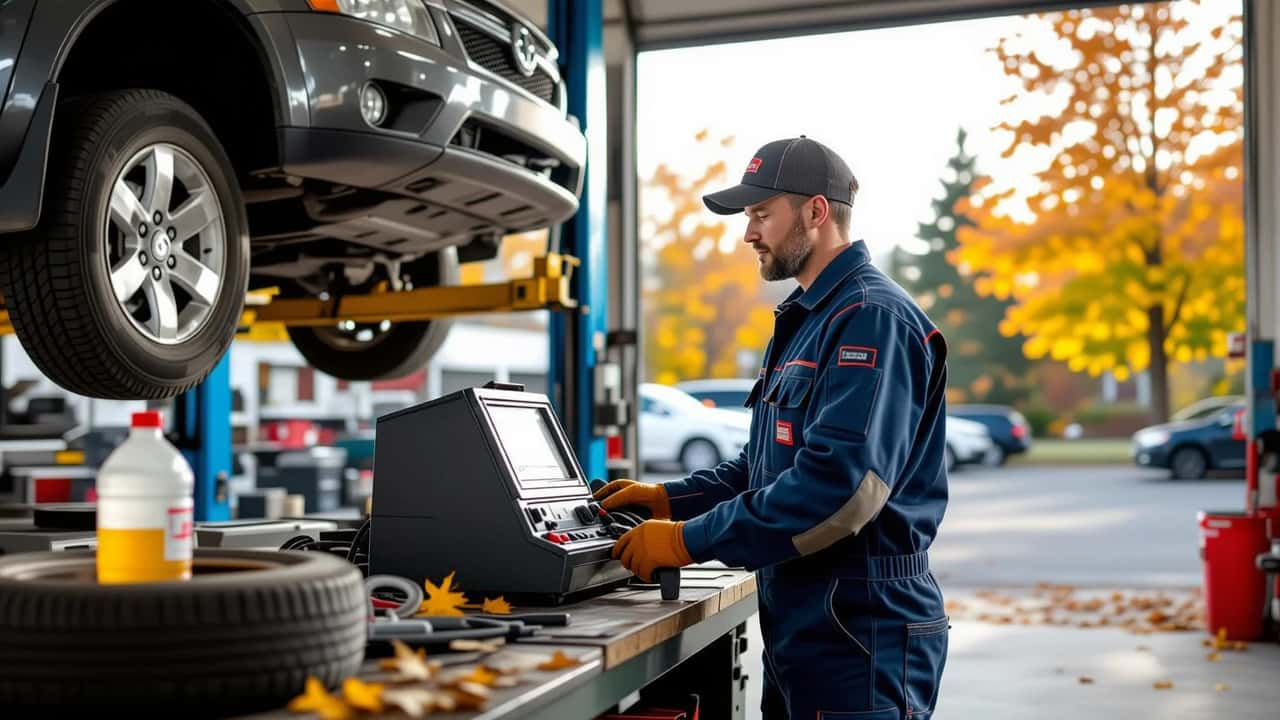
A thorough fall vehicle inspection covers more ground than the routine oil change that most drivers use as their default service visit. With the Almanac's cooler, drier fall 2026 forecast in mind, experienced mechanics are specifically looking at:
Battery load test: Not just a voltage check. A proper load test simulates the cold-start demand your battery will face in November and December, measuring actual cold cranking amp output against rated specs. A battery at 70% rated CCA is already a replacement candidate before temperatures fall.
Tire tread depth, pressure, and alignment: The penny test — if you can see Lincoln's full head, the tread is worn below 2/32 inch — gives a rough guide to depth, but alignment problems causing uneven wear are just as dangerous and only visible on close inspection. A car pulling left or right on wet autumn leaves is a vehicle on the edge of the driver's control margin.
Wiper blades: A blade that streaks through summer rain is nearly useless in a damp October. Most mechanics recommend annual replacement, and winter-specific blades with rubberized frames that resist freezing are worth the modest upgrade cost.
Coolant freeze-point protection: A quick test costs nothing at most shops but tells you exactly how low your temperatures can drop before engine damage becomes possible. This number should be at least 30°F below your regional coldest expected overnight low.
Brake pads and rotors: Fall driving introduces unusual brake demands — wet leaves, morning frost, and reduced visibility all extend stopping distances. A mechanic checking pad thickness in September can distinguish between "monitor through winter" and "replace before the first frost" with far more accuracy than a driver trying to estimate from the driver's seat.
Exterior lighting: Days shorten dramatically through September and October. A burned headlight or taillight on a rainy September evening is both a safety hazard and a moving violation in most states. Catching a burned bulb during a scheduled inspection costs minutes; catching it during a traffic stop costs more.
Fall is also a smart time to review your fuel efficiency habits — cold-weather driving patterns change gas mileage significantly, and understanding where your consumption goes during autumn helps drivers budget for the season realistically.
A Concrete Scenario: The Cost of Waiting Until November
Consider a driver in Columbus, Ohio — a city the Almanac places in the "cool September, below-average rainfall" zone for fall 2026. She drives a 2020 sedan with 58,000 miles, a four-year-old original battery, and tires that were last rotated in March 2026.
If she books a fall inspection in September, a mechanic would likely find:
- Battery testing at 370 cold cranking amps against a rated 550 CCA — marginal for Ohio winters. Replacement cost: $145–$180 installed.
- Tire pressure at 30 PSI on a 35 PSI vehicle — corrected at no charge during the visit.
- Front brake pads at 3.5mm — still legal, but a mechanic's note to replace within 60–90 days. Cost if done during the visit: $220–$280 for the front axle.
- Total September service cost: approximately $400–$500, booked at her preferred shop with a mechanic she knows.
If she waits until a cold November morning when the car won't start:
- Emergency roadside assistance call: $85–$150 (or deductible on a membership plan).
- Battery replaced roadside or at a shop without a scheduled appointment, with an emergency markup on the part: $210–$270.
- By now, brake pads have worn to 2mm — below safe minimums — requiring an urgent repair under time pressure and potentially at a shop she didn't choose, at labor rates she didn't compare.
- Estimated November emergency total: $550–$750, plus lost time, stress, and the safety risk of driving on marginal brakes through the season's first wet leaves.
The if/then math is direct: if she acts in September, she controls the cost, the timing, and the mechanic she trusts. If she waits until November, cold weather and circumstance make those choices for her — always at a premium.
When DIY Isn't Enough
Some fall prep is genuinely DIY-accessible — tire pressure with a $10 gauge, wiper blade swaps, exterior bulb checks. But battery load testing, coolant analysis, brake-pad thickness measurement, and alignment inspection all require equipment and trained interpretation that a driveway once-over can't provide.
The Old Farmer's Almanac has published its forecasts since 1792. Its fall 2026 prediction isn't a guarantee, but it represents a well-established signal that cooler air is arriving across much of the United States this September — and that drivers whose vehicles are approaching the 50,000- to 60,000-mile range are running into the window where cumulative wear becomes consequential.
ExpertZoom connects drivers directly with certified mechanics and automotive specialists who can walk through a complete fall inspection, answer questions specific to your vehicle, regional climate, and driving habits, and provide cost estimates before any work begins. Getting that expert perspective now — in September, while shops are still accessible and the weather still cooperates — costs a fraction of what cold-weather surprises typically run.
Don't wait for a November morning to find out what your September mechanic would have caught.
