 Emily Wang
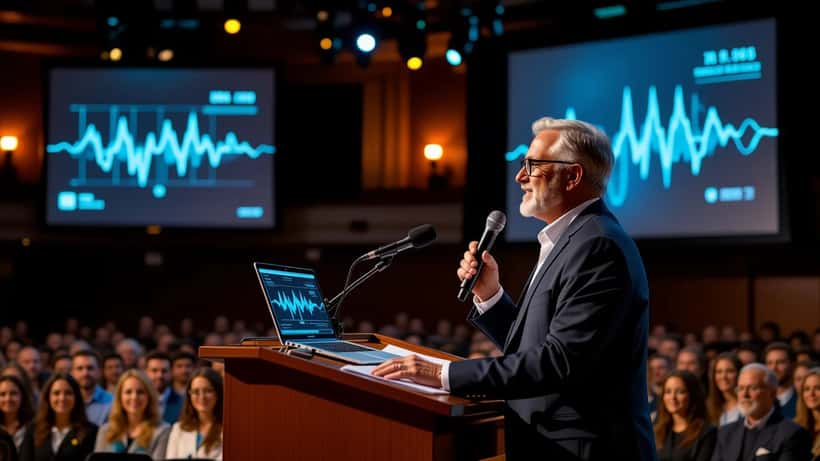
Scott Borchetta walked onto a stage at Middle Tennessee State University on May 10, 2026, expecting to inspire graduates. Instead, he was met with loud, sustained booing. The music executive — who launched Taylor Swift's career at the original Big Machine Records and recently departed Hybe America to relaunch the label — had urged the class of 2026 to embrace artificial intelligence rather than resist it.
"Invest in the skill and art of creation and not the platform or the system," Borchetta told students. The crowd responded with jeers.
The moment was telling. In an industry already fractured by AI-generated music, streaming royalty battles, and the collapse of traditional label structures, Borchetta's speech struck a nerve — not because his argument was wrong, but because the graduates in that room are entering a market where the legal protections for their creative work are still being written in real time.
For artists and musicians in 2026, the question is not whether AI will reshape the industry. It already has. The question is whether they have the legal frameworks in place to protect what they create.
The AI and Music Rights Gap
When a generative AI system produces music in the style of a specific artist — or trains on an artist's catalog to do so — it operates in a legal gray zone that U.S. courts and regulators are only beginning to address.
Under current U.S. copyright law, original creative works are protected from the moment of creation. But training data is treated differently. Technology companies have argued, in ongoing litigation, that using copyrighted music to train AI models constitutes "transformative use" and therefore qualifies as fair use. Several of those cases remain unresolved.
What is clear is that artists who signed recording contracts before 2023 are almost certainly protected by agreements that make no mention of AI at all. Their contracts do not address whether the label may license their masters for AI training datasets, whether the artist is owed royalties if an AI model produces derivative work from their recordings, or who owns AI-assisted compositions that mix human and machine contributions.
That silence is not neutral. In the absence of explicit contractual protections, disputes tend to resolve in favor of whoever has more leverage — typically the label.
What New Contracts Need to Include
Music lawyers who represent emerging artists recommend that any recording or publishing agreement signed in 2026 explicitly address at least four AI-related provisions:
1. Training data restrictions. The contract should specify whether the artist's recordings, vocal stems, compositions, or likeness may be used to train artificial intelligence systems — and under what conditions, if any. A blanket prohibition is the clearest protection. A negotiated licensing fee is an alternative.
2. AI-generated derivative work. If a label or distributor creates music using AI tools that were trained on the artist's catalog, the contract should clarify ownership of those outputs and whether the original artist is owed compensation.
3. Synthetic voice and digital likeness. Voice cloning technology has advanced to the point where an artist's vocal signature can be replicated without their participation. Explicit language prohibiting unauthorized use of a synthetic version of the artist's voice — or requiring consent and payment for any such use — is now considered essential in well-drafted agreements.
4. AI collaboration attribution. When an artist uses AI tools in their creative process, the resulting work raises authorship questions. U.S. copyright law currently does not recognize AI as an author, but the human contribution must be sufficiently creative to qualify for protection. Contracts that define how AI-assisted works are credited, owned, and monetized protect both parties from future disputes.
What the U.S. Copyright Office Has Said
The U.S. Copyright Office has issued policy guidance on AI and copyright that establishes a critical threshold: works generated entirely by AI, without meaningful human creative input, are not eligible for copyright protection. Works where a human makes significant creative choices — even using AI tools — may qualify.
For musicians, this creates both an opportunity and a risk. An artist who uses AI to generate a chord progression but writes the melody, arranges the layers, and selects the final output may have a protectable work. An artist who feeds a prompt into an AI tool and publishes the output without significant modification may not.
The distinction matters for licensing, streaming royalties, and legal enforcement. Artists who are uncertain where their creative process falls on this spectrum should consult a music IP attorney before releasing AI-assisted work commercially.
Borchetta's Moment in Context
Borchetta's exit from Hybe America, announced in February 2026, and the relaunch of Big Machine Records positions him at the center of a rapidly shifting industry. He is building a label operation at precisely the moment when the rules governing that operation — at least as they pertain to AI — are most in flux.
His message to graduates was not wrong. Artists who understand AI as a creative tool, rather than an adversary, will likely have advantages over those who don't. But understanding a tool and understanding your legal exposure to that tool are different things.
The students who booed Borchetta were not booing technology. They were signaling, with some precision, that they have watched an industry repeatedly absorb new technologies while the financial benefits flowed upward and the legal protections for creators lagged behind. That pattern — visible in the shift from physical sales to digital downloads to streaming — is now repeating with AI.
For emerging artists and songwriters navigating this moment, the most durable protection is not resistance to AI but access to music lawyers who understand the evolving landscape. Contracts signed today will govern creative rights for years. Getting those agreements right — before the first track is released, before the first sync license is signed — is the clearest path to protecting what the art generates.
The question Borchetta posed to graduates deserves a more specific answer than he offered: invest in the skill and art of creation, yes — and invest equally in understanding who owns it. For rising artists navigating recording contracts in this environment, understanding the fundamentals of artist rights before signing is the clearest way to avoid the disputes that have defined so many careers — including some that Big Machine helped launch. That is a conversation best had with a music attorney before it becomes a dispute handled in court.
This article is for informational purposes only and does not constitute legal advice. Consult a licensed intellectual property attorney for guidance specific to your situation.
