 Jessica Johnson
Chase Matthew is headlining festivals, charting with his single "Holdin' It Down," and has been named one of Taste of Country's "RISERS: 2026 Artists to Watch" — a list reserved for artists on the verge of breaking into country music's elite tier. He is signed to Warner Records Nashville and is running a 67-date tour spanning three countries. Behind the excitement, though, is a business reality that catches many rising artists off guard: the contracts that fuel a career can also constrain it.
From Viral Debut to Major Label Deal
Chase Matthew built his following the modern way — social media clips, independent releases, and the kind of grassroots momentum that makes labels take notice. His breakout single "Darlin'" hit No. 1 on Billboard's Country Airplay chart in 2024, making him one of country music's most-watched newcomers. In 2026, he's extending that run with new material and a headline touring schedule.
The journey from independent artist to Warner Records Nashville is a familiar story in country music. It is also a moment that carries significant legal and financial implications — implications that rarely receive the same coverage as the chart achievements.
What a Major Label Deal Actually Means
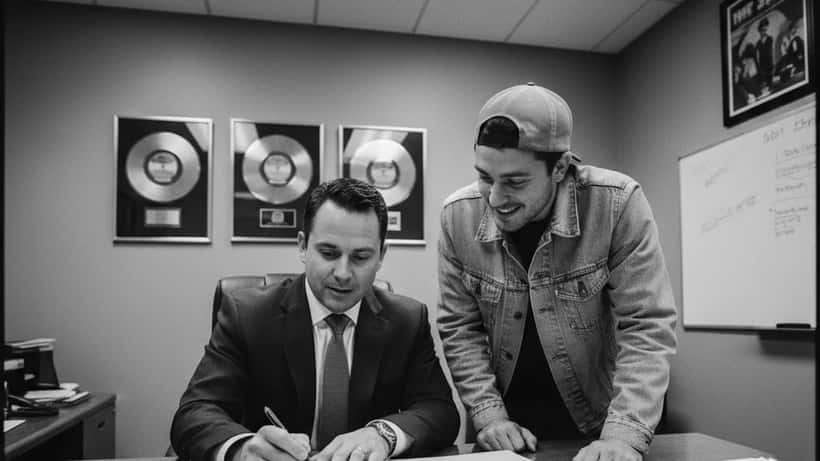
When an artist signs with a major label, they enter a commercial relationship governed by a recording contract. These agreements vary widely in their terms, but most share structural elements that every artist — and every artist's family or manager — should understand before signing.
Recording advances: Labels typically provide an upfront advance against future royalties. The advance is not a gift — it is a loan that must be recouped from the artist's royalty earnings before they see additional income from record sales. An artist can have a chart-topping song and still owe the label money if the advance has not been recouped.
Royalty rates and "all-in" deals: Standard recording royalty rates have historically ranged from 12% to 20% of sales revenue, but "all-in" deal structures, which bundle producer fees and other costs into the royalty pool, can effectively reduce what the artist takes home. Digital streaming has made this more complex: per-stream payouts are fractions of a cent, and the calculation of how they apply to recoupment is a point of ongoing legal dispute in the industry.
360 deals: Many major labels now offer "360 deals," which grant the label a percentage of all the artist's income — not just record sales, but touring revenue, merchandise, publishing, and endorsements. For an artist like Chase Matthew, who is generating income from a 67-date international tour, the difference between a standard deal and a 360 deal can amount to hundreds of thousands of dollars over a career.
Term and option periods: A recording contract may specify an initial term — often for one album — with options that allow the label to extend the deal for additional albums. Option periods are typically exercised at the label's discretion, not the artist's. An artist who has a hit but is still in a multi-option deal may find their creative and commercial freedom constrained for years.
Publishing Rights: The Revenue Stream Most Artists Overlook
Separate from the recording contract is the music publishing agreement. Publishing rights govern the composition itself — the underlying song — as opposed to the recording. For a songwriter like Chase Matthew, who co-writes his material, publishing can ultimately be worth more than the recording royalties.
Publishing agreements can involve the assignment of copyright ownership to a publisher, or a "co-publishing" arrangement where the artist retains a share. The U.S. Copyright Office's Music Modernization Act, signed into law in 2018, updated royalty rules for digital streaming but did not change the fundamental importance of understanding what you are assigning when you sign a publishing deal.
An entertainment attorney can review a publishing agreement before signing and identify terms — like "work for hire" clauses that eliminate the artist's ownership of their compositions — that can be negotiated or removed.
Touring Contracts and Venue Agreements
Chase Matthew's "Holdin' It Down Tour" spans North America and includes international dates. Each stop involves at least one contract: with the venue, the promoter, or both. These agreements specify payment splits, production responsibilities, cancellation clauses, and liability provisions.
For a headlining artist, the key provisions are the guarantee (the minimum payment regardless of ticket sales), the percentage split above the guarantee (if ticket sales exceed a threshold), the "force majeure" clause (what happens if a show cancels due to weather, illness, or other unforeseeable events), and the merchandise split (what percentage of merch revenue the venue takes).
Legal counsel experienced in the music industry can review these agreements to identify unfavorable terms — particularly liability clauses that could expose an artist to financial risk if a show cancels or an audience member is injured.
What Rising Artists Should Do Now
The window between independent success and major-label signing is the optimal moment for an artist to establish legal protections that will compound in value over a career. Specific steps include:
- Consult an entertainment attorney before signing any recording or publishing deal — not after. Post-signing negotiations are significantly harder.
- Register all compositions with ASCAP or BMI to ensure royalty collection is tracked from the first stream.
- Understand what rights you are retaining versus assigning in every agreement.
- Structure touring income properly — touring can generate significant taxable revenue, and an accountant or wealth advisor familiar with the entertainment industry can help artists avoid common mistakes.
ExpertZoom connects artists, creators, and music industry professionals with entertainment lawyers and financial advisors who can provide expert guidance on contract review, rights management, and financial planning for a music career.
Chase Matthew's 2026 trajectory is exactly the kind of moment that defines careers — not just because of the chart positions, but because of the decisions made in the business offices alongside the studios.
This article is for informational purposes only and does not constitute legal advice. Consult a qualified attorney for guidance on specific contractual matters.
Source: U.S. Copyright Office — Music Modernization Act (U.S. Copyright Office)
