 Cora Nelson
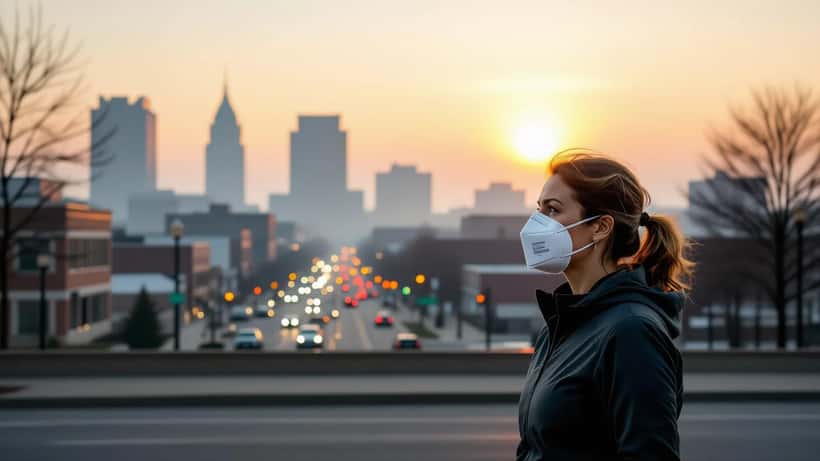
Canadian wildfire smoke drove air quality across Columbus into the "Unhealthy" range on Thursday, July 16, 2026, after the Ohio EPA issued a statewide Air Quality Advisory warning residents to limit time outdoors. The Mid-Ohio Regional Planning Commission (MORPC) had already flagged an Air Quality Alert for the metro area on July 14, and forecasters say hourly pollution spikes could briefly reach "Very Unhealthy" to "Hazardous" levels before conditions ease.
For most healthy adults, a day or two of hazy skies is an irritation. For people with asthma, COPD, heart disease, or young children, the same air can trigger a genuine medical event. Knowing the difference between normal irritation and a warning sign is what keeps a smoky week from turning into an emergency room visit.
What the advisory actually means
The Air Quality Index (AQI) is a 0-to-500 scale. Anything above 100 is "Unhealthy for Sensitive Groups," above 150 is "Unhealthy" for everyone, and above 200 is "Very Unhealthy." According to the Ohio EPA, pollutant levels statewide this week ranged from "Unhealthy for Sensitive Groups" in the southwest to "Unhealthy" across central Ohio, with short-term concentrations at times pushing into the highest categories.
The culprit is fine particulate matter, or PM2.5 — soot particles small enough to slip past the nose and throat and lodge deep in the lungs. Wildfire smoke is especially rich in it. That is why an AQI reading you can check on your phone matters more than how the sky looks: you can feel fine and still be breathing air that is measurably harmful. You can track real-time local readings on the federal AirNow site at airnow.gov.
Symptoms that warrant a call to the doctor
Mild, short-lived symptoms are expected during a smoke event and usually pass once you get indoors. The Ohio EPA lists wheezing, coughing, chest tightness, dizziness, and burning in the nose, throat, and eyes as typical reactions to poor air.
The picture changes when symptoms are severe or refuse to settle. A pulmonologist or urgent-care physician would want to hear about any of the following without delay:
- Shortness of breath that does not improve after you move indoors and rest
- A rescue inhaler that is no longer controlling asthma symptoms, or that you are using far more often than usual
- Chest pain, a pounding or irregular heartbeat, or lightheadedness
- Persistent coughing that keeps you up at night or brings up discolored mucus
- Confusion, extreme fatigue, or a bluish tint to the lips or fingertips — signs to treat as an emergency
For anyone with a chronic heart or lung condition, doctors generally advise having an action plan ready before the air turns bad, not after. That means confirming you have enough medication on hand and knowing at what point your personal symptoms should trigger a call.
Who is most at risk
Sensitive groups feel wildfire smoke first and hardest. That includes people with asthma or COPD, anyone with cardiovascular disease, pregnant women, adults over 65, and children, whose lungs are still developing and who breathe more air relative to their body weight. The Ohio EPA advised that sensitive groups avoid all outdoor activities during the advisory, while the general public should skip strenuous exercise outside.
Even healthy people can develop headaches, fatigue, or a scratchy throat after prolonged exposure. Outdoor workers — landscapers, construction crews, delivery drivers — face a longer dose and should watch for symptoms just as closely as any at-risk patient.
How to protect yourself indoors
Reducing exposure is the most effective single step. Keep windows and doors closed, and if you run central air conditioning, use a MERV-13 or higher-rated filter to capture fine particles, as public health agencies recommend during smoke events. A portable HEPA air purifier can meaningfully lower indoor particle counts in a bedroom or living room.
Avoid anything that adds particles indoors: candles, gas stoves, vacuuming without a HEPA filter, and of course smoking. If your home gets too hot with the windows shut and you have no air conditioning, a public library, mall, or cooling center is a safer place to spend the afternoon than a stuffy, smoke-infiltrated house.
Cloth and paper masks do little against PM2.5. A well-fitted N95 or KN95 respirator is the only mask type that filters fine smoke particles effectively, and it must seal against the face to work.
When professional advice pays off
A single smoky day rarely calls for a doctor. But recurring wildfire smoke — now a regular summer feature across the Midwest — is a reason for people with chronic conditions to revisit their care plan. A physician can reassess asthma or COPD medication, adjust a heart-condition regimen for high-pollution days, and advise pregnant patients or parents of young children on exposure limits.
If you are unsure whether your symptoms are routine irritation or an early warning sign, a telehealth consultation is a low-friction way to get an answer without leaving your filtered indoor air. An expert can review your history, your current symptoms, and the local AQI forecast, then tell you whether to monitor at home or seek in-person care.
Smoke advisories will lift within days as weather patterns shift the plume. Your respiratory health, especially if you live with a chronic condition, is worth a more lasting plan than simply waiting for the sky to clear.
This article is for general information and does not replace personalized medical advice. If you are experiencing severe breathing difficulty, chest pain, or other emergency symptoms, call 911 or seek immediate care.
