 Ava Miller
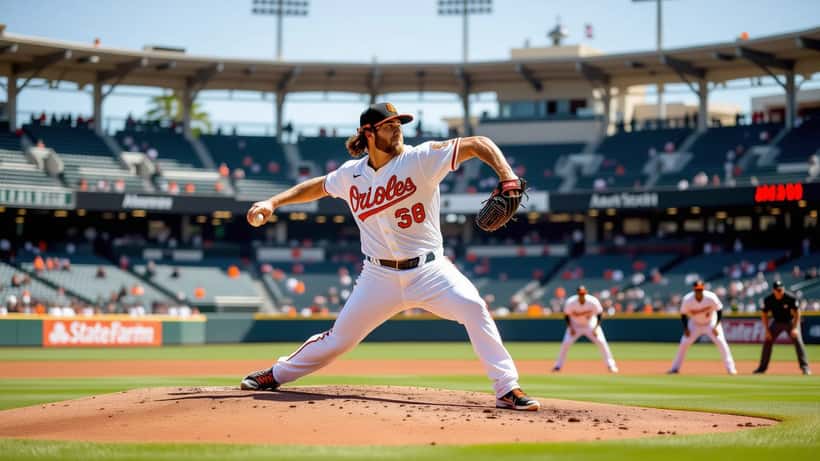
The Baltimore Orioles (37-42) arrived in Anaheim on June 22, 2026 for a three-game series against the Los Angeles Angels (32-47), both teams grinding through a difficult first half. On the mound for Baltimore: Kyle Bradish, the right-hander who signed a one-year, $3.55 million deal this spring after spending the better part of 2024–2025 recovering from Tommy John surgery. His start drew close attention — and not all of it was favorable.
Through 73 1/3 innings in 2026, Bradish carries a 4.83 ERA and a 1.66 WHIP, both above the league average of 4.30. Baltimore media has flagged him as "showing troubling signs," noting that command — rather than pure stuff — appears to be the issue. After a spectacular August 2025 return that saw him strike out 10 Red Sox hitters in six innings, the regression has been notable.
For sports medicine specialists, the Bradish story is familiar: a player clears the surgical timeline, returns to action, receives early praise — and then hits a wall. It raises a question worth asking well beyond Camden Yards: what does a genuinely complete recovery from elbow ligament surgery actually look like?
What Tommy John Surgery Actually Repairs — and How Long Healing Takes
Tommy John surgery, formally called ulnar collateral ligament (UCL) reconstruction, replaces a torn elbow ligament with a tendon graft taken from elsewhere in the patient's body. The operation itself is routine. The recovery is not.
The American Orthopaedic Society for Sports Medicine puts the return-to-pitching timeline at 12 to 18 months for most players, with full ligament maturation continuing for up to 24 months post-surgery. Pitchers face the longest road because every throw places significant valgus stress on the medial elbow — precisely where the reconstructed ligament sits. If Bradish underwent surgery in early-to-mid 2024, his August 2025 return arrived right at the front edge of the recommended window.
That context changes how his 2026 numbers read. A pitcher in month 14 of a 24-month biological process is not the same as one who is simply underperforming. The graft may still be gaining tensile strength. Proprioceptive signals from the rebuilt ligament may still be inconsistent. The body may be compensating in ways that show up as command inconsistency before they show up as pain.
5 Signs Your Elbow Recovery May Not Be Complete
These signals apply whether you're a Major League pitcher or a recreational athlete who had UCL reconstruction after a torn ligament playing tennis, baseball, or overhead sports.
1. Velocity or throwing power that hasn't returned to baseline
One of the clearest markers of incomplete UCL recovery is persistent reduction in throwing velocity or arm speed compared to pre-injury levels. Bradish's strikeout rate held up after his 2025 return, but his 2026 K:BB ratio has narrowed — a sign that execution precision, not raw velocity alone, is affected. In recreational athletes, this often feels like "I can throw, but not like I used to."
2. Aching in the medial elbow hours after activity, not during it
UCL stress often produces dull, post-activity discomfort on the inner side of the elbow — appearing the morning after a game rather than during it. This delayed pain pattern is distinct from the acute sharp pain of an acute tear. If you're noticing medial elbow soreness the day after throwing, overhead pressing, or racket sports, that pattern warrants a sports medicine evaluation.
3. Reduced grip strength on the operated arm
The flexor-pronator muscle group that stabilizes the elbow is anatomically linked to UCL function. Post-surgical grip strength asymmetry — where your operated arm tests noticeably weaker than the other — is one of the first data points a sports medicine specialist measures at follow-up. Persistent asymmetry beyond the expected recovery window is a signal that rehabilitation may be incomplete.
4. Unconscious changes to your mechanics
Bradish's elevated WHIP may partly reflect mechanical drift — subtle, unconscious adjustments his arm is making to protect a still-maturing ligament. Recreational athletes experience this too: a shortened throwing arc, a modified serve, a changed golf swing. These adaptations protect the elbow in the short term but transfer stress to the shoulder, wrist, or opposite side of the body, potentially creating new injury risk.
5. Psychological hesitation about exerting full effort
Return-to-sport readiness has a well-documented psychological dimension. Studies published in sports medicine literature consistently show that fear of re-injury alters mechanics and decision-making even after medical clearance. Athletes who hesitate to throw at full effort — or who consciously pull back in high-leverage moments — have not fully recovered in the functional sense. A sports medicine specialist can offer targeted re-exposure protocols that rebuild both physical confidence and biomechanical trust in the repaired structure.
The Orioles-Angels Series in Context
Beyond Bradish, the June 22 matchup offers a window into what roster fragility looks like when injury history accumulates across a roster. The Angels enter the series at 32-47, a record shaped in part by years of navigating the injury complexities of players like Mike Trout — whose comeback journey and the nutritional strategies that underpinned his 2026 resurgence became one of the season's notable stories.
Baltimore counters with Taylor Ward, a former Angel now starting in an Orioles uniform for the first time facing his old team, hitting .255 with a .748 OPS. Trade transactions, comeback narratives, and mid-career pivots are not limited to professional sports. Any athlete who has undergone elbow surgery knows the competing pressures: the desire to return to a team, a season, a league — versus the body's biological reality.
When Is the Right Time to See a Sports Medicine Specialist?
The American College of Sports Medicine (acsm.org) recommends that athletes who have undergone major elbow surgery maintain an ongoing relationship with a sports medicine physician for at least two full years post-operation. This is proactive monitoring, not crisis management: tracking graft maturation, strength symmetry, movement quality, and psychological readiness together.
If you've had UCL reconstruction and you're returning to throwing or overhead sports, a structured consultation can include functional strength testing, assessment of throwing mechanics, and a personalized return-to-full-load protocol. Early course correction — catching compensation patterns before they become injuries — is significantly less costly than a second surgery.
An Expert Zoom sports medicine or orthopedic specialist can evaluate your specific recovery timeline, discuss imaging or strength testing options, and answer the question Orioles fans are asking about Bradish right now: is this a temporary plateau, or a sign that the arm needs more time?
Disclaimer: This article is for informational purposes only and does not constitute medical advice. Consult a qualified sports medicine physician for evaluation and treatment of elbow injuries or post-surgical recovery.
