 Bernard Stone
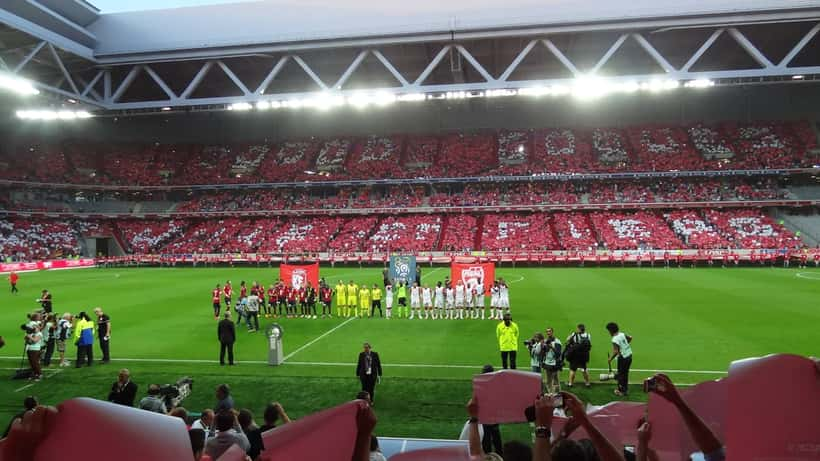
When Lille's squad takes the pitch at Decathlon Arena — Stade Pierre-Mauroy — tonight at 8:45 p.m. Paris time on August 28, 2026, American viewers tracking the opening week of the 2026-27 Ligue 1 season will mostly watch goals. A quieter audience of wealth advisors and family-office managers has been following these two clubs for an entirely different reason: LOSC Lille and Paris Saint-Germain represent the two dominant ownership models in continental European football, and the financial chasm between them is something every US investor eyeing the asset class needs to understand before writing a check.
Lille and PSG: The Same League, Two Financial Universes
Matchday 2 arrived with a table already telling a story. Lille sit atop the early Ligue 1 standings after a 2-0 road win at Angers on August 22. PSG — the defending champions who lifted France's first-ever UEFA Champions League trophy last May — trail with a single point after a 2-2 draw at Rennes. That slim gap in points obscures a breathtaking divergence in financial architecture that goes far beyond current form.
PSG is backed by Qatar Sports Investments (87.5%) and US-based private equity firm Arctos Partners (12.5%). According to CNBC's 2026 Global Soccer Team Valuations, the club generated $904 million in total revenue in the most recent fiscal year — split across $191 million in matchday income, $396 million in commercial activity, and $316 million from broadcast rights. The club carries zero debt as a percentage of enterprise value and posted a 16% year-on-year increase in valuation, with EBITDA of $105 million.
LOSC Lille operates on a structurally different model. Acquired in December 2020 by Callisto Sporting, a vehicle of Luxembourg-based fund Merlyn Partners SCSp, the takeover was partially structured to absorb €123 million in legacy debt — part of a €225 million creditor exposure from the previous ownership. The club has stabilized under president Olivier Létang, won the Ligue 1 title in 2021, and competed in European competition consistently since. It does so, however, with estimated annual revenues of roughly €180-200 million — less than a quarter of PSG's.
Why US Investors Are Flooding Into European Soccer Right Now
The broader market context explains why tonight's fixture is trending far beyond soccer Twitter. According to data published by PE Insights, private equity has deployed $23.7 billion into European soccer, with deal values surging from €66.7 million in 2018 to nearly €2.2 billion in 2024. More than 36% of clubs in Europe's Big Five leagues now carry financial backing from private equity or private debt.
American investors are driving much of that growth. US capital already controls Arsenal, Liverpool, Chelsea, and Manchester United in the Premier League. RedBird Capital owns AC Milan. The Friedkin Group controls AS Roma. In France specifically, Arctos' minority stake in PSG — completed above a €4 billion valuation — was one of the most closely watched sports finance deals of the past three years, signaling that even sovereign-backed football clubs are opening to US institutional capital.
Each of these deals carries a distinct risk profile that most pitch decks gloss over. The PSG-Arctos structure is a minority position with no guaranteed board seat and no fixed exit date. Arctos' return depends on PSG's continued global commercial expansion — a legitimate bet given the club's $396 million commercial base — but one that is directly vulnerable to a single regulatory variable: UEFA's Financial Sustainability Regulations. As detailed in UEFA's official framework, clubs exceeding the permitted squad cost ratio face transfer embargoes, point deductions, or European competition bans. That is a risk few due-diligence memos from 2022 adequately priced in.
A US Family Office Faces the Numbers
Consider a scenario that a growing number of US wealth managers are navigating in 2026. A 53-year-old tech founder — let's call them the Harrington family — holds a $16 million diversified portfolio. Their advisor is evaluating a proposal to allocate 7%, or $1.12 million, into a minority stake in a mid-tier Ligue 1 club, structured through a Luxembourg Special Purpose Vehicle. The projected IRR is 12-15% over a seven-year hold, with the exit tied to either a trade sale or a secondary private equity transaction.
Here is precisely where specialist advice changes the outcome:
If the club misses European competition in Year 3, its projected revenue drops by an estimated €25-40 million. UEFA's minimum distribution for a Champions League group-stage participant from France is approximately €18.6 million — money that does not arrive if the club finishes seventh instead of fourth. That revenue shock compresses EBITDA and delays the exit window by an estimated two to three years, fundamentally altering the deal's IRR.
If UEFA's Financial Sustainability Regulations trigger a monitoring review — initiated whenever a club has overdue payables to other clubs, employees, or tax authorities — the fund's ability to bring in a buyer at the agreed valuation is severely curtailed. No credible acquirer wants to inherit a club under active UEFA scrutiny.
The if/then the pitch deck omits: if the Harrington family's $1.12M tranche is part of a €40M capital raise, and club revenue falls 15% short of projection due to missed European qualification in Year 3, the realized IRR drops from 13% to approximately 6.5-7.5% — below the 8% hurdle rate most institutional LPs require. On a seven-year timeline, that swing translates to a net return difference of €200,000 to €280,000 on their allocation. A wealth advisor without cross-border sports investment expertise is unlikely to model that scenario. One who specializes in alternative assets will.
If you are curious how the Champions League prize money structure affects clubs across different market sizes, the Fenerbahçe vs. OL Champions League financial analysis published earlier this season breaks down how those distributions ripple through a club's full P&L.
Five Due-Diligence Points Most Advisors Miss
As "LOSC vs PSG" trends across every US sports platform tonight, it will predictably generate a spike in queries about European soccer ownership and investment. Before any commitment, a qualified wealth advisor will walk through at least five structural questions that standard prospectuses rarely address:
1. Anchor type: sovereign vs. PE fund lifespan. PSG's QSI backing means the club can absorb short-term losses indefinitely — Qatar's sovereign wealth capacity is effectively unlimited. A Merlyn-type structure has a fund life of 10-12 years, meaning the exit is not optional. Investors in the latter face a forced liquidity event regardless of market conditions.
2. Revenue concentration. If more than 50% of revenues come from collectively negotiated broadcast rights, a league-level TV deal downgrade — such as the restructuring Ligue 1 faced in 2022-2024 — hits every club simultaneously and cannot be hedged at the club level.
3. Stadium ownership vs. stadium lease. PSG leases Parc des Princes from the City of Paris. Lille plays at a municipally owned venue. Neither club controls its primary physical asset, which limits both their balance sheet optionality and their ability to generate stadium-based real estate value — a growing revenue lever for US sports franchises.
4. Player amortization dependency. French clubs collectively generated an estimated €920 million in player sales during the 2025 transfer window. Any club whose financial model depends on annual net player sales of €60-80 million to remain UEFA-compliant is, structurally, running a leveraged bet on its own scouting and development pipeline.
5. Currency exposure. All revenues are euro-denominated. A US investor bears full USD/EUR exchange rate risk unless the SPV structure includes a currency hedge — and most do not, particularly at the mid-market deal size.
Getting the Right Expert Before the Final Whistle
Tonight's LOSC-PSG fixture is a genuinely compelling piece of football. It is also a live case study in how dramatically different two clubs competing under identical league rules can be from a capital structure perspective.
For any US investor who has seen the headlines, fielded a pitch from an emerging sports fund, or simply wondered whether European soccer club ownership belongs in the alternatives sleeve of a well-structured portfolio, the question is not whether the asset class is interesting — it clearly is. The question is whether your wealth advisor has the specialized expertise to evaluate it properly.
A certified wealth management professional with cross-border investment experience can model the specific downside scenarios a prospectus glosses over, assess the regulatory exposure under UEFA's Financial Sustainability Regulations, and determine whether the currency, liquidity, and governance risks are compatible with your broader financial plan. The stakes in European football have never been higher — and neither has the complexity.
This article is for informational purposes only and does not constitute financial or investment advice. Consult a qualified financial advisor before making any investment decisions.
