 Bernard Stone
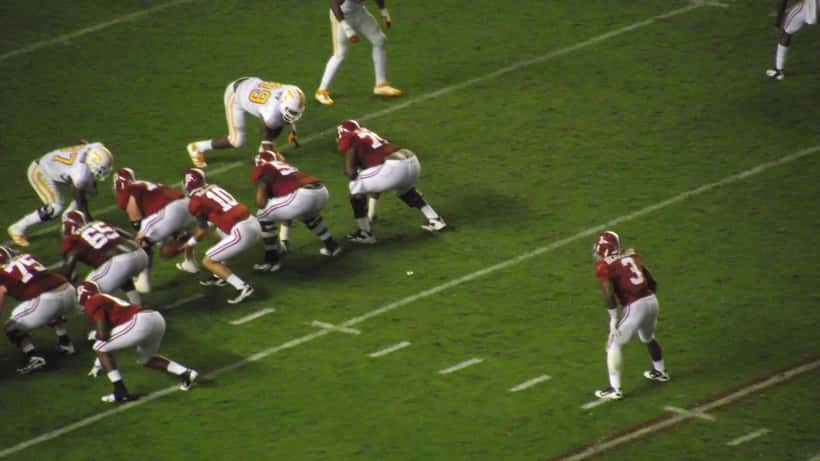
Keelon Russell walked into Bryant-Denny Stadium in September 2026 as an unproven sophomore and left as one of the most discussed quarterbacks in the country. Five weeks later, Alabama is 5-0, Russell carries a 92.5 PFF grade — second among 272 FBS starting quarterbacks — and Heisman Trophy conversations are running on every major sports platform. Behind the highlights, however, a quieter and equally significant story is unfolding: how a 19-year-old athlete navigates a financial landscape that did not exist five years ago, and what the moment reveals about what college athletes in 2026 should actually be doing with the money.
The New Economics of College Football in 2026
Russell's $1.7 million On3 NIL valuation is not exceptional by Power Four standards in 2026 — starting quarterbacks at flagship programs routinely reach similar figures. What is exceptional is the speed at which his value arrived. Russell signed his first NIL deal with Panini America for exclusive autograph trading cards before he had taken a single college snap. He subsequently signed with Team IFA, one of the more active sports representation agencies operating in the NIL era. His profile has grown with every completion, every highlight-reel scramble, and every week that Alabama's win column extends.
The revenue-sharing framework introduced by the House v. NCAA settlement, which came into effect for the 2025–26 academic year, adds a distinct new layer to athlete compensation. Schools are now authorized to share revenue directly with athletes — distributed across all sports from pools that reach roughly $20 million per institution per year. Alabama's NIL collective, Yea Alabama, used this structure to retain Russell when he weighed his options ahead of the 2026 season. What was once an informal arrangement between third-party collectives and athletes is now a formalized contractual relationship between a player and a university.
For a 19-year-old who may have filed taxes independently for the first time last spring, the combination of brand-deal royalties, trading-card agreements, and institutional revenue-sharing payments creates a financial picture more complex than most adults encounter in a decade. Wealth managers who specialize in athlete compensation say the pattern is nearly universal: young athletes earning significant NIL income for the first time make the same three costly mistakes.
What Financial Experts Say Athletes Consistently Miss
The first blind spot is the self-employment tax. NIL brand deals are classified as self-employment income by the Internal Revenue Service, which means the athlete owes not only federal income tax but also a 15.3% self-employment (SE) tax on net earnings — the portion that a traditional employer would withhold automatically. According to IRS guidance on self-employment tax, an athlete earning $45,000 in brand deals in a calendar year could owe roughly $6,885 in SE tax alone, before any federal or state income tax. Many college athletes encounter this figure for the first time when a tax bill arrives in April.
The second blind spot is the quarterly estimated tax requirement. Self-employed individuals — which college athletes with NIL income effectively are — must make estimated tax payments four times per year or face underpayment penalties. Most first-year earners skip this step, because no employer is sending a W-2 or withholding anything. The result is a penalty that compounds a tax burden that already arrived as a surprise.
The third blind spot is the absence of retirement savings infrastructure. An employee at a company benefits from employer-matched 401(k) contributions. A 19-year-old college athlete has no equivalent mechanism unless they build one proactively. A Roth IRA — with a 2026 contribution limit of $7,000 for earners below the income ceiling — allows athletes with earned income to begin building tax-free growth immediately. For athletes approaching higher income thresholds, a SEP-IRA offers contribution potential up to 25% of net self-employment income. Every year these accounts are not opened is a year of compounding foregone.
When the Numbers Become Real: A Concrete Case
Consider the situation faced by a 20-year-old starting quarterback — call him Marcus — at a Power Four school who begins his sophomore season with roughly $1.5 million in NIL valuation. In his first active earnings year, he receives $45,000 in brand partnership fees and $20,000 through his school's institutional revenue-sharing pool, for a combined $65,000 in athlete compensation.
Without financial planning, Marcus's tax exposure works out as follows: the $45,000 in NIL income triggers $6,885 in federal SE tax (15.3%). Combined federal income tax on the full $65,000 at the 22% marginal bracket adds approximately $14,300. His home-state income tax — at Alabama's 5% flat rate — adds roughly $3,250. Because Marcus made no quarterly estimated payments, the IRS assesses an underpayment penalty of around $420. His total tax obligation lands near $18,370, representing approximately 28% of total income, arriving as a lump sum he did not anticipate and has not set aside.
If Marcus had worked with a financial advisor and CPA who set up a single-member LLC for NIL activities, established quarterly estimated payments of roughly $4,000 per quarter, and maximized a Roth IRA contribution of $7,000 — the result shifts significantly. He avoids the $420 underpayment penalty. The Roth contribution is made before age 21, starting tax-free compounding growth during the highest-return window of his life. The LLC structure creates a clean paper trail that simplifies future endorsement negotiations and potentially allows deduction of legitimate business expenses. Over a three-year college career, the compounded difference between a planned and unplanned approach in penalties avoided, tax efficiency captured, and retirement assets seeded routinely exceeds $30,000, according to CPAs who specialize in athlete compensation structures.
If Marcus makes the NFL, that head start on financial discipline becomes the foundation for professional-level wealth management. If he does not, it is the difference between entering adult life with assets and entering it with a tax gap.
The Revenue-Sharing Variable That Changes the Game
What makes 2026 categorically different from 2024 for college athletes is not the NIL marketplace itself — that has existed since 2021 — but the institutional revenue-sharing structure created by the House settlement. Under prior rules, athletes received income from third-party brands and collectives but not directly from their schools. That distinction mattered for how income was classified, how it was reported, and what financial and legal obligations it created.
Under the current framework, school-to-athlete revenue-sharing payments carry a different contractual character. These are not gifts or educational stipends — they are negotiated agreements with performance terms, exclusivity provisions, and in some cases transfer restrictions that can affect an athlete's ability to move programs or protect their market value elsewhere. Many athletes sign these agreements without legal review, assuming the school's collective or program has their interests at heart. That assumption is not always warranted.
Athletes who sign institutional revenue-sharing contracts now hold binding documents that may include clawback language, endorsement restrictions, or clauses that interact with existing brand deals in ways the athlete did not anticipate. A single afternoon with a sports attorney to review such a contract costs a fraction of what a drafting oversight can create in complications. The experience of the prior NIL generation — athletes who lost brand deals because collective agreements contained dormant exclusivity provisions — is instructive.
What College Athletes Should Do Before the Next Signing
The most consequential financial decisions for a college athlete with significant NIL income are not made post-graduation. They are made during the first year of earning. The window to open a Roth IRA, elect a business structure, and set up estimated tax payments opens the moment income arrives. It cannot be retroactively improved.
For athletes projecting $20,000 to $50,000 in combined NIL and revenue-sharing income, the annual cost of a qualified financial advisor with athlete experience — typically between $1,500 and $3,000 — is almost invariably recovered through tax efficiency in the first year. For athletes approaching $100,000 and above, the absence of professional guidance becomes materially expensive. Russell's decision to retain an established representation agency before his valuation peaked reflects exactly the kind of early positioning that advisors recommend — and the same logic extends to the financial side of athlete life.
Similar planning principles apply across college sports. Kickers, wide receivers, and basketball players navigating their own NIL valuations face structurally identical questions, as explored in coverage of Tate Sandell's NIL planning situation at Oklahoma. The position changes. The tax code does not.
The opportunity Keelon Russell represents — not as a subject, but as a signal — is that the college athlete earning $1 million in NIL valuation in 2026 is no longer an anomaly. The infrastructure to manage that income responsibly exists. Whether a young athlete taps into it early or learns the hard way is, in most cases, a single phone call to an expert.
This article is for informational purposes only and does not constitute personalized financial or tax advice. Consult a licensed financial advisor and CPA for guidance specific to your situation.
