 Carl Graham
Jeanie Poling, the guitarist, banjo player, and upright bass performer who spent 42 years at the center of San Francisco's bluegrass community, died on August 26, 2026, at age 67. Her death, following a 3.5-year battle with two rare forms of cancer, left behind a beloved musical legacy — and raised urgent questions about what happens to a working musician's creative work, royalties, and rights when they can no longer speak for themselves.
Who Was Jeanie Poling?
Born in Amityville, New York on January 23, 1959, Poling moved to San Francisco and built a life that was equal parts musician and community anchor. Despite standing barely five feet tall, she modified instruments to fit her reach and mastered guitar, banjo, and upright bass — earning the nickname "the human jukebox" from fellow musicians who marveled at her command of thousands of songs across bluegrass, pop, Motown, show tunes, and R&B.
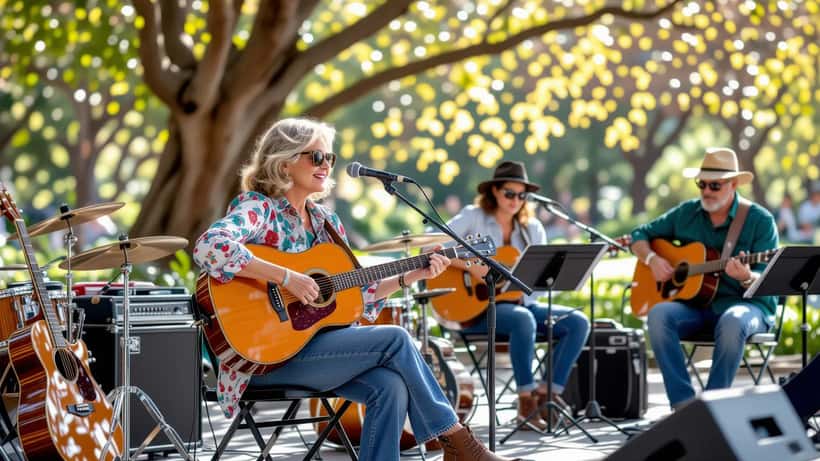
For 20 consecutive years, she and her husband Chuck co-hosted the Bluegrass Country Jam at the Plough and Stars on Clement Street — weekly three-hour sessions that drew 15 to 30 performers and became a neighborhood institution. She organized the annual Bluegrass Pickin' Picnic in Golden Gate Park and ran Free Range Fridays, a series of showcases at local cafes that gave first-time performers their introduction to live stages. She performed with Chickwagon Junction, BettyJacks, and the Fillmore Four, in addition to Jeanie and Chuck's Country Roundup, a 42-year musical partnership with her husband.
Mick Hellman, a close friend and fellow bluegrass musician, said she "gave so many people their first stage experiences" and was "warm and personable." She also served as a San Francisco city planner and PTSA president — the rare musician whose impact extended equally into civic life.
She was diagnosed with two rare forms of cancer in January 2023 and died at UCSF Stanyan on August 26, 2026.
The Legal Reality Behind a Musician's Legacy
Under U.S. copyright law, a songwriter's original compositions are protected for their lifetime plus 70 additional years. That means Jeanie Poling's original works did not expire on August 26 — they transferred to her estate and, from there, to her heirs. The question is not whether her work survives her legally. The question is whether anyone has the documentation to claim it.
For independent musicians — those without major label contracts, publishing deals, or music attorneys on retainer — copyright ownership is often informal at best. Songs are co-written at jams and on porches, arrangements are shared without written credit, and recordings exist on hard drives that only the creator knows how to find. When the musician dies, the trail goes cold.
According to the U.S. Copyright Office, registration of a musical work establishes a legally enforceable public record and is a prerequisite for suing over infringement. Without registration, a musician's heirs may have a valid copyright — but limited ability to enforce it. Registration costs as little as $65 per individual work, or $85 for a group registration of unpublished collections.
The Expert Angle: Why a Music Attorney Matters Now
Music law attorneys describe two types of estates they encounter after a working musician's death: those with documents, and those without. The difference, in practical terms, is often thousands of dollars and years of family conflict.
A musician who spent 42 years performing in bands with shifting membership — as Poling did across multiple acts — likely created a complex web of shared intellectual property. A song co-written with a bandmate in 1995, performed together for a decade, and later split across two separate projects may have three or four parties who could credibly claim ownership. Without a band agreement drafted at the time, or at minimum contemporaneous documentation of each party's contribution, any dispute is settled by litigation — not legacy.
California law adds another layer. As a community property state, California presumes that assets acquired during marriage — including intellectual property — belong equally to both spouses. This can work in a surviving spouse's favor, but it can also conflict with prior band agreements or a musician's expressed wishes about how their work should be used after death.
A music attorney can also ensure affiliation with a Performance Rights Organization: ASCAP, BMI, or SESAC. These organizations track and distribute royalties whenever a registered song is performed publicly, broadcast on radio, or streamed online. Without active PRO affiliation, those royalties may go uncollected — or, worse, collected by someone who has no rightful claim.
What Happens When There Is No Paper Trail
Consider a musician who, like Jeanie Poling, spent four decades performing across multiple bands, co-wrote songs informally, and maintained recordings on personal hard drives. No copyright registrations were filed. No band agreement exists. No will specifically names who inherits the musical catalog.
Here is what unfolds if a dispute arises:
If a co-bandmate claims 50% ownership of six songs written together in the early 2000s, then the estate must go to probate court to challenge it. Legal fees for a contested intellectual property dispute in California start around $8,000 and commonly exceed $20,000. The commercial value of six self-released folk songs may fall well below that threshold — making litigation economically irrational even when the estate is legally in the right.
If, on the other hand, those six songs had been registered as a group collection ($85 at the time of registration), a signed band agreement had specified contribution percentages, and a properly drafted will named a music executor — the transfer would be administrative, taking weeks instead of years and costing a fraction of that amount.
For a catalog spanning 42 years and four bands, the gap between these two scenarios is enormous. The Bluegrass Country Jam ran for 20 years and produced dozens of arrangements — real intellectual property with real value to the San Francisco music community, and potentially to streaming platforms, archives, and documentary filmmakers. Thousands of independent musicians across the United States are currently in the undocumented scenario, and most won't discover it until a health crisis removes the opportunity to fix it.
What Music Attorneys Recommend
Music and estate planning attorneys who specialize in creative professionals outline a three-part baseline for any working musician:
1. Register original compositions with the U.S. Copyright Office. Group registration of unpublished collections costs $85 and covers multiple works in a single filing. For working musicians with large catalogs, this is the highest-leverage step available — and the one most often skipped.
2. Affiliate with a Performance Rights Organization. ASCAP, BMI, and SESAC each offer registration options. PRO membership ensures that royalties generated by public performance of your songs — including after your death — can be tracked and distributed to the right beneficiaries.
3. Draft a music-specific estate plan. A standard will handles bank accounts and real estate. A music-specific plan designates a "music executor" who understands the catalog, names beneficiaries for specific works, and states clearly whether and how the musician's work can be licensed after death. Without documentation, courts guess.
For musicians in community-based scenes, a fourth step matters equally: band agreements. A one-page document specifying each member's percentage of authorship in jointly created works takes less than an hour to draft and prevents years of post-death conflict.
Protecting Your Creative Legacy Before You Need To
Jeanie Poling spent four decades ensuring that other musicians had the resources, stages, and community they needed to grow. The musicians she mentored — Avery Hellman, Nancy and the Lambchops, and dozens of first-timers at the Plough and Stars — carry her musical influence forward in ways no legal filing can fully capture.
But protecting the tangible legacy — the recordings, the compositions, the arrangements that made her "the human jukebox" — requires documentation that most working musicians delay until it is too late. Stories similar to Poling's have surfaced repeatedly in recent years: the estate of Rubettes guitarist Tony Thorpe and the unresolved rights questions surrounding Argentinian rock icon Indio Solari both show that even deeply beloved artists can leave behind a legal puzzle their families must solve under the worst possible circumstances.
The time to act is not after a diagnosis. It is now, while the music is still being made.
This article is provided for informational purposes only and does not constitute legal advice. Consult a licensed attorney for guidance specific to your situation.
If you are an independent musician with unregistered compositions, unsigned band agreements, or no music-specific estate plan, a consultation with a music attorney is the most direct step available. Expert Zoom connects you with lawyers who specialize in entertainment and intellectual property law — on your schedule, without a retainer.
