 Cora Nelson
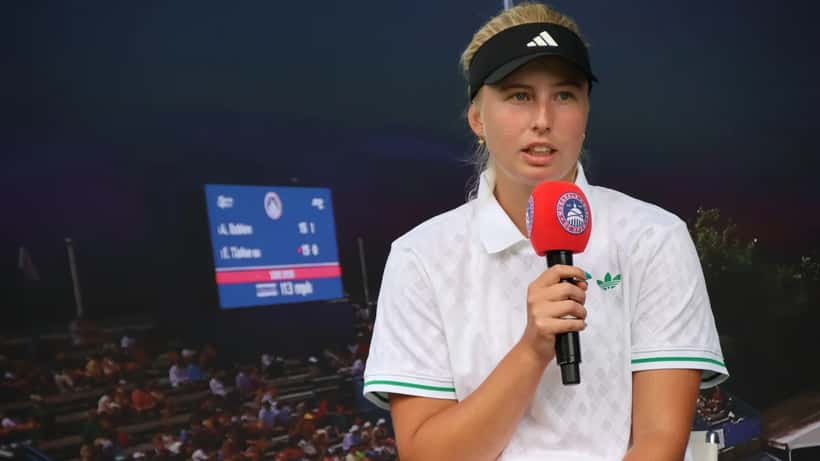
Clara Tauson arrived at the 2026 WTA season ranked inside the top 20, fresh off winning in Auckland and reaching her first career WTA 1000 final in Dubai. By late spring, her calendar was empty — not because she ran out of tournaments, but because her body kept failing her in a way that perplexed even seasoned observers: a back injury, then a shoulder injury, then a back injury again.
A Season Derailed by Cascading Injuries
The pattern began in Miami, where Tauson retired mid-match against Katie Boulter due to low-back pain. She withdrew from Stuttgart and Linz while she recovered, then targeted the Mutua Madrid Open for her return. But before she could step onto a Madrid clay court, a new right shoulder problem emerged. She withdrew again. Lucky loser Anna Blinkova took her spot.
Tauson eventually returned at the Internazionali BNL d'Italia in Rome in May, but retired in the second round against Oleksandra Oliynykova — back pain, again — after one hour and 51 minutes on court.
Three separate injury episodes. Two different body regions. One dangerous, repeating cycle that has a name in sports medicine: compensatory overload injury cascade.
The phenomenon is not unique to elite tennis. According to the American Academy of Orthopaedic Surgeons, secondary injuries caused by compensatory movement patterns account for a significant share of musculoskeletal setbacks in both professional and recreational athletes. Understanding how and why this happens — and what it means for anyone who plays a racquet sport or trains regularly — could be the difference between a week on the bench and six months on the sideline.
Why One Injury Triggers Another: The Science Behind the Cascade
When a professional like Tauson absorbs a back injury, the instinctive response is to protect the painful area. The brain reroutes movement. Muscles that don't normally carry a particular load start compensating for the ones that have backed down from their job.
In tennis, the serve and overhead motions rely on a kinetic chain that flows from the legs through the core and into the shoulder. When the lower back becomes inflamed and painful — as Tauson experienced in Miami — that chain breaks. The shoulder is suddenly forced to do more than its share of the work. It absorbs rotational forces that should be distributed across multiple muscle groups. Do that often enough, during practice or in a single high-intensity match, and you get exactly what Tauson got: a shoulder problem on top of a back problem.
This is not simply bad luck. It is the predictable consequence of returning to competition before the original injury site has been properly stabilized and rehabilitated. The WTA medical team and Tauson's own coaches would be well aware of this risk. For recreational players, the stakes are lower but the mechanism is identical.
"The most common mistake we see from recreational athletes after a soft-tissue injury is premature return to full activity," says the AAOS in its patient education materials. "Returning before the injured area has regained full strength and range of motion significantly increases the risk of a secondary injury — often in an adjacent joint or muscle group."
Tauson's back inflammation did not give her enough time to rebuild the stabilizing muscles around her lumbar spine before Rome. The cascade continued.
The Recreational Player Who Refused to Stop: A Scenario With Real Numbers
Consider the situation of a 38-year-old recreational tennis player — call her Sarah — who plays at a local club in Dallas three mornings a week. In February, she twists awkwardly during a doubles match and feels a sharp pull in her lower back. She ices it, takes ibuprofen, and is back on court five days later because "it feels 80% better."
What happens over the following six weeks illustrates Tauson's situation in a compressed, non-professional version.
Because Sarah's lumbar stabilizers — specifically the multifidus and erector spinae muscles — have not fully recovered, her serve begins to rely more heavily on her right rotator cuff and deltoid. This overload is invisible to her: she feels no shoulder pain initially, only fatigue.
By week four, she notices tenderness in the front of her right shoulder after matches. She ignores it. By week six, she serves into the net on a ball she normally makes easily and feels a pop. An MRI confirms a partial rotator cuff tear: Grade II, affecting approximately 40% of the supraspinatus tendon.
The financial and time cost of that decision to return at "80%": an orthopedic consultation ($180 after insurance), physical therapy 3× per week for 12 weeks ($60 per session after insurance = $2,160), and a total of 14 weeks off the court — nearly four times the rest period her original back injury required.
If the original back injury had been assessed by a sports medicine physician who cleared her only after confirming that lumbar stabilizer strength tested at 90% of baseline — the AAOS's standard threshold — Sarah would have lost three additional weeks before returning. Instead, she lost fourteen.
The math is straightforward: rushing back costs more, not less.
The Specific Warning Signs That Should Send Any Athlete to a Specialist
Not every ache requires a physician visit. The challenge for athletes — recreational or professional — is knowing the difference between normal training soreness and a structural warning signal.
Orthopedic and sports medicine guidelines point to several symptoms that should stop any athlete from returning to their sport until they have been evaluated by a specialist:
Pain that changes location. If a back injury is resolving but you suddenly notice new discomfort in your hip, shoulder, or knee during activities that didn't bother those areas before, compensatory overload has likely begun. This is the clearest early signal that the original injury site has not yet been stabilized.
Asymmetry in movement. If you find yourself unconsciously altering how you swing, lift, or run to protect the original injury site — leaning to one side, raising your opposite shoulder, shortening your stride — your nervous system has already rerouted the kinetic chain. This is a clinical indicator, not just a feeling.
Loss of power without pain. A serve that used to travel at 95 mph that now tops out at 80 mph, with no obvious discomfort, is not a sign of fatigue. It is a sign that the muscle groups normally responsible for generating that power have disengaged, often because of an unresolved injury somewhere in the kinetic chain.
Night pain. Pain in a joint or muscle that wakes you from sleep or is present first thing in the morning — before any activity — is categorically different from soreness after exercise. It typically indicates inflammation or structural damage rather than simple overuse.
The "80% rule" trap. Many recreational athletes — and some professionals — follow the intuitive but misleading guideline of "I'll return when it feels about 80% better." Sports medicine specialists consistently note that the sensation of 80% recovery often corresponds to only 40–60% of functional tissue strength in the affected area. Subjective pain is a poor proxy for structural readiness.
Returning Safely: What Proper Clearance Looks Like
A qualified return-to-sport assessment from a sports medicine physician or physiotherapist does not simply ask whether you are in pain. It evaluates whether you can perform sport-specific movements — at game speed — without compensating. For a tennis player, that means serving at 90% effort without visible trunk rotation asymmetry, lateral movements without favoring one side, and overhead motion through full range without substituting shoulder elevation for thoracic extension.
This evaluation cannot be replaced by rest alone. Rest reduces inflammation; it does not rebuild the neuromuscular control that prevents compensatory movement.
Clara Tauson has the resources of a professional sports medicine team. Even so, her 2026 season shows how difficult it is to break the cascade once it has started — and how much easier it is to prevent it by investing an extra week or two in the original injury, not weeks or months managing its consequences.
Amateur athletes rarely have access to the same level of medical support, which is precisely why the decision to consult a health specialist before returning to sport matters more, not less, in non-professional settings. An evaluation that costs a few hundred dollars and a few days can prevent an injury — and treatment cycle — that costs thousands of dollars and months.
According to orthoinfo.aaos.org, athletes who complete a formal return-to-sport program supervised by a physiotherapist or orthopedic specialist have a re-injury rate approximately 50% lower than those who return based on subjective pain assessment alone.
Tauson is expected to return to the WTA circuit in the second half of the 2026 season. Other professionals who have navigated similar injury cycles — including Bianca Andreescu, whose 2026 comeback story illustrates the same return-to-sport challenges — show that full recovery is possible, but only when athletes resist the urge to shortcut the rehabilitation process. Her back and shoulder will be monitored carefully. The question for every recreational athlete reading her story is simpler: the next time you feel 80% better, will you wait for 100% — or will you repeat the cascade?
Health and injury information in this article is educational and does not replace a consultation with a licensed healthcare professional. If you are experiencing persistent pain or recurring sport injuries, consult a qualified specialist.
