 Isabella Torres
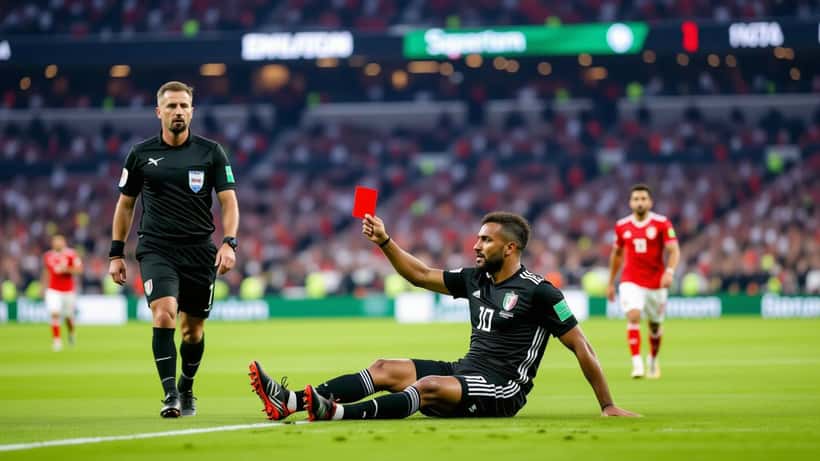
In the 67th minute of Belgium's Group G opener against Iran on June 21, 2026, in Los Angeles, defender Nathan Ngoy made a split-second decision that changed the match. Mehdi Taremi broke clear as Belgium's last man, and Ngoy hauled him down to stop an obvious goal. Referee Darío Herrera produced a straight red card. No VAR review was needed. Belgium played out the final 23 minutes with ten men, and a Taremi goal that threatened to break the deadlock was later ruled offside.
The scoreline stayed 0-0, but Ngoy's dismissal will reverberate into Belgium's next group game — and it raises a question that players, clubs, and agents ask every time a red card drops at a major tournament: what are the player's rights now?
What Triggered the Red Card
FIFA's Laws of the Game call this offense "denial of an obvious goal-scoring opportunity," known in referee circles as DOGSO. When an attacker is clearly through on goal and a defender stops them by any means — a trip, a hold, a sliding challenge — the referee is required to show a red card if the defender was the last man and no other defender could have intercepted the ball.
There was no ambiguity in Los Angeles. Taremi had the angle, the pace, and the open net in his sights. The red card was textbook DOGSO, which is why VAR had nothing to review. The technology confirms; it does not correct what was already correct.
The incident adds to a striking statistic at the 2026 World Cup: through 27 group-stage matches, referees have already shown 8 straight red cards — more than the total for both the 2018 and 2022 editions combined. The expanded 48-team format means more matches, more pressure, and more high-stakes moments where a single foul can end a player's tournament.
The Automatic Suspension: What Happens to Ngoy
A DOGSO red card at the World Cup triggers a minimum one-match automatic suspension under FIFA Disciplinary Code, Article 12. Ngoy will miss Belgium's next group fixture. He cannot play until FIFA's Disciplinary Committee formally notifies the Belgian Football Association, which happens within 24 hours of the match.
The committee classifies red card offenses on a scale:
- Tactical foul / second yellow card: 1 match minimum
- Serious foul play (reckless challenge with excessive force): 2 to 3 matches
- Violent conduct (striking, elbiting, deliberate aggression): 3 matches minimum
- Assault on officials or extreme violence: tournament expulsion, plus a future international ban
Ngoy's offense sits at the lowest tier — a tactical foul to stop a counterattack, with no evidence of reckless force or dangerous play. The one-match ban should stand unless the committee views a replay and sees something the referee missed.
There is one additional wrinkle: if Belgium are eliminated before Ngoy can serve his ban in full, the suspension carries over to their next official international, no matter when that is. World Cup suspensions do not expire at the end of the tournament.
Can Belgium Appeal? The 24-Hour Window
Under FIFA's Disciplinary Code, the Belgian Football Association has exactly 24 hours from receipt of the committee's decision to lodge a formal appeal with FIFA's Appeal Committee. In practice, appeals against straightforward DOGSO red cards succeed only in exceptional circumstances — typically when the committee finds that the offense did not meet all four conditions for the decision (last man, no other defender, contact was intentional, goal-scoring opportunity was genuine).
For Ngoy's dismissal, all four conditions appear satisfied. Appeals that proceed despite weak grounds carry additional risk: the Appeal Committee can increase a sanction if they judge the original penalty was too lenient. A team asking to have a one-match ban overturned risks turning it into two if the committee decides the challenge showed more recklessness than the initial ruling recognized.
That risk calculus is exactly where a sports law attorney earns their fee. The question is not simply "can we win the appeal?" but "does the probability of success outweigh the probability of an upward revision?" Clubs and national federations that have experienced legal support on disciplinary matters navigate that calculation with data — precedent cases, committee tendencies, referee profiles — rather than emotion.
Disclaimer: This article discusses FIFA disciplinary procedures for informational purposes only. It does not constitute legal advice. Players, agents, and national federations facing disciplinary decisions should consult a qualified sports law attorney.
Yellow Card Accumulation: A Separate Risk
While the red card suspension dominates headlines, Belgium's remaining players now carry heightened yellow card risk. FIFA resets yellow card accumulations at the end of the group stage, not during it. Any Belgian player who picks up two yellow cards across their three group matches will miss the round of 16.
In a tournament where Belgium needed every goal and every man on the pitch, the 23 minutes of ten-man football against Iran may prove costly even beyond Ngoy's absence from the next match.
What a Sports Lawyer Actually Does in These Situations
Disciplinary proceedings at FIFA level are more procedurally complex than they appear. A sports law attorney working with a national federation during the World Cup typically handles three parallel tracks:
First, they review the match footage against the committee's written ruling to identify any factual inaccuracies — a wrong minute recorded, a misidentification of the last defender's position, or an error in the four-condition analysis.
Second, they prepare precedent research. FIFA's Disciplinary Committee does not always apply the code identically across cases. An attorney can identify comparable DOGSO incidents from recent tournaments and argue for consistency in sentencing.
Third, they manage timelines. The 24-hour appeal window is strict. Missing it means the original ruling becomes final, regardless of its merits. Having legal counsel on standby during a tournament is not a luxury for top-tier national teams — it is standard operational procedure.
For Ngoy, the Belgian Football Association's legal team will almost certainly assess the footage tonight and make a decision on appeal before the morning. The outcome will determine which players are available for Belgium's second group match.
You can review FIFA's full Disciplinary Code, including the rules governing red card suspensions and appeal rights, at the official FIFA legal statutes page.
When Red Cards Become Legal Cases
Most red cards at the World Cup are processed, served, and forgotten within a week. But some escalate. A ban that carries over into qualifying, a suspension that disqualifies a player from a final, a committee ruling that a one-match sanction should have been three — these create real legal and financial consequences for players with professional contracts tied to tournament performance.
The parallel to employment law is direct. A red card in a major tournament is, in legal terms, a summary disciplinary action taken against a professional during the course of their employment. The procedural safeguards — written notification, appeal rights, a defined timeline — exist for the same reason they exist in any regulated industry: to ensure that decisions affecting livelihoods are made fairly and transparently.
If you or someone you represent faces a sports disciplinary decision with career consequences, speaking to a qualified sports law attorney who understands both FIFA regulations and national labor law is the right first step. The appeal window is short. The precedent matters long after the tournament ends.
