 Michael Campbell
With Texas quarterback Arch Manning putting up 305 passing yards and four touchdowns in his 2026 season opener — and mock draft boards already penciling him in as the likely No. 1 overall pick in 2027 — his every move is under a microscope. But the question that matters most for him and tens of thousands of college athletes right now has nothing to do with football: how do you protect the money that's finally, legally yours?
The House Settlement Changed Everything in 2025
After years of NCAA restrictions, the House v. NCAA settlement — approved in July 2025 — created a direct revenue-sharing system that allows universities to pay student-athletes up to 22% of average revenues from media rights, ticket sales, and sponsorships. For the 2025–2026 academic year, that cap is set at $20.5 million per institution, according to a Congressional Research Service analysis. That figure is projected to rise to approximately $33 million per school by 2035.
For a player like Manning at a flagship SEC program like Texas, this is not theoretical money. It's real, it's significant, and — critically — it doesn't come with a financial advisor attached.
The settlement also authorized $2.8 billion in back-pay damages over 10 years to approximately 184,000 former Division I athletes who competed from 2016 onward, covering lost NIL opportunities under prior rules. The new era is here. The question is whether young athletes know how to navigate it.
Why This Money Hits Differently Than NIL Deals
NIL contracts — name, image, and likeness deals that were legalized in 2021 — had one key feature: they were negotiated. A third party, usually a brand or collective, sat across the table from the athlete or their agent, and there was a paper trail, a tax form, and often a lawyer involved.
Revenue-sharing payments from the school are different. They're distributed directly from the athletic department. They're structured like employment income — subject to federal and state income taxes, Social Security, and Medicare — and they arrive in large chunks. For a 19-year-old freshman who has never earned more than summer job wages, receiving $50,000 to $200,000 in a single academic year is a financial event with no roadmap attached.
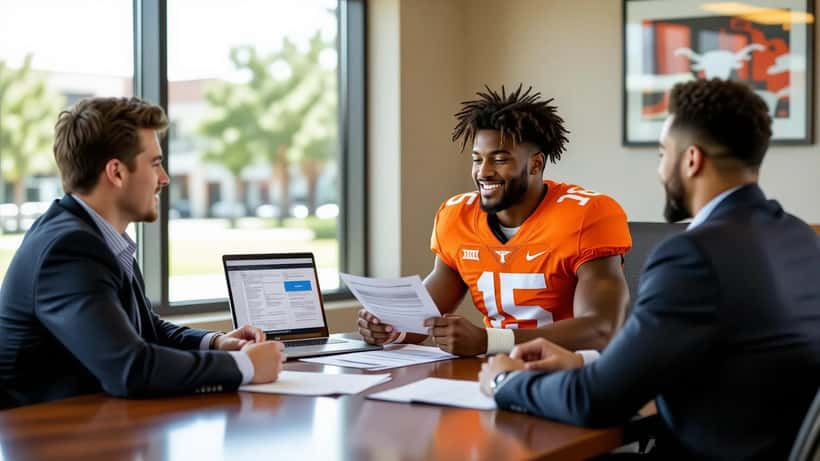
A wealth management expert can bridge that gap. The intersection of sports contracts, tax planning, and long-term asset protection is a specialist field — and athletes who consult one before the money arrives, rather than after, are in a fundamentally different position.
"The athletes who get into trouble aren't the ones who earn too much," one financial planning specialist noted in a recent industry panel. "They're the ones who earn fast and decide slowly."
Concrete Case: What This Looks Like for a Texas Athlete Right Now
Take a hypothetical redshirt sophomore offensive lineman at Texas — not a star, but a regular contributor on a Big 12 contender. Under the House settlement's $20.5 million annual cap spread across a 100+ person roster, a mid-tier athlete might receive $30,000 to $80,000 in direct revenue-sharing payments for the 2025–2026 school year.
Here's where the numbers get complicated:
If the athlete receives $60,000 in revenue-sharing payments:
- Federal income tax (single filer, 22% bracket): approximately $10,200 owed
- Texas has no state income tax — but athletes competing in away games in states like California or New York may owe taxes in those states under "jock tax" rules
- Self-employment or FICA taxes may apply depending on how the school structures the contract
- Net take-home after basic federal liability: approximately $49,800 — before any state-by-state game-day filings
If the same athlete also holds a $40,000 NIL deal with a local car dealership, their combined income of $100,000 pushes them into a 24% federal bracket and triggers quarterly estimated tax obligations. Fail to pay quarterly estimates, and the IRS imposes underpayment penalties — typically 8% annualized in 2026. On $100,000 of unplanned income, that's an $8,000 surprise at tax time.
For an athlete like Manning — whose NIL valuation has been estimated well into seven figures for 2026 — the complexity compounds. Between revenue-sharing from Texas, NIL deals, appearance fees, and social media partnerships, a proper tax and wealth strategy is not optional. It's the difference between entering the NFL draft as a financially secure prospect and entering with liabilities that follow you into your first professional contract.
The Transfer Portal Adds Another Layer of Risk
College athletes who switch schools via the transfer portal face an additional wrinkle: their revenue-sharing agreements are institution-specific. A player who transfers mid-year may forfeit pro-rated payments, trigger clawback provisions, or find that NIL deals tied to their previous school's brand are now in breach.
Consider the financial math: if a wide receiver at a Power 4 program signs a revenue-sharing agreement worth $45,000 for the full academic year and then enters the transfer portal in January, they may be entitled to only the fall semester's pro-rated share — approximately $22,500. If their school's contract contains a "material change" clause (many do in 2026), transferring could technically constitute a breach, obligating the athlete to return a portion of payments already received.
That scenario — increasingly common as portal activity accelerates — is exactly the kind of contingency a wealth manager and a sports attorney should review together before a single dollar changes hands. The paperwork has gotten more complex, even as the amounts have grown larger.
A wealth manager who specializes in athlete finances can map these contingencies before a transfer decision is made — not after the paperwork is signed.
What Athletes Should Do Before the Next Check Arrives
The timeline matters. Revenue-sharing distributions for the 2026–2027 academic year begin in August and September. Athletes who act now — before the first payment — have the most flexibility.
The three immediate priorities a financial expert typically recommends:
Structure a tax reserve account. Set aside 25–30% of every revenue-sharing payment in a separate account earmarked exclusively for tax obligations. This is non-negotiable for athletes in states with income tax, and still advisable in Texas.
Review your total income picture before signing anything. If you hold or are negotiating NIL deals alongside revenue-sharing payments, your effective tax rate changes. A financial advisor can model your combined income before you commit.
Understand your contract's termination clauses. School-administered revenue-sharing agreements often contain performance or enrollment requirements. Missing a minimum grade threshold, transferring, or going pro mid-year can trigger repayment obligations. A lawyer — not just a financial advisor — should review these terms.
For a 20-year-old college athlete, the House settlement is the best thing to happen to college sports in decades. But money that arrives without a strategy is money that's already at risk.
Arch Manning may be the face of this new era in college football. But the real story of the House settlement is being written by the thousands of athletes who are, for the first time, dealing with grown-up financial decisions on an 18-year-old's experience level. The ones who consult a wealth management expert now will have a very different story to tell by the time they leave campus.
Disclaimer: This article addresses general financial and legal concepts. It is not legal, tax, or financial advice. Athletes should consult a licensed financial advisor, CPA, or attorney for guidance specific to their situation.
format_used: Expert reaction
