
 Isabella Torres
Does your Pennsylvania employer have to give you paid sick days? The answer depends entirely on where in the state you work. Here are the questions workers and HR managers ask most often about Pennsylvania sick leave law — and the honest answers.
Does Pennsylvania Have a Statewide Sick Leave Law?
No. Pennsylvania has no statewide law requiring employers to provide paid or unpaid sick leave to adult employees. The Pennsylvania Minimum Wage Act and the Wage Payment and Collection Law (WPCL) govern wages and payment timing, but neither creates a sick leave entitlement.
Unlike New Jersey (which passed a statewide paid sick leave law in 2018), Illinois (which enacted the Chicago Sick Leave Ordinance followed by a statewide law), or California (which has both state and local requirements), Pennsylvania has not acted at the state level. Attempts to pass statewide sick leave legislation in Harrisburg have repeatedly stalled.
This means that for workers in most Pennsylvania cities and townships — outside of Philadelphia and Pittsburgh — sick leave is entirely at the employer's discretion. An employer in Reading, Allentown, Harrisburg, or Scranton can legally have a policy of zero paid sick days without violating any Pennsylvania law.
À retenir: If you work outside Philadelphia or Pittsburgh, your sick leave rights come only from your employer's own policy or a collective bargaining agreement — not from state or local law.
| Jurisdiction | Paid Sick Leave Required | Threshold | Max Hours |
|---|---|---|---|
| Pennsylvania (state) | No — not required | N/A | N/A |
| Philadelphia | Yes | 10+ employees | 40 hrs/year |
| Pittsburgh | Yes | 15+ employees | 40 hrs/year |
| Other PA municipalities | No | N/A | N/A |
Source: Philadelphia Code § 9-4100; Pittsburgh City Ordinance § 626.01; PA L&I, 2026.
How Does Philadelphia's Paid Sick Leave Law Work?
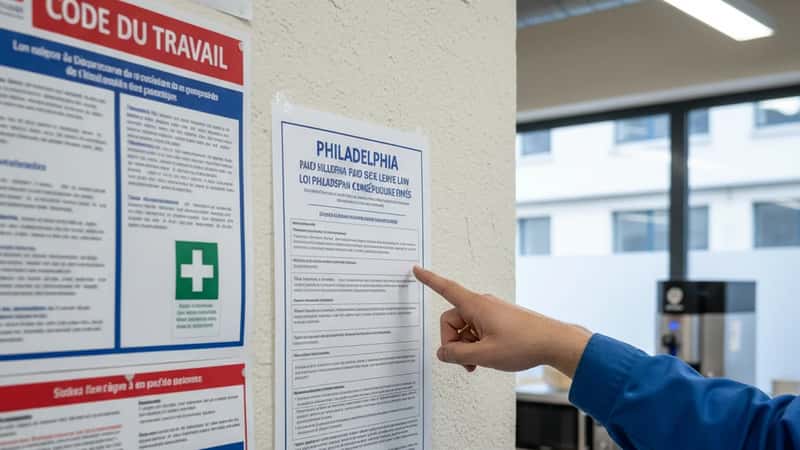
Philadelphia's Paid Sick Leave Law (Philadelphia Code § 9-4100), enacted in 2015, requires employers with 10 or more employees to provide up to 40 hours of paid sick leave per year to workers who perform at least 40 hours of work in the city. Workers accrue sick leave at a rate of 1 hour for every 40 hours worked. Employers with fewer than 10 employees must still provide 40 hours of unpaid sick leave per year.
The law covers part-time, full-time, and temporary workers, as well as domestic workers and most independent contractors who are treated like employees in practice. "Employees" are defined broadly — if you regularly perform work in Philadelphia, you likely qualify.
How to use it: Workers can use accrued paid sick leave for:
- Their own illness, injury, medical care, or preventive care
- Care for a family member (child, parent, sibling, grandparent, grandchild, or spouse/domestic partner)
- Closure of the workplace or school due to a public health emergency
- For survivors of domestic violence, sexual assault, or stalking — medical care, legal proceedings, or relocation
Employers can require up to 7 days' advance notice for foreseeable leave, and up to 2 days' notice for unforeseeable leave. Employers cannot require workers to find a replacement as a condition of using sick leave.
How Does Pittsburgh's Paid Sick Days Act Work?

Pittsburgh's Paid Sick Days Act (Pittsburgh City Ordinance § 626.01), which survived a legal challenge at the Pennsylvania Supreme Court in 2019, requires employers with 15 or more employees to provide up to 40 hours of paid sick leave per year. Employers with fewer than 15 employees must provide up to 24 hours of unpaid sick leave per year.
Accrual begins from the first day of employment, and workers can start using accrued sick time after 90 days of employment. The qualifying reasons for use mirror Philadelphia's law — personal illness, family member care, and domestic violence situations.
Pittsburgh enforcement is handled by the city's Department of Personnel and Civil Service Commission. Workers can file a complaint if their employer refuses to provide earned sick leave, retaliates for its use, or otherwise violates the ordinance.
Key difference from Philadelphia: Pittsburgh's threshold is 15 employees, not 10. Workers at small employers (10-14 employees) in Pittsburgh have no paid sick leave right under city law — they fall into the gap between the city's ordinance and the absence of any state mandate.
Can My Employer Retaliate Against Me for Using Sick Leave?
In Philadelphia and Pittsburgh, retaliation is explicitly prohibited. Employers cannot terminate, demote, reduce hours, or otherwise penalize a worker for using accrued sick leave. Employers who retaliate face civil penalties and can be ordered to pay back wages, reinstate the employee, and cover attorney's fees.
Protecting yourself from retaliation:
- Document your sick leave requests and usage in writing (text or email) whenever possible
- Keep a record of any changes to your schedule, pay, or treatment after using sick leave
- If adverse action follows within a short time (days or weeks) of using sick leave, this timeline is important evidence
- File a complaint with the applicable enforcement agency — Philadelphia's Mayor's Office of Labor or Pittsburgh's Department of Personnel
Outside Philadelphia and Pittsburgh, there is no legal prohibition on retaliation for taking sick leave, since no right to sick leave exists. Any protection for workers in those areas must come from the employee handbook or employment contract.
See the full Pennsylvania Labor Law dossier for how sick leave interacts with final paychecks and other PA wage rights.
Legal Disclaimer: This article provides general information about Pennsylvania sick leave law and does not constitute legal advice. Consult a licensed Pennsylvania employment attorney or contact the Philadelphia or Pittsburgh enforcement agencies for guidance on your specific situation.
If My Employer Offers PTO, Does That Satisfy the Sick Leave Requirement?
In Philadelphia and Pittsburgh, an existing Paid Time Off (PTO) policy may satisfy the sick leave ordinance if the policy provides at least as many hours as the ordinance requires AND employees can use PTO for the qualifying sick leave reasons without any additional restriction.
The condition: The PTO policy must be at least as generous as the ordinance in three ways: (1) total available hours meet the minimum (40 hours), (2) workers can use PTO for illness, family care, and domestic violence situations without being penalized, and (3) the accrual rate and waiting period don't impose stricter conditions than the ordinance.
An employer cannot satisfy the ordinance with a PTO policy that requires workers to provide advance notice for sick leave when advance notice isn't always possible, or that docks employees' attendance records for illness-related PTO usage.
If your employer's PTO policy is more generous than the ordinance, that policy governs. Philadelphia and Pittsburgh's sick leave laws set a floor — employers can exceed them, but not fall below them.