
 Emily Wang
Idaho has no state law requiring employers to provide meal or rest breaks to adult workers. For many employees new to Idaho — especially those coming from California, Washington, or Oregon — this is genuinely surprising. This Q&A addresses the most common questions Idaho workers ask about break rights in 2026.
Does Idaho law require employers to give me a lunch break?
No. Idaho has no statute requiring employers to provide meal periods (unpaid breaks of 30+ minutes) to adult employees. The Idaho Department of Labor's position is clear: meal and rest break requirements for adults are not governed by state law. Whether you get a lunch break, and whether it is paid, depends entirely on your employer's policy, your employment contract, or any applicable collective bargaining agreement.
This contrasts sharply with neighboring states. Washington requires a 30-minute unpaid meal period for shifts over 5 hours. Oregon requires a 30-minute unpaid meal period for shifts over 6 hours. California requires a 30-minute unpaid meal period for shifts over 5 hours AND a second meal period for shifts over 10 hours.
In Idaho, no such requirements exist for adult employees.
Do I have to be paid for short breaks during my shift?
This is where federal law steps in. The FLSA does not require employers to provide rest breaks, but if an employer provides short breaks (5 to 20 minutes), those breaks must be counted as compensable work time and paid. An Idaho employer cannot offer a 15-minute break and then refuse to pay for it — the moment they allow the break, federal law requires it to be compensated.
Meal periods of 30 minutes or more are a different matter. If an employee is completely relieved of all duties during the break period, a meal break of 30+ minutes does not need to be paid. But "completely relieved" means genuinely free — an Idaho call center agent who eats lunch at their desk while monitoring incoming calls is working during that period, and it must be compensated.
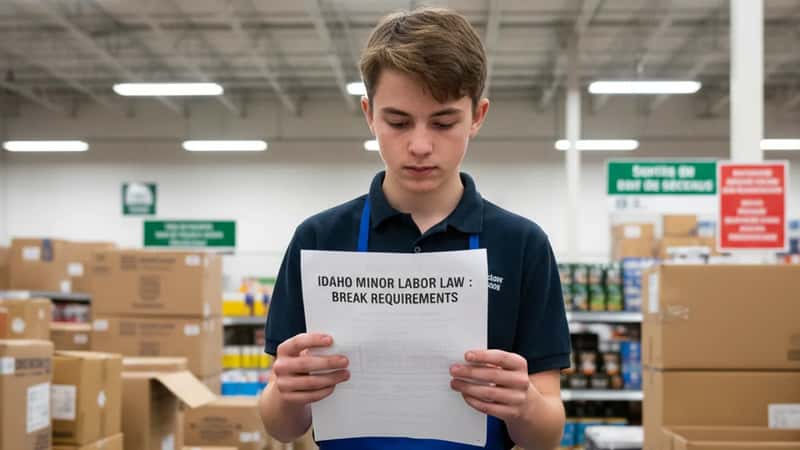
Are there any Idaho break requirements for minors?
Yes. Idaho has specific break requirements for workers under age 16, under Idaho Code § 44-1301. Minors under 16 must receive:
- A 30-minute break for any shift exceeding 5 consecutive hours
This applies regardless of industry, employer size, or whether the shift is during the school year. Employers in retail, food service, and summer camps — sectors with high concentrations of teen workers — must build break schedules into their operations.
There is no corresponding requirement for workers aged 16 or 17.
Can my employer require me to stay on-call during my unpaid lunch break?
If your employer requires you to remain available — to answer the phone, respond to questions, cover the front desk "just in case" — during your designated lunch period, that time is compensable. An Idaho employer who tells workers "you're on a 30-minute lunch break" but simultaneously requires them to remain accessible to customers or colleagues is not providing a genuine break. The FLSA's "completely relieved" standard applies. This is a common wage compliance issue in Idaho healthcare, retail, and food service environments.
Does Idaho require a break after a certain number of hours worked?
No. For adult employees, Idaho law does not require any break at any point during the workday, regardless of shift length. An employer in Boise can legally require a non-exempt adult to work an 8-hour shift without any break at all, and this does not violate Idaho law.
However, most employers provide breaks as a practical matter — for productivity, safety (particularly in physically demanding work like construction or manufacturing), and employee retention. The absence of a legal requirement does not mean the absence of breaks.
My employer promised breaks in the employee handbook but isn't honoring them. What can I do?
If your employer's written policy creates a break entitlement and then fails to provide it, you may have a claim under contract principles — the handbook language may constitute an implied agreement. Similarly, if short breaks are being provided but not compensated, that is an FLSA wage violation you can report to the Idaho Department of Labor or the U.S. Department of Labor's Wage and Hour Division.
For context on how Idaho's break rules compare to the broader landscape of state employment requirements covered in the Idaho Labor Law dossier, including overtime, final paychecks, and non-compete rules, the contrast with New Jersey's mandatory break laws illustrates the significant variation across states.
Can I get fired for taking a break that wasn't offered?
An employee who takes an unauthorized break — leaving their post without permission — can face disciplinary action, including termination in an at-will state like Idaho. However, if the break was taken because of a genuine physical necessity (a medical condition, pregnancy-related needs, or a nursing break), additional federal protections may apply. The FLSA requires employers to provide reasonable break time for nursing mothers to express breast milk for up to one year after a child's birth. This must be in a private, non-bathroom space. Unlike the general break-for-adults question, nursing breaks have a specific federal mandate regardless of Idaho state law.
What about breaks under collective bargaining agreements?
Unionized workplaces in Idaho operate under the terms of their collective bargaining agreement (CBA). Many CBAs for industries like meat processing, building trades, and transportation include break provisions that exceed what state law requires. If you are covered by a union contract, your break rights are determined by the CBA, not Idaho statute.
À retenir: Idaho provides no state-mandated meal or rest breaks for adult workers. Federal law requires that short rest breaks (5-20 minutes), if provided, must be paid. The only statutory break obligation under Idaho law applies to workers under 16 — a 30-minute break after 5 consecutive hours. Everything else is a matter of employer policy.
Disclaimer: This article provides general information about Idaho break law and does not constitute legal advice. Consult an Idaho employment attorney for guidance specific to your situation.