
Kansas labor law is quieter than most people expect — no state overtime statute, no mandatory break law, no state paid sick leave mandate. But that silence is deceptive. A handful of Kansas-specific rules on final paychecks, non-compete enforceability, and wage claim procedures catch both employers and employees off guard every year. Understanding where federal law ends and Kansas law begins is the first step to staying compliant — and protected.
Key takeaway: Kansas defaults to federal Fair Labor Standards Act (FLSA) standards on overtime and minimum wage, but enforces its own rules on final paycheck timing under K.S.A. 44-314. Non-compete agreements are valid but reviewed for reasonableness by Kansas courts. And unlike California or Colorado, Kansas has no state mandate for meal breaks or paid sick leave — making employer policy the primary protection for workers in those areas.
This dossier covers six core topics that define the Kansas employment landscape in 2026: overtime classification, final paycheck rules, non-compete agreements, meal and rest breaks, sick leave, and minimum wage. Each article goes deep on one topic so you can find exactly what applies to your situation.
Kansas Employment Law at a Glance
Kansas sits at an interesting intersection: a business-friendly state with minimal labor regulation beyond federal floors, yet one with specific statutory rules that catch unprepared employers with real penalties. The Kansas Department of Labor (KDOL) enforces wage payment laws, workers' compensation requirements, and unemployment insurance — while the federal Department of Labor handles FLSA overtime, child labor, and FMLA for most private employers.
The key numbers for 2026:
Kansas is one of 20 states that has not enacted a minimum wage above the federal floor. That means employers covered by both state and federal law pay $7.25/hr — but those not covered by FLSA (small businesses with revenues under $500,000 and no interstate commerce) technically face the Kansas minimum wage of $7.25/hr under K.S.A. 44-1203, which mirrors the federal rate. In practice, the distinction rarely matters — but it does for very small local businesses.
For employers, the most consequential state-specific rules involve final paycheck timing and non-compete enforceability. For employees, knowing which protections Kansas mandates vs. which depend entirely on employer policy is essential before signing any contract or negotiating a separation agreement.
Overtime in Kansas: Federal Rules With Local Consequences
Kansas has no state overtime statute of its own. Overtime in Kansas is governed entirely by the federal Fair Labor Standards Act (FLSA), which requires non-exempt employees to receive 1.5 times their regular rate for all hours worked beyond 40 in a workweek. The Kansas Department of Labor does not add any state-specific multiplier, daily overtime rule, or 7th-day premium — features that exist in states like California but are absent here.
That simplicity cuts both ways. For employers, Kansas overtime compliance is straightforward: track hours, apply the 40-hour weekly threshold, and classify employees correctly as exempt or non-exempt. For employees, it means that common California-style protections — daily overtime after 8 hours, mandatory double-time — simply do not apply here.
The critical variable is exemption classification. A misclassified employee labeled "exempt" who regularly works 50-hour weeks can generate significant back-pay liability. The FLSA's white-collar exemptions (executive, administrative, professional) require both a salary basis test ($684/week in 2026) and a duties test. Kansas courts apply federal FLSA standards directly, and the KDOL Wage and Hour Division accepts wage claims for overtime violations from Kansas workers.
One nuance unique to Kansas: agricultural workers are excluded from FLSA overtime protections under federal law, and Kansas's significant farming sector means this exemption applies broadly to farmhands, seasonal workers, and certain livestock employees. Understanding which employees fall under agricultural exemptions is critical for Kansas's rural employers.

Kansas Overtime Laws: The Complete FLSA Guide for 2026
15 minFinal Paychecks and Breaks: Where Kansas Gets Specific
Final Paycheck Rules Under K.S.A. 44-314
When employment ends — whether through termination, resignation, or layoff — Kansas law is specific about when that final paycheck must arrive. Under K.S.A. 44-314, an employer must pay all earned wages on the next regular payday following the separation. There is no distinction between employees who are fired versus those who quit — both receive the same timeline.
This contrasts with states like California, which require final pay on the day of termination for fired employees. Kansas's "next payday" rule is more employer-friendly, but it carries a penalty: employers who fail to pay on time can face a civil penalty of 1% of the unpaid wages per day, up to 100% of the total amount owed, under K.S.A. 44-315.
Permitted deductions from a final paycheck include taxes, court-ordered garnishments, and amounts the employee has authorized in writing (such as health insurance premiums or equipment loans). Deductions for cash register shortages or damage to company property without written authorization are prohibited and constitute a wage violation.
Meal and Rest Breaks: No State Mandate
Kansas is one of the states that does not require employers to provide meal or rest breaks to adult employees. This does not mean breaks are optional for employers covered by the FLSA — federal guidelines still apply. The FLSA requires that short rest breaks (20 minutes or less) be paid as working time. Meal periods of 30 minutes or more are unpaid only if the employee is completely relieved of duties.
For minor employees (under 18), Kansas law diverges: the Kansas Child Labor Law requires a 30-minute rest break for any shift exceeding 8 hours, under K.S.A. 38-603. Adult employees have no equivalent protection unless their employment contract or company policy provides one.

Kansas Final Paycheck Law: Timing, Deductions, and the 1% Daily Penalty
8 minNon-Compete Agreements: Kansas Courts Apply a Reasonableness Test
Non-compete agreements are enforceable in Kansas, but they are not automatically valid. Kansas courts apply a reasonableness test under common law: a non-compete clause must be reasonable in scope, duration, and geographic reach to be enforceable. Unlike California, which bans non-competes almost entirely, or Minnesota, which has enacted a statutory ban, Kansas remains a common-law state where enforceability is determined case by case.
"In Kansas, a non-compete agreement must protect a legitimate business interest and be no broader than reasonably necessary. Courts will not enforce agreements that amount to an unreasonable restraint on an employee's ability to work." — Employment attorney perspective consistent with Kansas case law, including Idbeis v. Wichita Surgical Specialists, 2005.
A Kansas court reviewing a non-compete will typically examine: (1) duration — clauses exceeding two years face heavy scrutiny; (2) geographic scope — a statewide ban is often acceptable for senior roles but not for local service workers; (3) legitimate business interest — protecting trade secrets and client relationships qualifies, while preventing ordinary competition does not.
Kansas employers should note that confidentiality agreements and trade secret protections under the Kansas Uniform Trade Secrets Act (K.S.A. 60-3320) can often achieve similar protection with less legal risk than a broad non-compete. For employees, a non-compete that restricts your ability to work in your industry statewide for three or more years is likely unenforceable — but you may need an employment attorney to challenge it effectively.
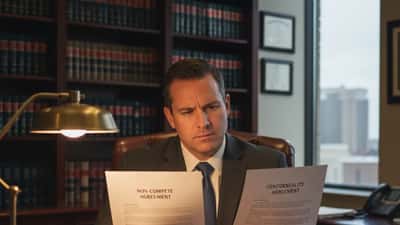
Kansas Non-Compete vs. Trade Secret: Which Protection Fits Your Business
6 minSick Leave and Minimum Wage: What Kansas Does — and Doesn't — Require
Sick Leave: Employer Policy, Not State Law
Kansas has no state law requiring employers to provide paid or unpaid sick leave to private-sector employees. This places it among the majority of US states that leave sick leave entirely to employer discretion. There is no Kansas-specific equivalent to the federal FMLA for shorter illnesses — the FMLA only applies to employers with 50 or more employees and requires 12 months of tenure before it kicks in.
For Kansas employees, this means your sick leave rights depend on your employer's policy and your employment contract. If an employer's handbook promises a set number of sick days, Kansas wage payment law treats that promise as an earned benefit — one that cannot be taken away mid-employment without notice. Whether unused sick time must be paid out upon separation depends entirely on the employer's stated policy.
Local ordinances have not supplemented state law in Kansas: no Kansas city or county has enacted a mandatory paid sick leave ordinance as of 2026, unlike cities in neighboring Missouri (Kansas City, MO) or Colorado.
Minimum Wage: At the Federal Floor in 2026
Kansas's minimum wage of $7.25/hr has not increased since 2009, when the federal rate last rose. The state minimum is anchored to the federal floor by K.S.A. 44-1203. Tipped employees may be paid $2.13/hr in base wages, provided tips bring total compensation to at least $7.25/hr per hour worked — the federal "tip credit" applies in Kansas without modification.
Kansas workers under 20 years old may be paid a youth minimum wage of $4.25/hr for the first 90 consecutive calendar days of employment under the FLSA's opportunity wage provision. After 90 days, they must receive the full $7.25/hr. For employers in Wichita, Topeka, or Kansas City operating across state lines, note that Missouri's minimum wage was $12.30/hr in 2025 and continues to adjust annually — workers on the Missouri side of the border operate under a different rate.
The gap between Kansas's $7.25/hr and living-wage estimates for the Wichita metro area (approximately $17-$20/hr for a single adult in 2026, per MIT Living Wage Calculator) underscores the practical importance of employer wage policies, union agreements, and negotiated contracts for Kansas workers.
Where to Turn If You Have an Employment Problem in Kansas
Understanding the rules is one thing — navigating a real dispute is another. Kansas workers facing wage theft, wrongful termination, or a contested non-compete have several official channels available.
Kansas Department of Labor (KDOL): The KDOL handles wage claims for unpaid wages, final paycheck violations, and certain discrimination complaints under the Kansas Act Against Discrimination. File a wage claim online at dol.ks.gov. The KDOL can investigate, mediate, and order back-pay in qualifying cases.
US Department of Labor — Wage and Hour Division: For FLSA overtime violations and federal minimum wage claims, file with the WHD. Federal enforcement is often faster and covers a broader range of workers than state processes.
Kansas Human Rights Commission (KHRC): For discrimination claims under the Kansas Act Against Discrimination (KAAD), including wrongful termination based on protected characteristics, file with the KHRC at khrc.net. The KAAD covers employers with 4 or more employees — broader than federal Title VII's 15-employee threshold.
Employment attorneys: For non-compete disputes, complex wage claims, or wrongful termination cases, consulting a Kansas employment attorney early matters. Non-compete litigation moves quickly, and the first attorney to file can shape the outcome. ExpertZoom connects Kansas workers and employers with qualified employment law attorneys who handle these disputes across Wichita, Topeka, Kansas City (KS), and smaller markets statewide.
Neighboring states like Nebraska and South Dakota face many of the same federal/state law questions as Kansas — comparing approaches can clarify which protections are state-specific versus universal.
Legal disclaimer: The information in this dossier is provided for informational purposes only and does not constitute legal advice. Employment law is fact-specific and subject to change. For advice on your particular situation, consult a licensed Kansas employment attorney.
