 Odette Caplan
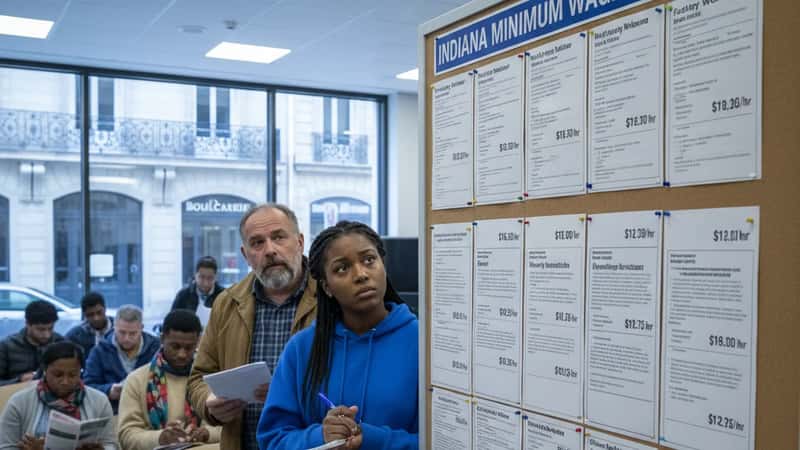
Indiana's minimum wage has not changed since 2009. At $7.25 per hour, Indiana ties the federal minimum — and unlike most neighboring states, Indiana has made no moves toward an increase. For workers, job seekers, and employers across the Hoosier State, knowing the exact rules around minimum wage is not just a compliance matter; it determines whether paychecks are legal. Here are the eight most important facts about Indiana minimum wage law in 2026.
8 Key Facts About Indiana Minimum Wage Law
1. Indiana Follows the Federal Minimum of $7.25 per Hour
Indiana Code § 22-2-2 sets the state minimum wage at $7.25 per hour and explicitly states that if the federal minimum wage is higher, the federal rate applies. As of 2026, both rates are identical. Any Indiana employer who pays less than $7.25 per hour is violating both state and federal law.
Indiana's minimum wage has been at $7.25 since the federal increase in July 2009. There is no scheduled increase in Indiana law, and no legislation increasing the state rate has passed the General Assembly as of 2026.
2. No City or County in Indiana Can Set a Higher Minimum Wage
Indiana state law preempts local governments from enacting their own minimum wage ordinances. Unlike Illinois, where Chicago mandates $16.20 per hour (2025), or New York City with its own floor, no Indiana municipality — not Indianapolis, Fort Wayne, South Bend, or any other city — can set a local minimum wage above the state rate.
This is a firm statutory prohibition. Any local ordinance attempting to set a higher minimum wage is void under Indiana law. Workers living near the Illinois border who work in Chicago are covered by Chicago's higher rate — but workers in East Chicago or Hammond, Indiana, on the opposite side of the state line, are entitled only to the $7.25 Indiana minimum.
See the State Minimum Wage Laws in 2026 comparison for how Indiana's rate ranks nationally.
3. Tipped Employees Can Be Paid as Little as $2.13 per Hour in Cash
Indiana adopts the federal tip credit under FLSA § 203(t). Employers of tipped employees — workers who customarily and regularly receive more than $30 per month in tips — may pay a direct cash wage of as little as $2.13 per hour, provided that the combination of tips and cash wage equals at least $7.25 per hour in any workweek.
If tips in a given workweek do not bring the effective rate to $7.25, the employer must make up the difference in that workweek's paycheck. Employers who fail to monitor tip shortfalls and make them up in real time are among the most frequent Indiana wage violators cited by the DOL.
Employers using the tip credit in Indiana must also comply with the FLSA's tip credit disclosure requirement: workers must be informed of the tip credit before it can be applied. Employers who fail to provide this notice must pay the full $7.25 minimum wage for all hours worked, with no tip offset — a costly error for Indiana restaurants and hospitality operations that assume the credit is automatic.
4. Workers Under 20 Can Be Paid $4.25 per Hour for Their First 90 Days
Under the FLSA's "youth minimum wage" provision (§ 206(g)), Indiana employers may pay workers under 20 years old a training wage of $4.25 per hour during the first 90 consecutive calendar days of employment. After 90 days — or upon turning 20, whichever comes first — the full $7.25 minimum applies.
Employers cannot displace existing workers to hire youth at the lower rate. Intentional displacement to avoid paying the regular minimum wage is a violation of the FLSA's anti-displacement provision.
5. Workers with Disabilities May Be Paid Below Minimum Wage Under Section 14(c)
Section 14(c) of the FLSA authorizes certain Indiana employers — typically sheltered workshops and work rehabilitation programs — to obtain special certificates from the DOL permitting them to pay workers with disabilities wages commensurate with their productivity, which may be below the $7.25 minimum.
This provision is controversial and has faced legislative challenges nationally. As of 2026, it remains available in Indiana but requires a DOL certificate. Employers without a valid 14(c) certificate cannot pay below-minimum wages to workers with disabilities.
6. Full-Time Students Can Be Paid 85% of Minimum Wage in Some Contexts
The FLSA's full-time student program allows certain retail, service, agriculture, and higher education employers to pay full-time students 85% of the applicable minimum wage ($6.16 per hour in Indiana in 2026) for part-time work, under a DOL certificate. This is a limited exception, not a broad youth-wage rule, and requires specific employer certification.
7. Agricultural Workers Have Different Minimum Wage Rules
As with overtime, agricultural workers in Indiana are subject to different FLSA minimum wage standards. Small farms — specifically those that used fewer than 500 man-days of agricultural labor in any quarter of the preceding calendar year — are entirely exempt from the FLSA minimum wage requirement. Workers on these small Indiana farms may legally be paid below $7.25 per hour.
Larger Indiana agricultural operations must pay the federal minimum wage, but are exempt from overtime. This agricultural carve-out reflects the FLSA's original structure, which excluded farm workers from full labor protections.
8. Indiana Has Two Enforcement Agencies for Minimum Wage Violations
Indiana workers who are paid below the minimum wage can pursue claims through two pathways:
Indiana Department of Labor (IDOL): Enforces Indiana's minimum wage statute (IC § 22-2-2). Workers can file a wage complaint at in.gov/dol. Indiana allows employees to recover back wages and liquidated damages equal to the unpaid amount.
U.S. Department of Labor Wage and Hour Division: Enforces the FLSA. Workers can file at dol.gov/agencies/whd or call 1-866-4-US-WAGE. Federal FLSA claims carry a 2-year statute of limitations (3 years for willful violations) and allow recovery of back wages plus equal liquidated damages plus attorney fees.
Key Takeaway: Indiana's minimum wage is $7.25 per hour, matching the federal floor. Tipped workers, youth employees, students, and agricultural workers have different rates and rules. No Indiana city can raise this floor, and two enforcement agencies can recover back wages for violations.
Indiana workers who believe they have been paid below the minimum wage should act promptly — the FLSA's 2-year statute of limitations means that each passing pay period forecloses recovery for older violations. Documentation of hours worked and pay received, even informal notes, can be critical evidence in a wage claim.
Disclaimer: This article provides general information about Indiana minimum wage law as of 2026 for educational purposes only. It does not constitute legal advice. For wage claim assistance, contact the Indiana Department of Labor or a licensed Indiana employment attorney.