 Daniel Sterling
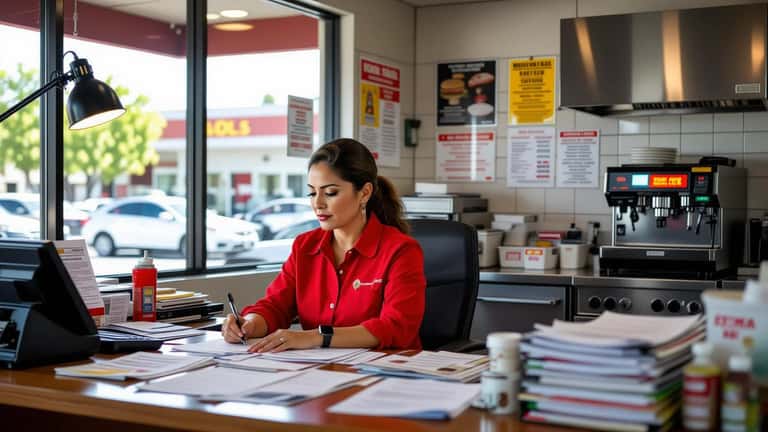
When Rosa Delgado opened her second fast food location in Bakersfield in early 2025, she assumed the same wage calculation system she used at her Fresno restaurant would apply. It didn't. Her Fresno franchise location fell under the state's general minimum wage. Her Bakersfield location — operating under the same franchise brand but structured differently on paper — fell under AB 1228's $20/hour fast food minimum. When she later hired nursing aides for a healthcare referral service she co-owned, SB 525 added a third rate to track.
Three businesses, three California minimum wages, one payroll system. The story of how Rosa and her HR consultant built a compliant multi-rate wage structure illustrates the challenge facing thousands of California employers in 2026.
This article is part of the California Labor Law: The Complete 2026 Dossier.
The Problem: California's Multi-Tier Minimum Wage in 2026
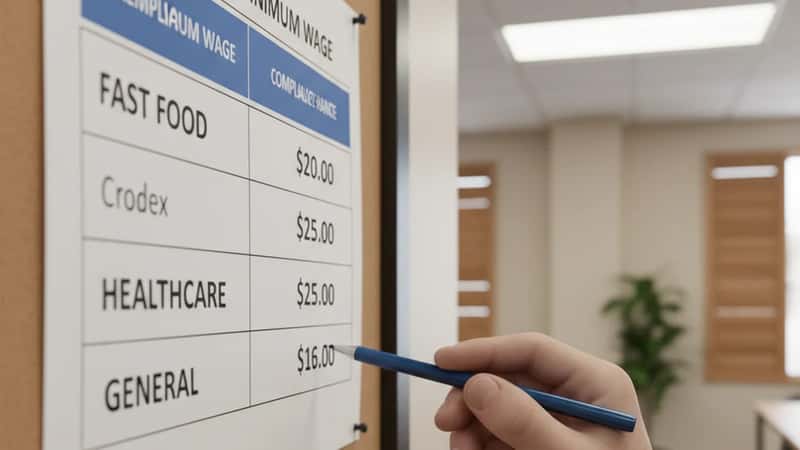
California no longer has a single minimum wage. The state has built a layered structure where the applicable rate depends on industry, employer type, and location — and in some cities, all three at once.
Rosa's HR consultant, Maria Suarez, described the discovery: "The first thing we had to do was map each employee to a rate — not by job title, but by employer entity, industry category, and worksite. Three employees doing essentially the same work were on three different minimum wages."
The $20 Fast Food Floor: Who It Covers — and Who It Doesn't
Assembly Bill 1228 (the FAST Recovery Act), effective April 1, 2024, established a $20/hour minimum wage for "covered" fast food restaurant employees in California. The scope is defined precisely:
Covered establishments:
- Fast food restaurants that are part of a national or regional chain of 60 or more establishments nationwide
- The restaurant primarily sells food and beverages for immediate consumption
- Customers primarily order and pay before receiving food (counter service or drive-through model)
Not covered:
- Bakeries that bake and sell bread on-site (they produce a product sold in multiple retail channels, not purely fast food service)
- Fast food restaurants with fewer than 60 locations nationwide (rare in practice)
- Sit-down restaurants with table service, regardless of their pricing tier
Rosa's Bakersfield location was covered under AB 1228 because her franchise brand had over 60 national locations. Her Fresno restaurant operated under a different entity structure and narrowly qualified as an on-site producer under the bakery exemption. The difference in treatment was not intuitive — but it was definitive.
The Fast Food Council: AB 1228 also created the Fast Food Council — a 10-member body with authority to increase the $20/hour floor annually based on the CPI, capped at 3.5% per year. Employers should monitor council decisions each year, as future increases will not follow the general minimum wage schedule.
The Healthcare Minimum Wage: SB 525 Phase-In
Senate Bill 525 created a separate minimum wage structure for "covered healthcare employees" — defined broadly to include virtually all workers (not just clinical staff) employed by covered healthcare facilities. The phase-in rates vary by employer type:
| Employer Type | 2024 Start Rate | Full Rate | When Full Rate |
|---|---|---|---|
| Large hospital systems | $23/hr | $25/hr | June 2026 |
| Rural and independent hospitals | $18/hr | $25/hr | June 2033 |
| Clinics and outpatient facilities | $21/hr | $25/hr | June 2028 |
| Dialysis clinics | $23/hr | $25/hr | June 2026 |
Source: SB 525, California Health and Human Services Agency, 2024
"Covered healthcare employee" includes not just doctors and nurses, but also janitors, security officers, food service workers, and administrative staff at covered facilities. Rosa's co-owned healthcare referral service employed nursing aides at an outpatient clinic, triggering the outpatient rate track at $21/hour in 2025 — well above the $16.50 general rate.
For employers operating multiple types of facilities, the complexity compounds: a hospital system with both a large acute-care hospital and a chain of outpatient clinics may owe different minimum rates to workers at each site.
Local Minimum Wages: The Third Layer
Several California cities and counties have enacted minimum wages that exceed the state rate. Employers with workers at those locations must apply the highest applicable rate. As of early 2026:
- San Francisco: $18.67/hour (updated January 1, 2026 by SF OLSE)
- West Hollywood: $19.08/hour (city-specific ordinance)
- Berkeley: $18.67/hour
- Los Angeles (city): $17.28/hour
- Los Angeles (county unincorporated): $17.27/hour
- Emeryville: $19.36/hour (highest general rate in California as of 2026)
- Santa Monica: $17.27/hour
These rates adjust annually, often on different schedules from the state rate. An employer with multiple Los Angeles-area locations must track the city rate for locations inside the city limits, the county rate for unincorporated county locations, and the state rate for locations outside both jurisdictions.
Rosa's future expansion plan included a potential location in West Hollywood. Her consultant flagged that the West Hollywood minimum wage would require payroll system updates — a $2.58/hour differential from the state rate for every employee at that location.
How Rosa's Team Built a Compliant System
After mapping each employee to their applicable rate, Maria developed a three-step compliance framework that other California employers can adapt.
Step 1: Employer classification. For each legal entity, determine which industry-specific minimum wage laws apply. Is the entity a covered fast food establishment? A healthcare facility? A general employer? This classification must be documented and reviewed annually as legislation evolves.
Step 2: Location mapping. For each worksite, determine whether a local minimum wage ordinance applies and at what rate. Build a table mapping each city/county to the current applicable rate, with the date of the last update.
Step 3: Rate verification at payroll setup. When adding a new employee to payroll, the system prompts for employer classification and worksite location — then automatically applies the correct minimum rate. The system flags any rate that hasn't been updated in more than 90 days.
À retenir: California's minimum wage is not one number — it's a dynamic matrix of rates that shifts by industry, employer type, and city. Any employer running all California employees at a single rate is likely underpaying someone.
Use the California Overtime Calculator 2026 to verify that your California overtime calculations reflect the correct minimum wage floor for your industry and location.
Lessons for All California Employers in 2026
Rosa's experience highlights the structural challenge California's layered minimum wage system creates for multi-site or multi-sector employers. Three practical lessons:
1. Your payroll software may not know about industry-specific rates. Most payroll platforms apply the state minimum wage automatically. They do not know whether your restaurant franchise has 60 or 600 national locations — that determination is yours. Override defaults manually where industry-specific rates apply, and audit the result quarterly.
2. The CPI adjustment is not automatic. The general statewide minimum wage adjusts annually based on the Consumer Price Index, with the DIR announcing the new rate by August 1 each year for the following January 1 effective date. Employers must manually update payroll rates; the state does not notify payroll processors.
3. Recordkeeping at the individual employee level matters. California Labor Code Section 226 pay stub requirements include listing each applicable hourly rate and the hours worked at that rate. For employers with employees covered by multiple rates in the same pay period (e.g., an employee who worked at two different sites), this means separate line items for each rate.
For a national comparison of how California's minimum wage structure compares to other states, see State Minimum Wage Laws in 2026.
Legal disclaimer: This article is for informational purposes only and does not constitute legal advice. California minimum wage law changes annually and is subject to local variation. Consult a California employment attorney or contact the California Labor Commissioner's Office for compliance guidance specific to your situation.
Minimum Wage Violations and Employer Penalties in 2026
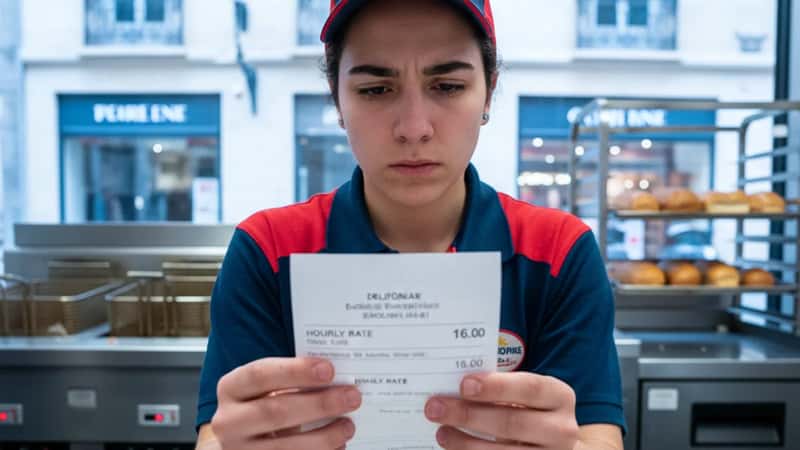
California's enforcement of minimum wage violations is robust and reaches further than most employers expect.
Civil wage assessments. The California Labor Commissioner can audit employer payroll records and issue a civil wage assessment for all unpaid wages owed to all affected employees, going back three years. A restaurant chain that underpaid 50 employees by $2/hour for 2 years owes $2 × 40 hours/week × 52 weeks × 2 years × 50 employees = $416,000 in back wages — before penalties.
Liquidated damages. Under Labor Code Section 1194.2, employees are entitled to liquidated damages equal to the unpaid minimum wages plus interest. This doubles the base exposure.
PAGA penalties. As with other labor code violations, minimum wage underpayment is a PAGA-eligible violation. Each pay period in which an employee is underpaid is a separate violation: $100 per employee for the first violation, $200 for subsequent violations.
Criminal liability. Willful failure to pay minimum wages is a criminal misdemeanor under Labor Code Section 1199. While prosecution is rare, it remains a formal enforcement tool available to the Labor Commissioner.
The combined exposure from a systematic minimum wage error — underpaying 50 employees by $2/hour for two years — can easily exceed $1.5 million when liquidated damages, PAGA penalties, and attorney's fees are included. Annual payroll audits comparing actual wages to the applicable minimum rate for each employee class are a standard recommendation from California employment attorneys.