 Grace Davies
Tickets for BBC Radio 2 in the Park 2026 went on sale this morning, with Chaka Khan and Simple Minds confirmed as headliners for a three-day festival at City Park in Stirling on 11, 12 and 13 September 2026. While fans scramble for tickets today, audiologists are urging festivalgoers to plan more than their travel — outdoor concerts at this volume level can permanently damage your hearing in less time than it takes to watch a headline set.
What Is Radio 2 in the Park 2026?
BBC Radio 2 in the Park returns to Stirling this September with a full three-day programme at City Park. The weekend opens on Friday 11 September with a DJ pre-party featuring Radio 2 presenters Sara Cox, DJ Spoony, Gary Davies, Michelle Visage, and Rylan. Chaka Khan headlines the main stage on Saturday 12 September, and Simple Minds close the festival on Sunday 13 September in what the BBC has confirmed will be their only UK performance of the year.
Tickets became available at 8.30am on 10 June 2026 via Ticketmaster, with general admission placing tens of thousands of fans in an outdoor park setting at varying distances from the stage and PA systems. That proximity to high-powered speaker stacks is precisely the concern that health professionals want festivalgoers to understand before they head to Stirling.
The Hearing Risk That Most Concert Fans Underestimate
Sound is measured in decibels (dB). The NHS advises that prolonged exposure to sounds above 85 dB can cause permanent hearing damage. Live music at outdoor festivals routinely exceeds 100 dB near the stage — a level at which irreversible damage to the inner ear can begin after just 15 minutes of continuous exposure.
A typical headline set at Radio 2 in the Park runs for 90 minutes. A full festival weekend at City Park involves multiple sessions across three consecutive days. For fans who position themselves near the front or close to PA stacks, the cumulative acoustic exposure far exceeds safe limits before Simple Minds play their final encore.
Noise-induced hearing loss is permanent. The tiny hair cells in the cochlea that are damaged by loud sound do not regenerate. The damage accumulates silently, often going unnoticed until years after the concerts that caused it.
Nine in Ten Concert Fans Have Already Experienced the Warning Signs
A major 2026 report published by Tinnitus UK found that 92 per cent of people had experienced temporary tinnitus — the ringing, buzzing, or hissing in the ears — after attending a live music event. For most people this resolves within 24 hours. For a significant minority, what began as a temporary annoyance becomes a permanent condition that affects concentration, sleep, and quality of life.
The same report launched the Live Music Hearing Health Alliance Pledge, calling for national guidelines on safe listening at live events, mandatory hearing health training for music industry workers, and far wider access to affordable earplugs at UK venues and festivals. Tinnitus UK's nine-point plan represents a professional consensus that hearing protection at concerts like Radio 2 in the Park is no longer optional.
If you have attended multiple concerts in recent years — from summer rock tours to nostalgia-act revivals — and noticed persistent ringing after shows, you may already be accumulating noise-induced hearing damage. A baseline hearing assessment from an audiologist before the festival season gives you a clear picture of your current position and the protection level you need.
How Your Position in the Crowd Determines Your Risk
The distance between you and the nearest speaker stack is the single biggest variable in your hearing exposure at City Park. PA systems are engineered to project sound across large distances and deliver their highest decibel output directly in front of the stacks. Standing within 10 metres of any visible speaker, even briefly, pushes exposure well above 105 dB — a level where damage potential is high.
Audiologists recommend:
- Stay at least 10–15 metres from visible speaker stacks. Volume drops substantially with distance. Further from the speakers is not a worse festival experience — it is a safer one.
- Take a 10–15 minute break away from the main stage area between sets. The hair cells in your inner ear can partially recover from acoustic stress if given sufficient rest time.
- Avoid standing near front-of-stage monitors. Wedge monitors face the artists directly but radiate significant sound into the barrier area.
- Treat the Friday DJ pre-party with equal caution. Electronic DJ sets often run at higher average decibel levels than live band performances. The Radio 2 presenters opening the weekend carry the same hearing risk as the Saturday headliner.
What to Bring to Stirling This September
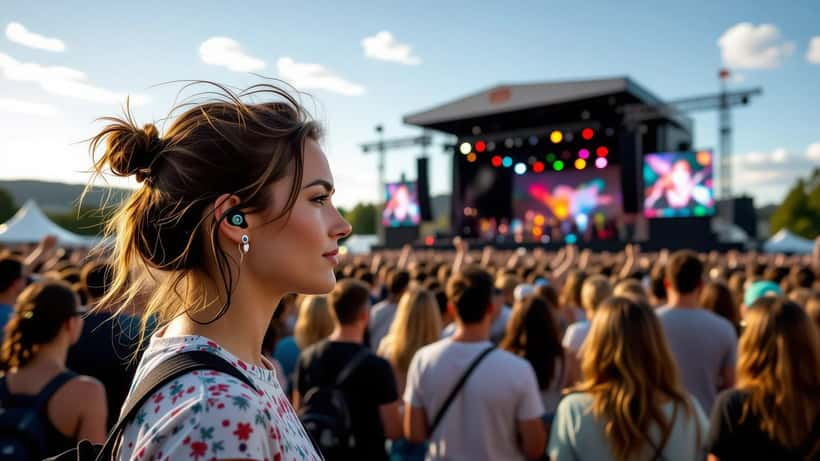
High-fidelity concert earplugs are a different product from the foam cylinders sold for industrial use. Modern music earplugs use a flat attenuation filter that reduces overall volume evenly across frequencies — you hear the same soundscape, at a safer level, without the muffling effect of standard ear protection. Well-regarded options include Alpine MusicSafe, Earasers, and Loop, all available for under £20 and reusable across multiple events.
For anyone with an existing hearing condition — diagnosed tinnitus, hyperacusis (sensitivity to sound), or measured hearing loss — attending Radio 2 in the Park carries additional risk that merits personalised advice. A consultation with an audiologist before September can identify your individual exposure threshold and ensure you are wearing appropriate protection for your specific situation.
Children attending the event with parents require particular care. Young ears are more sensitive to acoustic damage than adult ears, and children are less likely to communicate discomfort until after harm has already occurred. Children's ear protection rated for music environments is available from most UK pharmacies and online retailers.
When to See a Doctor After the Festival
Some ringing in the ears in the hours following Radio 2 in the Park is common. If tinnitus persists beyond 48 hours, or if you notice muffled hearing, reduced volume perception, or a feeling of pressure or fullness in the ear, book an appointment with your GP promptly. Sudden noise-induced hearing loss has a narrow treatment window — early medical intervention significantly improves outcomes.
Seek urgent care if you experience sudden complete hearing loss, sharp ear pain, or dizziness following loud noise exposure. These symptoms indicate acoustic trauma rather than ordinary post-concert fatigue.
Enjoy the Show — Prepared
Chaka Khan and Simple Minds headlining in Stirling this September is the kind of event UK music fans have been anticipating. The hearing risks are real but manageable. A pair of quality music earplugs costing under £20 is a small investment compared to the permanent cost of tinnitus or hearing loss.
If you have concerns about your hearing ahead of the Stirling festival, a qualified audiologist can assess your baseline hearing, advise on appropriate protection, and help you continue enjoying live music safely for years to come.
This article provides general health information only and does not constitute medical advice. If you have concerns about your hearing, consult a qualified audiologist or your GP.
