 Amelia Ward
The Bee Gees are back — and louder than ever. In March 2026, the legendary trio's legacy is trending across the UK as a combination of Hollywood biopic news, tribute tours, and TikTok-driven discovery has introduced "Stayin' Alive" to a whole new generation. Bradley Cooper is reportedly in talks to star as Barry Gibb in a Ridley Scott-directed biopic, with production buzz hitting a high point this month. But as thousands of fans rush to tribute concerts, one question rarely gets asked: is your hearing ready for it?
Why the Bee Gees Are Everywhere Again in 2026
The resurgence is real. Multiple tribute productions — including Stayin' Alive: One Night of the Bee Gees and Bee Gees Celebration — are selling out mid-size UK venues through spring and summer 2026. On TikTok, Gen Z are drawing comparisons between the Gibb brothers' falsetto harmonies and artists like The Weeknd and Dua Lipa, generating millions of views.
The biopic development, now officially linked to director Ridley Scott and producer Graham King (of Bohemian Rhapsody fame), has given the story renewed cultural weight. Barry Gibb — the last surviving member of the trio — has reportedly been involved in how his brothers are portrayed.
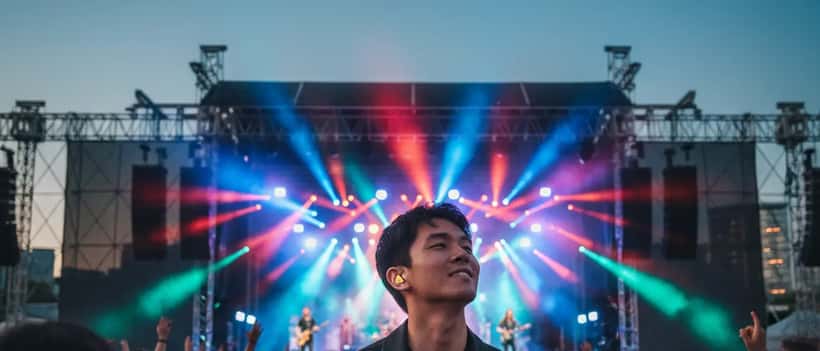
For fans attending tribute shows and revisiting the back catalogue at volume, the good news is: it sounds incredible. The less-discussed news is that concerts, even tribute events, are capable of causing permanent hearing damage — and most attendees have no idea.
What concert noise actually does to your ears
The average Bee Gees tribute concert runs at 100–110 decibels (dB) at the front of the crowd — roughly equivalent to a motorcycle engine at close range. According to NHS guidelines, safe noise exposure at 100 dB is limited to just 15 minutes before the risk of damage begins.
Yet most concerts last 90 to 120 minutes. Without hearing protection, that means cumulative exposure many times beyond the recommended threshold.
The two main conditions caused by concert exposure:
Noise-Induced Hearing Loss (NIHL). Hair cells in the cochlea — the spiral organ in the inner ear that converts sound to nerve signals — are permanently destroyed by sustained loud noise. Unlike skin cells or bone, they do not regenerate. According to the British Tinnitus Association, around 1 in 7 adults in the UK already experiences some form of hearing loss.
Tinnitus. A persistent ringing, buzzing, or hissing sound in the ears, tinnitus affects approximately 7.1 million people in the UK (British Tinnitus Association, 2025). It can develop after a single concert. In chronic cases, it is not reversible and can significantly impact sleep, concentration, and mental health.
The risk is not hypothetical. Roger Daltrey of The Who has spoken publicly about significant hearing loss from decades of performing. Mick Jagger has similarly acknowledged the irreversible damage. The musicians were unprotected — but modern fans have a choice.
Who is most at risk?
Concert-induced hearing damage does not only affect frequent gig-goers. A single event at extreme volume — particularly if you stand near speaker stacks — can trigger tinnitus that never fully resolves.
Higher-risk profiles:
- Fans who attend 3+ live events per year without hearing protection
- Those who experienced ringing ears after a previous concert (a signal of early hair cell damage)
- People over 40 — natural age-related hearing decline accelerates vulnerability
- Music industry workers: sound engineers, session musicians, venue staff
The Royal National Institute for Deaf People (RNID) estimates that around 50% of all avoidable hearing loss in the UK is linked to noise exposure — much of it recreational.
What an audiologist can do
An audiologist is an NHS or private specialist trained to assess, diagnose and manage hearing conditions. For concert-related concerns, a consultation involves:
- Pure-tone audiometry: a painless hearing test that maps your hearing threshold across frequencies — identifying early high-frequency loss before it becomes noticeable in conversation
- Tinnitus assessment: evaluating pitch, loudness, and the degree to which tinnitus affects quality of life
- Custom hearing protection fitting: musician-grade earplugs (£150–£250) that reduce volume evenly without distorting the music — the gold standard for regular concert-goers
- Hyperacusis management: for patients who have developed abnormal sensitivity to everyday sounds after noise exposure
NHS audiology services are available with a GP referral. For faster access, private audiologists can usually book within 1–2 weeks.
Enjoying the Bee Gees revival — safely
This Bee Gees moment is a cultural joy. The music holds up precisely because of the extraordinary craft involved in those three-part harmonies, and hearing them live — even via tribute — is an experience worth having.
But caring for your hearing is not about missing the experience. It is about having it again next year, and the year after.
Practical steps:
- Wear foam earplugs minimum — inexpensive, available at any pharmacy
- Step back from speaker stacks — every metre of distance halves the perceived intensity
- Take breaks from the loud space — noise exposure is cumulative over the event
- If you leave with ringing ears, rest your hearing for at least 16 hours
If you have noticed ringing after concerts, or feel that your hearing is not what it used to be, do not wait for it to get worse. On Expert Zoom you can consult health specialists including audiologists, for advice and onward referral.
