 Rebecca Taylor
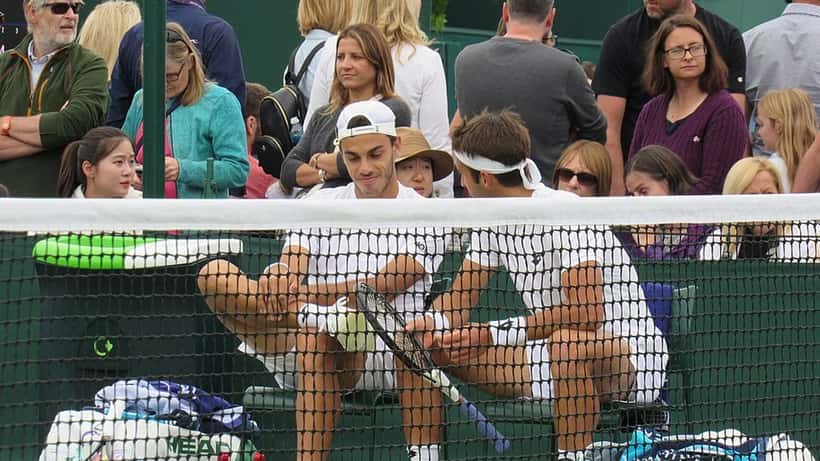
Francisco Cerúndolo reached the semi-finals of the 2026 Queen's Club Championships on Friday 20 June after ending a six-match losing streak on grass — a run of defeats stretching back to his second-round exit at Wimbledon 2023. The Argentine seventh seed defeated British wildcard Arthur Fery 7-6(1), 3-6, 6-4 at the cinch Championships in west London to set up a Saturday semi-final against American Brandon Nakashima, who stunned top seed Alex de Minaur 7-5, 6-3 in the quarter-finals. It is Cerúndolo's third ATP 500 semi-final appearance of 2026.
Six Consecutive Grass Losses — Then a West London Semi-Final
The numbers behind Cerúndolo's week at Queen's Club are quietly remarkable. Before arriving in London, he had lost six consecutive matches on grass courts. His most recent win on the surface had been at Wimbledon 2023, nearly three years earlier. Yet within five days at the Queen's Club in Barons Court, the 25-year-old from Buenos Aires dismantled Aleksandar Kovacevic in the first round, thrashed Jenson Brooksby 6-0, 6-4 in the second, and then ground out a bruising three-set quarter-final against Fery.
On paper, little changed in his game between those six defeats and this week's run. His serve percentage, his groundstroke patterns, his movement on the grass — none appear dramatically retooled. What appears to have shifted is how he managed the mental demands of a surface on which he had built a history of failure.
That shift is precisely what sports psychologists work to achieve. Surface-specific performance drops are well documented in tennis and across sport. When an athlete develops a negative association between a particular context and poor results, the association can become self-reinforcing — until something, internal or external, interrupts the cycle.
Why Context-Specific Slumps Develop
A single loss in a specific environment — a grass court, a particular stadium, a rivalry fixture — can begin to seed an association between that context and threat. Through a process psychologists call associative learning, repeated exposures to that context while feeling anxious or underperforming strengthen the neural pathway linking setting to stress response.
The practical effect is that the athlete anticipates difficulty before a point has been played. Heart rate climbs, muscles tighten, decision-making narrows. Each subsequent loss reinforces the pattern.
This is not weakness — it is a learnable cognitive habit. Sports psychologists draw on cognitive behavioural therapy (CBT), imagery rehearsal, and acceptance and commitment therapy (ACT) to interrupt the cycle and rebuild a neutral association with the threatening context.
The question for any athlete is: when does a dip in form cross the line into something that warrants professional support?
5 Signs Your Sporting Slump Is Psychological
Cerúndolo's case is extreme enough to illustrate the pattern clearly. But the same dynamic shows up at every level of sport, from professional tennis to club football, amateur running, and competitive cycling. Here are five signs that a slump is more psychological than technical — and that a consultation with a qualified sports psychologist is likely to help.
1. Your difficulty is context-specific, not general
If you perform consistently well in training or in one type of environment but underperform in a specific venue, on a specific surface, or against a specific type of opponent, the problem is more likely to be the meaning you have attached to that context than any technical deficiency. Cerúndolo's form on clay and hard courts in 2026 has been strong enough to reach two other semi-finals. The grass issue was isolated — which is precisely what makes it a psychological signal.
2. You notice intrusive thoughts mid-performance
Thoughts such as "I always play badly here," "my serve is going to break down," or "I cannot read this surface" pull conscious attention away from the task and into self-monitoring. Sports psychology refers to this as paralysis by analysis — the moment technique becomes an object of conscious focus rather than automatic action. If these thoughts are consistent in a specific context, cognitive intervention is more useful than more technical drilling.
3. You experience physical symptoms without a physical cause
Pre-match muscle tightness, a trembling serving arm, shallow breathing in a second set, or excessive sweating in specific match situations without an underlying injury are typically the body's stress response at work rather than signs of physical illness or fatigue. They are real, they impair performance, and they respond well to structured psychological support. The NHS recognises performance anxiety as a treatable condition that responds to talking therapies and behavioural techniques.
4. Emotional recovery from setbacks takes disproportionately long
Frustration after a poor performance is normal and healthy. If you are still ruminating three or four days later, withdrawing from training partners, replaying specific points obsessively, or experiencing disturbed sleep after losses in a particular context, the emotional impact has exceeded what the setback warrants. Recurrent disproportionate distress after context-specific defeats is a consistent indicator that structured psychological support is valuable.
5. You are beginning to avoid the problematic context
Choosing not to enter certain tournaments, asking to be left out of specific competition formats, or unconsciously reducing preparation for particular match types are all forms of avoidance. Avoidance reduces short-term anxiety but strengthens the underlying association between context and threat. Left unaddressed, avoidance tends to expand: the originally narrow exclusion widens to include related contexts, limiting the athlete's competitive range. This is the most significant sign that professional support is needed promptly.
What Sports Psychology Consultations Involve
A qualified sports psychologist maps the specific thoughts, physical sensations, and behaviours associated with the problematic context, then builds a structured plan using CBT, imagery rehearsal, or ACT. For many athletes, three to six sessions produce a meaningful shift; more deeply entrenched patterns may take longer, but progress is typically steady.
At ExpertZoom, qualified sports health consultants are available for one-to-one consultations without long waiting lists — whether you are a competitive amateur managing pre-match nerves or a junior athlete navigating a recurring surface-specific slump.
For more context on how grass-court specialists navigate performance blocks, see our piece on Davidovich Fokina's 2026 grass-court comeback and what performance consultants identified behind his return to form on the surface.
If you are a young athlete managing the pressures of high-level junior competition, this piece on Iva Jovic at Queen's Club 2026 explores the specific demands that sports health professionals see in rising players at ATP and WTA level.
What Cerúndolo's Week Tells Us
Cerúndolo faces Nakashima — who has not dropped a set all tournament — as Saturday's underdog. The outcome is uncertain. What his week at Queen's Club has demonstrated is that a three-year surface-specific freeze can be overcome, and that the path back often runs through mental rather than technical work.
For anyone currently stuck in a similar pattern, sports psychology is clear: the habit is learnable, and unlearning it is well within reach with the right professional support.
This article is for informational purposes only. If anxiety or mental health difficulties are significantly affecting your daily life, seek support from a qualified health professional or visit the NHS talking therapies service.
