 Ethan Wright
Every October 4, the world quietly marks a historic milestone: the anniversary of the 1957 Sputnik launch that first carried humanity beyond Earth's atmosphere. In 2026, World Space Week (October 4–10) arrives under the theme "Rocket Revolution" at a moment when Canada's space industry is growing faster than it can find qualified people. If your child showed any curiosity about rockets, satellites, or orbital mechanics this week, that curiosity is worth taking seriously — because the industry already is.
Canada's Space Sector Is Growing — and Running Short of Talent
The numbers from the Canadian Space Agency's 2025 State of the Canadian Space Sector Report are striking. Direct employment in Canada's space sector reached 14,622 jobs in 2024 — a 4% year-over-year increase and 24% growth since 2019. When indirect and induced economic ripple effects are included, the sector supports nearly 28,000 jobs across the country.
And yet, demand is outpacing supply. As of 2024, 43% of Canadian space companies reported unfilled positions, with engineers, scientists, and technicians listed as the hardest roles to fill. The workforce is highly academic: 74% of employees hold at least a bachelor's degree, and 41% work specifically as engineers or scientists. The industry is actively searching for its next generation of talent — and that talent is currently sitting in Canadian high school classrooms.
This is the context behind World Space Week 2026. The World Space Week Association reported that the 2025 edition generated nearly 50,000 activities in 102 nations. This year's "Rocket Revolution" theme is designed specifically to connect that energy to STEM education pipelines — to show students that a career in space is not a distant fantasy, but a documented series of academic checkpoints that begin now.
What "Rocket Revolution" Really Means for Students
The theme goes well beyond rockets themselves. It reflects a genuine transformation in how humanity reaches and operates in space: commercial launch providers, reusable booster systems, miniaturized CubeSats built by university teams, and entirely new national space programs from countries that had none a decade ago. Space is no longer the exclusive domain of a handful of government agencies. It is a growing industry with startups, engineering consultancies, satellite operators, and regulatory bodies — all of which need people trained in mathematics, physics, coding, and systems thinking.
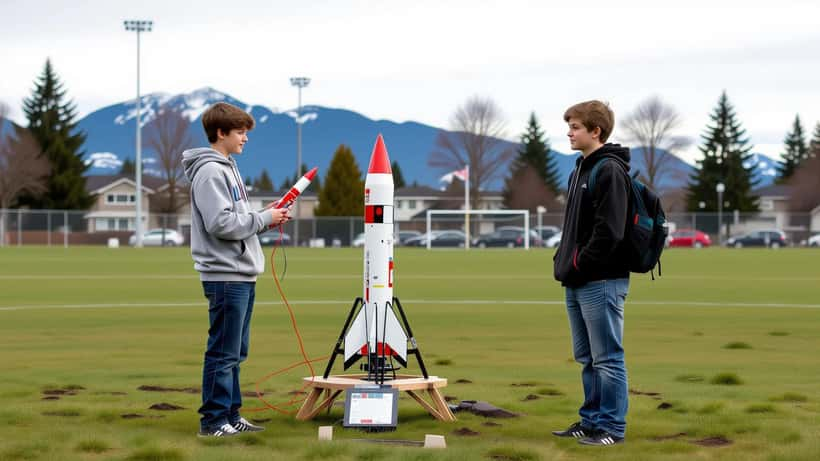
For World Space Week 2026, the World Space Week Association partnered with Estes Education to release a free Rocket Revolution Toolkit, covering model and DIY rocket activities for classrooms, families, and community groups. Across Canada, science centres, planetariums, and universities are running events from telescope observation nights to virtual career panels with working aerospace professionals. Any space-related activity held between October 4 and 10 qualifies as an official contribution to the global celebration.
How STEM Educators Are Reading This Moment
Academic tutors and educators who work with science-oriented students increasingly use high-engagement events like World Space Week as an entry point to subjects students find abstract. Physics, calculus, and computer science — the foundational requirements for any aerospace career — can feel disconnected from daily life when taught in isolation. Space provides a concrete, emotionally compelling reason why these subjects exist.
A tutor who specializes in STEM subjects can transform a student's World Space Week enthusiasm into a structured academic plan. Orbital mechanics require trigonometry. Rocket propulsion curves require calculus. Every satellite in orbit runs software written by someone who first learned to debug in a classroom. The week supplies the motivation; targeted academic support builds the capability. Expert Zoom connects Canadian students with tutors who have backgrounds in physics, applied mathematics, and engineering, and who can map a student's current academic gaps against the specific requirements of space-related career pathways.
This kind of contextual learning builds on the curiosity students are already developing through current space science news. The mysterious decagon storm structure recently discovered at Saturn's south pole raised new questions about planetary physics that researchers are still working to answer. Earlier this year, the June 2026 meteor shower drew thousands of Canadian students outside for hands-on astronomy observation — the kind of direct experience that makes scientific reasoning feel real rather than abstract. World Space Week can do the same.
A Concrete Scenario: From 63% in Math to the Engineering Pathway
Here is a realistic scenario that illustrates how the academic pipeline actually works in Canada.
Liam is a 15-year-old in Vancouver who becomes genuinely excited during World Space Week 2026. He watches a commercial rocket booster return to its launch site — caught mid-air by two mechanical arms — and decides he wants to understand the physics behind it. His current Grade 10 mathematics grade is 63%.
The problem is not motivation. The problem is a compounding gap. British Columbia university engineering programs — at UBC, Simon Fraser, and Carleton — generally require 75–80% in Grade 11 and 12 mathematics and physics for competitive consideration. Some programs at Waterloo and Toronto routinely see applicants averaging above 90%. A 63% Grade 10 math grade does not just reflect a current weakness: it represents a closing window.
If Liam's family acts during World Space Week 2026, booking 10 focused tutoring sessions targeting the specific algebra and trigonometry gaps driving that low grade, the investment runs approximately $70–$85 per session for a specialized STEM tutor in Metro Vancouver — a total of $700–$850. The goal is to exit Grade 10 at 78% or above, which opens the Pre-Calculus and Calculus pathway for Grades 11–12 and keeps Liam's university engineering options intact.
If that gap instead compounds untreated through Grades 11 and 12, Liam would likely need a post-secondary bridging or upgrading program before any engineering faculty would review his application — adding 12–18 months of study and $8,000–$15,000 in additional costs. The $800 tutoring investment made in October 2026 is not an extravagance. It is the difference between an open pathway and one that has quietly closed.
What Canadian Families Can Do Before October 10
World Space Week runs through Friday, October 10. Several concrete actions are available right now:
Engage with the celebration first. The World Space Week Association maintains a searchable map of registered events at worldspaceweek.org. Canadian science centres and planetariums typically add listings through the end of the week — most events are free. The Estes Education Rocket Revolution Toolkit is available for free download and includes family rocket-building activities suitable for ages 10 and up.
Review your child's current STEM grades. World Space Week is an ideal natural prompt for a conversation about mathematics, physics, and computer science performance. If any of these subjects is currently below 75%, that gap is easier to close in Grade 10 than in Grade 11 or 12. The urgency is proportional to how close the student is to university applications.
Connect with a specialist tutor. Not every tutor can draw a straight line from orbital mechanics to a Grade 10 algebra exercise — but tutors who work specifically with STEM-oriented students can, and regularly do. Expert Zoom connects Canadian students with educators who specialize in physics, applied mathematics, and the academic foundations that space and engineering careers require.
The Window Is This Week — and the Next Few Years
World Space Week 2026 ends October 10. The commercial space sector's growth is documented and ongoing. Canada's talent shortage is confirmed by the sector's own employers. And the career pathway from a curious teenager to a working space engineer consists of a well-mapped series of academic checkpoints, beginning with the math grade your child is earning right now.
The industry does not need your child to be exceptional today. It needs them to remain on the pathway — and that starts with not letting a fixable academic gap quietly foreclose an option they have not yet had a chance to choose.
