 Brenna White
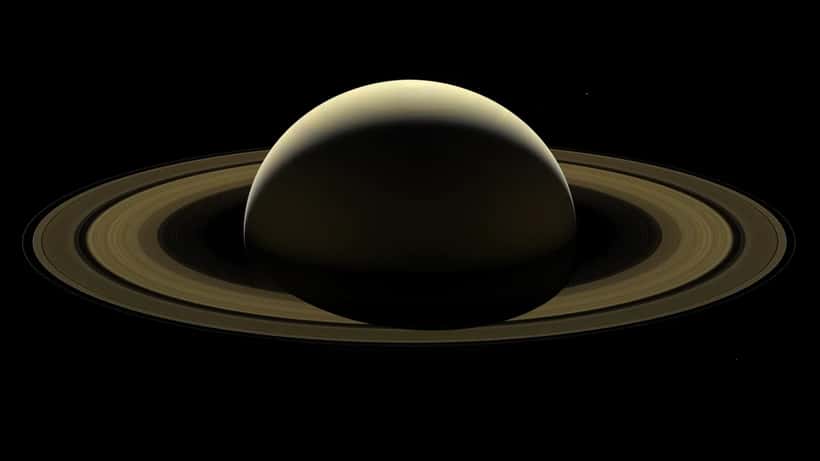
NASA's Hubble Space Telescope has confirmed a spectacular atmospheric discovery at Saturn's south pole: a 10-sided geometric wave — a decagon — swirling through the planet's cloud layers at a scale that dwarfs Earth. Published in the journal Science Advances on September 3, 2026, by a team led by astrophysicist Agustín Sánchez-Lavega, the finding marks the first time scientists have observed a large, regular polygonal atmospheric pattern in Saturn's southern hemisphere. For Canadian families preparing children for a new school year, it arrives at a striking moment — the math behind the discovery is exactly what Grade 7 through 10 students are studying right now.
A Giant Polygon Hiding in Saturn's Atmosphere
The decagon first appeared as a faint disturbance in Hubble imaging data in 2023. Ground-based observers noted an undulating band near Saturn's southern pole throughout 2024, and by August 2025, Hubble's wide-field cameras had sharpened the feature into a fully defined 10-sided polygon extending through multiple atmospheric layers. The international research team published their full analysis on September 3, 2026, in Science Advances, confirming what had gradually emerged over three years of careful observation: Saturn's southern atmosphere now hosts a geometric wave structure with no precedent in planetary science.
The feature is strikingly similar to — but fundamentally different from — Saturn's famous northern hexagon, a six-sided atmospheric jet stream that has persisted for decades. Where the hexagon is stable and long-lived, the decagon appears still to be forming and strengthening. Scientists believe it was triggered by perturbations from a nearby storm system, but the mechanism that produced a precise 10-vertex shape — rather than 8 or 12 — remains unexplained. As NASA's Hubble mission team noted in their September 2026 announcement, "this is an unexpected and completely new type of wave structure not previously seen in any planet of the solar system."
The decagon's interior angles measure exactly 144°, compared to 120° for Saturn's northern hexagon. It extends across multiple cloud layers and is still growing stronger, making it both a scientifically active phenomenon and one of the most visually dramatic geometric features ever photographed in our solar system.
The Formula Behind the Discovery Is the One in Your Child's Textbook
What makes the Saturn decagon story so powerful for STEM education is that it rests on elementary mathematics. Regular polygons — shapes with equal sides and equal angles — obey a simple formula for calculating interior angles: (n−2) × 180° ÷ n, where n is the number of sides. A hexagon (n=6) yields 120°. A decagon (n=10) yields 144°. Scientists used this same geometric logic, combined with atmospheric fluid dynamics modelling, to characterise the shape's structure from Hubble's imaging data. The polygon formula did not appear for the first time in a planetary science paper — it appears in every province's Grade 8 mathematics curriculum.
For students in Grades 7 through 10 across Canada, this formula is familiar on paper but often disconnected from anything real. It is typically taught as a procedure: substitute n, divide, arrive at an angle, write it down. Without an anchor in the physical world, many students follow the steps correctly without understanding why the pattern exists or where it shows up. The Saturn decagon changes that. It gives the formula an address — a precise atmospheric structure confirmed this week, 1.4 billion kilometres from Earth, that puzzles the world's best planetary scientists. The same calculation that passes a unit quiz also describes an alien weather system that has never been seen before.
Why This Discovery Is a Tutoring Opportunity
The gap between executing a formula and truly understanding it is precisely where a skilled private tutor provides the most value — and where the Saturn decagon becomes a practical asset.
A qualified STEM tutor does not simply re-teach the textbook. They identify the exact point where a student's understanding fractures: is it the formula itself? The concept of interior angle? The transition from regular to irregular polygons? From that diagnosed breaking point, a good tutor rebuilds using whatever the student finds genuinely engaging. Breaking science news — a discovery published the same week a student is struggling with polygons — is one of the most powerful hooks available, because it collapses the perceived distance between "school math" and "things that matter."
For parents considering a STEM tutor this fall, the Saturn story also illustrates a broader principle: great tutoring is opportunistic. A tutor who monitors current science news and connects it to provincial curriculum outcomes — Ontario's 2020 revised Mathematics curriculum, BC's Core Competency framework in numeracy, Alberta's Program of Studies for Mathematics — adds a dimension that textbooks and classroom instruction alone cannot provide. The geometry in the news this week and the geometry on the test next month are the same geometry.
When One Space Discovery Moved a Grade by 19 Points: A Concrete Case
Consider a 13-year-old student in Grade 8 in Burnaby, British Columbia, starting the polygon unit in the fall 2026 term. She followed the steps in class and scored 61% on her first quiz — not failing, but not understanding. Her parent arranged five sessions with a private math tutor at $65/hour, for a total of $325 over two and a half weeks.
In the first session, the tutor opened with NASA's September 3, 2026, Hubble image of Saturn's south pole. "This shape has exactly 10 sides," the tutor said. "NASA says its interior angle is 144°. Can you use the formula to check whether that's right?" The student worked through it: (10−2) × 180° ÷ 10 = 144°. It matched. She tried a hexagon next — (6−2) × 180° ÷ 6 = 120°. She asked why Saturn's well-known hexagon has the smaller angle. The tutor asked her to try both n=10 and n=6 and find the pattern herself.
By session three, she was building the polygon table independently — octagon (135°), dodecagon (150°), icosagon (162°) — and had noticed that more sides push the angle toward but never past 180°. By session five, she scored 80% on a practice unit test: a 19-percentage-point improvement.
The if/then logic here is clear. If a student is working on polygon interior angles this semester, and a tutor connects that exact formula to the Saturn decagon discovery within the first session, then the concept acquires a concrete referent — not just an abstract equation but a planetary structure confirmed this week by NASA. Durable understanding, not just test passage, becomes substantially more likely. The $325 investment in five sessions is also a hedge against compounding difficulty: a student who enters Grade 9 without functional geometric reasoning faces escalating challenges in coordinate geometry, physics vectors, and data analysis throughout high school.
What to Look for When Choosing a STEM Tutor in Canada
Subject-matter depth. A tutor with university-level training in mathematics, physics, or engineering will have the conceptual fluency to move between formula and meaning without losing the student. A quick diagnostic question: "Why does a decagon have a larger interior angle than a hexagon?" — a strong tutor answers intuitively, not by consulting a formula sheet.
Provincial curriculum knowledge. Canada's mathematics curricula differ meaningfully by province. Ontario's revised 2020 curriculum emphasises mathematical thinking processes alongside procedures; BC's curriculum is competency-based; Alberta's Program of Studies remains more traditionally structured. Ask any prospective tutor which provincial curriculum they know best and how they align sessions to it.
Diagnostic-first sessions. The most effective tutors do not begin by reviewing material — they begin by listening to the student explain a concept in their own words. That process surfaces the exact misunderstanding. A 20-minute diagnostic conversation before committing to a full session package is a reasonable request and a sign of professional rigour.
Realistic timeline and cost. For a specific unit catch-up, most families need four to eight sessions at the outset. Qualified STEM tutors in Canadian cities typically charge between $55 and $90/hour depending on grade level and specialisation. Ongoing weekly sessions through the academic year produce more durable gains than reactive intensive sessions just before exams.
Expert Zoom connects Canadian students with verified STEM and mathematics tutors who work across all provinces, in English and French, matched to the grade level and subject where the gap exists — whether that is polygons, algebra, or scientific reasoning.
The Geometry of Real Discovery
Saturn's south pole decagon was published on September 3, 2026. The formula that describes its angles was written into Grade 8 mathematics curricula long before Hubble ever photographed it. The distance between those two facts — between what NASA confirmed this week and what your child is studying this month — is smaller than it appears. A tutor who bridges that gap in a single session is not simply teaching polygon geometry. They are demonstrating that mathematical understanding reaches, quite literally, into the outer solar system.
This article discusses educational support for mathematics curricula. For academic or school programme decisions, consult a certified educator or academic advisor.
